
NBTF Prototypes: Advancing Negative Ion Sources with SPIDER and MITICA
The Neutral Beam Test Facility (NBTF) serves as a critical proving ground for the high-energy neutral beam systems required for fusion energy. By developing and testing large-scale experimental devices, researchers can refine the complex physics of ion extraction and acceleration before these systems are implemented in full-scale reactors. Central to this effort are two primary prototypes: SPIDER and MITICA.
SPIDER: The First Step in Beam Validation
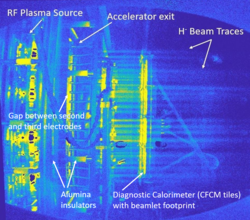
SPIDER began operations in May 2018 as the first large experimental device at the test facility. It is designed as a caesiated surface-plasma negative ion source—a system that uses caesium to enhance the production of negative ions from a plasma surface. The device utilizes eight cylindrical RF (radio frequency) drivers operating at 1 MHz, all connected to a single expansion chamber measuring 0.8 m × 1.6 m × 0.25 m.
The system is designed to process hydrogen or deuterium. To extract the negative ion beam, SPIDER employs a series of electrodes with specific nominal voltages: a Plasma Grid at -110 kV, an Extraction Grid at -100 kV, and a Grounded Grid at 0 V. While the target extracted hydrogen negative ion beam current is 54 A, the device's beam pattern is highly complex, consisting of 1,280 beamlets organized into 4 × 4 groups, with each group containing 5 × 16 beamlets.
Development progressed steadily following its launch. In 2018, engineers optimized the plasma discharge from the eight RF drivers. By 2019, hydrogen negative ion beam operations commenced. Due to vacuum system limitations during its first year, SPIDER operated with a reduced capacity of 80 beamlets instead of the full 1,280. The first operation involving caesium was successfully performed in 2021.
MITICA and the Path to ITER HNB
While SPIDER focuses on the ion source, MITICA is designed to test the acceleration and neutralization stages. Currently under procurement, MITICA is expected to begin its first operations in late 2023 (with some projections extending to 2025). It will utilize a multi-grid multi-aperture concept featuring seven electrodes and four gas cells for neutralization.
MITICA acts as a bridge to the ITER Heating Neutral Beam (HNB). Both MITICA and the ITER HNB target beam energies of 880 kV for hydrogen and 1,000 kV for deuterium. A critical operational challenge for these high-energy systems is managing heat loads caused by stray particles. To minimize these loads, which are generated when beam ions interact with background gas, the systems are operated at a low filling pressure of 0.3 Pa.
Key Facts
- SPIDER Launch: First operation began in May 2018.
- SPIDER Target Current: 54 A for hydrogen negative ion beams.
- MITICA Energy Targets: 880 kV (Hydrogen) and 1,000 kV (Deuterium).
- Beamlet Configuration: SPIDER is designed for 1,280 beamlets.
- Pressure Management: A low filling pressure of 0.3 Pa is used to reduce heat loads from stray particles.
- MITICA Timeline: First operation expected between late 2023 and 2025.
Comparative Capabilities of Neutral Beam Devices
The following table compares SPIDER and MITICA with other RF-driven sources and the ultimate objectives of the ITER HNB.
| Experiment | First Operation | Beam Energy (Achieved/Target) | Neg. Ion Current (Achieved/Target) | Ion Source Type | Accelerator Type | Beamline Length |
|---|---|---|---|---|---|---|
| BATMAN Upgrade | 2018 | ~60 kV | ? (H) | RF-driven caesiated surface-plasma | Multi-aperture electrostatic triode | ~3 m |
| ELISE | Feb 2013 | ~60 kV | ~27 A (H) | RF-driven caesiated surface-plasma | Multi-aperture electrostatic triode | ~5 m |
| SPIDER | May 2018 | 50 kV / 110 kV | ~1 A / 54 A (H) | RF-driven caesiated surface-plasma | Multi-aperture electrostatic triode | ~5 m |
| MITICA | 2025 (Exp.) | 880 kV (H) / 1000 kV (D) | - / 40 A (H) | RF-driven caesiated surface-plasma | Multi-grid (7 electrodes) | ~13 m |
| ITER HNB | TBD | 880 kV (H) / 1000 kV (D) | 40 A | RF-driven caesiated surface-plasma | Multi-grid (7 electrodes) | ~22.5 m |
Frequently Asked Questions
What is the primary purpose of SPIDER?
SPIDER is a prototype caesiated surface-plasma negative ion source designed to validate the production and extraction of negative ion beams, specifically targeting a hydrogen beam current of 54 A.
Why does SPIDER use a reduced number of beamlets in early operation?
During its first year of operation in 2019, SPIDER used 80 beamlets instead of the designed 1,280 due to limitations within the vacuum system.
How does MITICA differ from SPIDER in terms of acceleration?
While SPIDER uses a multi-aperture electrostatic triode, MITICA employs a more advanced multi-grid multi-aperture concept featuring seven electrodes to achieve much higher beam energies (up to 1,000 kV).
Why is a low filling pressure of 0.3 Pa necessary?
A low pressure is required to minimize heat loads caused by stray particles, which are created when beam ions interact with the background gas along the accelerator.
What is the role of caesium in these ion sources?
Caesium is used in the surface-plasma source to facilitate the creation of negative ions, which is essential for the high-current beams required for fusion heating.