
Neutron Scattering at OPAL
The Bragg Institute at the Australian Nuclear Science and Technology Organisation (ANSTO) hosts the OPAL neutron scattering facility. Operating as a global user facility, it provides the scientific community in Australia and worldwide with advanced tools to probe the atomic and molecular structures of materials. Following a funding boost in 2009, the facility expanded its capabilities by installing highly competitive beamlines and instruments.
Key Facts
- Location: Hosted at the Bragg Institute, ANSTO.
- Primary Purpose: Determining crystalline structures, interface properties, and internal stresses of materials.
- Core Instruments: Includes ECHIDNA, PLATYPUS, WOMBAT, and KOWARI.
- Capabilities: Supports physics, chemistry, materials science, mineralogy, and earth sciences.
- Techniques: Utilizes thermal and cold neutrons for diffraction, reflectometry, and spectrometry.
ECHIDNA: High-Resolution Powder Diffractometer
ECHIDNA is a high-resolution neutron powder diffractometer used to determine the crystalline structures of materials. This process is analogous to X-ray techniques but utilizes neutron radiation. The instrument is named after the Australian monotreme echidna, as its spiny peaks resemble the animal.
Operating with thermal neutrons (neutrons in thermal equilibrium with their surroundings), ECHIDNA features an array of 128 collimators and position-sensitive detectors for rapid data acquisition. It is used for structure determinations, texture measurements, and reciprocal space mapping of single crystals across various sample environments.
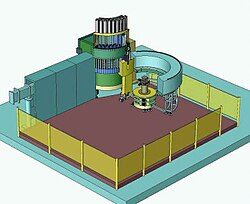
Technical Components of ECHIDNA
- Neutron Guide: Located on the TG1 thermal neutron guide, 58 metres from the reactor. The guide measures 300 mm high by 50 mm wide and features supermirror coatings.
- Primary Collimator: Uses Söller collimators (interchangeable 5' and 10' options) to reduce beam divergence and increase angular resolution.
- Monochromator: Consists of [115] oriented Germanium crystal slabs that focus the Bragg reflected beam. This component was acquired from the Brookhaven National Laboratory.
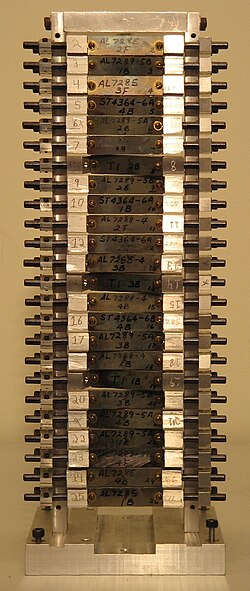
- Secondary Collimator: An optional 10' angular acceptance collimator (200 x 20 mm) that further refines the resolution function.
- Slit System: Automated horizontal and vertical absorbing plates that define the beam size and reduce background noise.
- Beam Monitor: A U fission monitor that tracks incident neutrons to correct for beam flux variations.
- Sample Stage: A heavy-load goniometer supporting several hundred kilograms. It allows for the use of cryostats, furnaces, and magnets, typically using vanadium cans for powder samples to minimize background interference.
- Detector System: 128 linear position-sensitive He gas detector tubes with 5' collimators, arranged in a 160° sector. These detectors use charge division over a resistive anode to determine neutron event positions.
PLATYPUS: Time-of-Flight Reflectometer
PLATYPUS is a reflectometer built on the cold neutron source, named after the Australian platypus. It determines the structure of interfaces by shining highly collimated cold neutrons (neutrons with lower energy and longer wavelengths) at low angles, typically less than 2 degrees.
Operating with a wavelength band of 0.2–2.0 nm, PLATYPUS uses time-of-flight measurements to access the timescales of kinetic processes. This allows researchers to analyze the chemical structure of biomembranes, lipid bilayers, magnetism, and adsorbed surfactant layers.
WOMBAT: High-Intensity Powder Diffractometer
WOMBAT is a high-intensity neutron powder diffractometer named after the Australian marsupial. Designed for maximum flux and speed, it provides time-resolved diffraction patterns in fractions of a second.
WOMBAT focuses on in-situ studies and time-critical investigations, including structure determinations and reciprocal space mapping for the physics, chemistry, and earth-science communities.
KOWARI: Residual Stress Diffractometer
KOWARI is a specialized instrument for neutron residual stress diffraction. It employs strain scanning—a powder diffraction technique—to probe changes in atomic spacing caused by internal or external stress in polycrystalline materials.
As a non-destructive diagnostic tool, KOWARI is used to optimize post-weld heat treatment (PWHT) and calculate the remaining life of engineering components by analyzing tensile stresses (which drive crack growth) and compressive stresses (which inhibit it).
Summary of OPAL Neutron Instruments
| Instrument | Type | Neutron Source | Primary Application |
|---|---|---|---|
| ECHIDNA | High-Resolution Powder Diffractometer | Thermal | Crystalline structure & texture mapping |
| PLATYPUS | Time-of-Flight Reflectometer | Cold | Interface and biomembrane structure |
| WOMBAT | High-Intensity Powder Diffractometer | Thermal | Time-resolved in-situ studies |
| KOWARI | Residual Stress Diffractometer | Thermal | Non-destructive strain scanning |
Additional Facility Instruments
- TAIPAN: Thermal 3-Axis Spectrometer
- KOALA: Laue Diffractometer
- QUOKKA: Small-Angle Neutron Scattering
- PELICAN: Cold-Neutron Time-of-Flight Spectrometer
- SIKA: Cold 3-Axis Spectrometer
- KOOKABURRA: Ultra-Small-Angle Neutron Scattering (USANS)
- DINGO: Neutron Radiography, Tomography and Imaging
Frequently Asked Questions
What is the difference between thermal and cold neutrons?
Thermal neutrons are in thermal equilibrium with their environment, while cold neutrons have lower energy and longer wavelengths, making them suitable for different types of structural analysis, such as reflectometry on PLATYPUS.
How does KOWARI help in engineering?
KOWARI provides a non-destructive way to measure residual stress in components. By identifying tensile and compressive stresses, engineers can optimize heat treatments and predict the remaining lifespan of critical parts.
Why are vanadium cans used in ECHIDNA?
Vanadium is used for powder samples because it produces very little unstructured background noise, ensuring that the diffraction patterns from the sample are clear and accurate.
What is the purpose of the monochromator in ECHIDNA?
The monochromator, consisting of Germanium crystals, filters the neutron beam to select a specific wavelength (monochromatic beam) and focuses it toward the sample for precise measurement.
What can be studied using the PLATYPUS reflectometer?
PLATYPUS is used to examine the chemical structure of interfaces, including lipid bilayers, biomembranes, and adsorbed surfactant layers.