
New Hampshire Historical Markers 51 to 75
New Hampshire's landscape is dotted with markers that serve as windows into the past, preserving stories of colonial struggle, industrial innovation, and religious evolution. From the early settlements of the Scotch-Irish to the pioneering days of the American ski industry, these markers highlight the diverse heritage of the Granite State.
Key Facts
- Oldest State Capitol: Concord is home to the nation's oldest State Capitol where the legislature still meets in its original chambers.
- Industrial Legacy: The state had a significant glassmaking industry in Stoddard and Keene during the 19th century.
- Pioneering Sports: The first organized ski school in the United States was established in Sugar Hill in 1929.
- Global Connectivity: Rye hosted the receiving station for the first Atlantic Cable laid in 1874.
- Agricultural Firsts: The potato was first grown in North America in the settlement of Londonderry.
Colonial Foundations and Early Settlements
The early history of New Hampshire is marked by the arrival of diverse groups and the conflict between settlers and indigenous populations. In April 1719, sixteen Presbyterian Scotch-Irish families established a settlement in Derry, originally called Nutfield and renamed Londonderry in 1723. This site is historically significant as the location where the potato was first grown in North America.
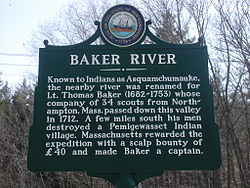
Conflict also defined the era. The Baker River in Rumney, known to indigenous people as Asquamchumauke, was renamed after Lt. Thomas Baker, whose 1712 expedition resulted in the destruction of a Pemigewasset Indian village.
Further tragedy is noted in Haverhill, where the junction of rivers served as a rendezvous for Rogers Rangers in 1759. Following their attack on St. Francis, Quebec, many Rangers perished from starvation and pursuit during their retreat, leaving remains that were later discovered by early settlers.
Religious and Intellectual Landmarks
New Hampshire has been a center for religious diversity and intellectual pursuit. Dr. Jeremy Belknap (1744–1798), a Harvard graduate and naturalist, served as a pastor in Dover and authored the first History of New Hampshire, later founding the Massachusetts Historical Society in 1794.
In Richmond, Hosea Ballou (1771–1852) emerged from a wilderness farm to become the Father of Universalism, promoting religious liberalism across New England. Meanwhile, the first Methodist meeting in the state took place in 1772 on the James Robertson farm in Chesterfield, later visited by Francis Asbury in 1803.
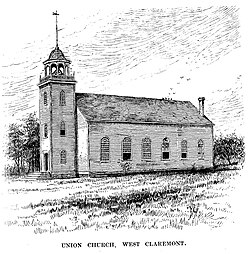
Architectural gems also mark the state's spiritual history. The Union Church in Claremont, built between 1771 and 1773, stands as the oldest Episcopal church in New Hampshire.
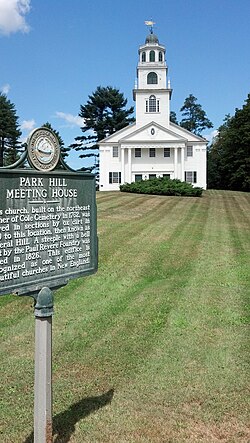
In Westmoreland, the Park Hill Meeting House, built in 1762 and moved by ox cart in 1779, features a bell cast by the Paul Revere Foundry, added in 1826.
Industry and Innovation
The 19th century brought a surge of industrialization. Glassmaking was a major industry, with works operating in Stoddard from 1842 to 1873 and in Keene starting in 1814. The "Keene Glass" bottles and flasks produced between 1815 and 1842 remain highly prized by collectors today.
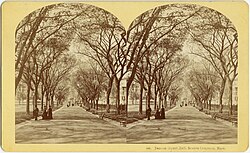
Other industrial efforts included the charcoal kilns of Lisbon in the 1860s, which converted pine knots into fuel for iron smelters. In Littleton, the Kilburn brothers operated a world-famous stereoscopic view factory from 1867 to 1909, producing popular 3D-style parlor entertainment.
Political and Civic History
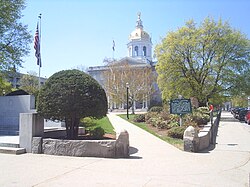
Concord serves as the political heart of the state. The State Capitol, constructed of local granite between 1816 and 1819, is a national landmark. Nearby, the Bridges House became the official Governor's residence in 1969 after being owned by Governor Styles Bridges.
Other notable residences include the Pierce Homestead in Hillsborough, built in 1804 by General Benjamin Pierce, father of the 14th U.S. President, Franklin Pierce. In Wolfeboro, the 4,000-acre estate of John Wentworth, the last royal governor (1767–1775), once featured the Lakes Region's earliest summer home before it burned in 1820.
Geography and Curiosities
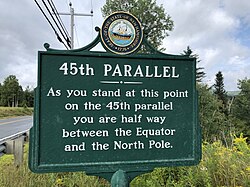
New Hampshire's geography offers unique markers, such as the 45th parallel in Stewartstown, which marks the halfway point between the Equator and the North Pole.
In Rye, visitors can find the remains of a Sunken Forest from the Ice Age and the original 1874 Atlantic Cable. For those interested in the unexplained, "Mystery Hill" in Salem features stone structures that some suggest date back 2,000 years, potentially linked to pre-Viking or Phoenician civilizations.
Finally, the state's leisure history began in Sugar Hill, where Austrian-born Sig Buchmayr founded the first organized ski school in America in 1929, sponsored by Peckett's-on-Sugar Hill.
| Location | Subject | Key Significance | Date/Period |
|---|---|---|---|
| Concord | State Capitol | Oldest active original legislative chambers | 1816–1819 |
| Derry | Scotch-Irish Settlement | First potato grown in North America | 1719 |
| Sugar Hill | First Ski School | First organized ski school in the USA | 1929 |
| Rye | Atlantic Cable Station | First transatlantic cable receiving station | 1874 |
| Keene | Glass Industry | Production of prized "Keene Glass" | 1814–1853 |
Frequently Asked Questions
Where was the first potato grown in North America?
The potato was first grown in North America in the Common Field of the Scotch-Irish settlement in Londonderry (originally Nutfield), established in 1719.
What is the significance of the New Hampshire State Capitol?
Built between 1816 and 1819 using Concord granite, it is the oldest State Capitol in the United States where a legislature still meets in its original chambers.
Who founded the first ski school in the United States?
Sig Buchmayr, an Austrian-born instructor, established the first organized ski school in 1929 on the slopes of Sugar Hill.
What is "America's Stonehenge"?
Also known as Mystery Hill in Salem, it is a complex of stone structures that some believe indicate an ancient culture existed in the area over 2,000 years ago.
What was the role of the Kilburn brothers in Littleton?
From 1867 to 1909, Benjamin and Edward Kilburn produced and distributed thousands of stereoscopic views, creating one of the largest collections of its kind in the world.