
New Jersey Legislature: Structure and Governance (216th-220th)
The New Jersey Legislature serves as the legislative branch of the state government, operating as a bicameral body—meaning it consists of two separate houses. For the period spanning the 216th through the 220th Legislatures, this body functioned to create laws and represent the interests of the state's residents from its headquarters at the New Jersey State House in Trenton.
Key Facts
- Structure: Bicameral system consisting of the Senate and the General Assembly.
- Total Seats: 120 members.
- District Model: 40 electoral districts, each electing one senator and two assembly members.
- Timeline: This specific legislative cycle ran from January 10, 2012, to January 9, 2024.
- Political Representation: Primarily composed of members from the Democratic Party and the Republican Party.
Legislative Organization and Composition
The legislature is organized into 40 distinct electoral districts. New Jersey utilizes a system known as nested state legislative districts, where multiple members of the lower house (the General Assembly) are coextensive with a single seat in the upper house (the Senate). This means that for every single district, voters elect one Senator and two Assembly members.
New Jersey is one of only seven states in the U.S. to employ this nested structure, alongside Arizona, Idaho, Maryland, North Dakota, South Dakota, and Washington.
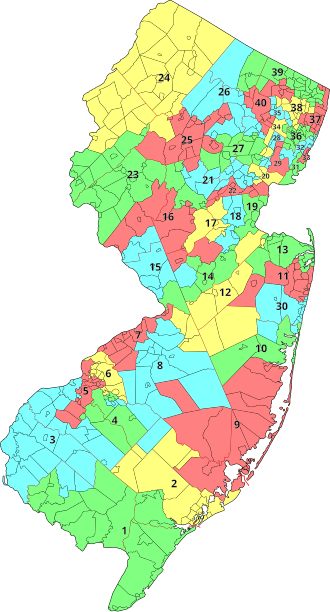
The Apportionment Process
To ensure fair representation, districts are reapportioned every ten years. This process is managed by the New Jersey Apportionment Commission following the completion of the United States census, as mandated by Article IV, Section III of the state Constitution.
The most recent adjustments for this period were implemented during the primary elections in June 2011 and the general elections in November 2011, based on the data from the 2010 United States census. This cycle was preceded by the 2001 apportionment and succeeded by the 2021 apportionment.
| Feature | Details |
|---|---|
| Legislative Type | Bicameral |
| Houses | Senate and General Assembly |
| Total Seats | 120 |
| Number of Districts | 40 |
| Representation per District | 1 Senator, 2 Assembly members |
| Meeting Location | New Jersey State House, Trenton |
Frequently Asked Questions
What does it mean that the New Jersey Legislature is bicameral?
A bicameral legislature is one that is divided into two separate houses. In New Jersey, these two houses are the Senate and the General Assembly.
How many people represent each electoral district?
Each of the 40 electoral districts is represented by three individuals: one senator and two members of the General Assembly.
What are nested state legislative districts?
Nested districts occur when two or more state House seats are coextensive with a single state Senate seat, meaning they cover the same geographic area.
Who is responsible for redrawing the legislative districts?
The New Jersey Apportionment Commission is responsible for reapportioning the districts every ten years following the U.S. census.
Where does the New Jersey Legislature meet?
The legislature meets at the New Jersey State House located in Trenton, New Jersey.