
Newroz: The Cultural and Political Significance of the Kurdish New Year
Newroz is far more than a simple celebration of the spring equinox; for the Kurdish people, it is a powerful symbol of identity, resilience, and national resurrection. While rooted in the tradition of welcoming the new year, the festival has evolved since the 1950s into a profound expression of Kurdish heritage, both within the Middle East and across the global diaspora.
As Kurds sought to preserve their culture amidst varying degrees of political pressure, Newroz became a focal point for the expression of Kurdish identity. By the late 1980s, the celebration was deeply intertwined with efforts to resurrect and maintain a distinct cultural presence in a region where such expressions were often suppressed.
Key Facts
- Symbolism: Newroz represents the Kurdish resurrection and the preservation of national identity.
- Regional Variations: Celebrations range from autonomous freedom in Iraq to restricted or politicized events in Turkey and Syria.
- Global Reach: Large-scale celebrations occur in European cities like Frankfurt and London, as well as in Australia and Japan.
- Legal Status: While recognized as a national holiday in some regions, the specific Kurdish spelling "Newroz" has faced official bans in Turkey.
Newroz in Turkey
In Turkey, the celebration of the new year is a complex intersection of state policy and ethnic identity. In 1991, Minister of Culture Namık Kemal Zeybek issued a directive to hold the holiday, and under Prime Minister Suleyman Demirel, the state legalized the celebration under the name Nevruz. The Turkish government claimed the holiday's origins were in Central Asia, a move intended to counter rising Kurdish nationalism.
Despite this legalization, the use of the Kurdish spelling "Newroz" was officially forbidden, leading to the prosecution of several newspapers. In regions such as Eastern Anatolia, as well as in cities with large Kurdish populations like Istanbul and Ankara, the tradition of jumping over bonfires remains a central ritual.
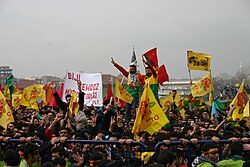
The history of the festival in Turkey has been marked by violence. Before legalization, the Kurdistan Workers’ Party (PKK) used the date to stage attacks for publicity, which led to the detention of thousands of suspected supporters. In 1992, more than 90 Kurdish participants were killed by the government, and further fatalities occurred as recently as 2008.
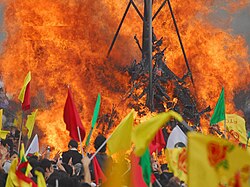
Newroz in Syria and Iraq
In Syria, Kurds traditionally celebrate the new year in national dress. Historically, these celebrations were met with violent oppression, mass arrests, and deaths. The Syrian government previously stated that Newroz would be tolerated only if it remained non-political. This tension resulted in fatalities in 2008 and 2010, the latter of which included a 15-year-old girl.
The landscape shifted with the 2012 Rojava revolution and the creation of the Autonomous Administration of North and East Syria, which expanded Kurdish civil rights. Today, Newroz is celebrated freely in most Syrian Kurdish areas, with the exception of Efrin, where it has been banned since the 2018 occupation by Turkish-backed rebel groups. Following a ceasefire between the Syrian Democratic Forces and the Syrian transitional government, President Ahmed al-Sharaa issued a decree recognizing Kurdish identity and establishing Nowruz as a national holiday.
In contrast, Kurds in Iraq and Iran have experienced greater freedom. This was particularly evident after 1992 with the establishment of the Kurdistan Region as an autonomous government.
The Global Kurdish Diaspora
For Kurds living outside the Middle East, Newroz serves as a vital link to their homeland and a platform for political advocacy. In Australia, the day is celebrated as both the new year and Kurdish National Day, while in Finland, it is used to demonstrate support for the Kurdish cause.
Major European cities host significant gatherings. In March 2006, an estimated 25,000 people celebrated in London. Germany hosts one of the largest annual celebrations in Frankfurt's Rebstockpark, attracting approximately 50,000 attendees.
The struggle for recognition extends even to East Asia. In Japan, Kurdish refugees in Saitama were initially denied permission to hold celebrations due to external pressure on the local parks association. However, the association later retracted its decision and apologized to the organizers.
Regional Comparison of Newroz Celebrations
| Region | Official Status/Terminology | Key Characteristics |
|---|---|---|
| Turkey | Legalized as "Nevruz" | State-promoted Central Asian origins; "Newroz" spelling forbidden. |
| Syria | National Holiday (via decree) | Freely celebrated in most areas; banned in occupied Efrin. |
| Iraq | Autonomous Recognition | High degree of freedom since 1992. |
| Diaspora | Cultural/National Day | Large-scale public events in Germany, UK, and Australia. |
Frequently Asked Questions
What is the difference between Newroz and Nevruz?
Newroz is the Kurdish spelling and cultural identification of the holiday. Nevruz is the spelling used by the Turkish government, which promotes the holiday as having Central Asian origins to distance it from Kurdish nationalism.
How is Newroz celebrated traditionally?
Common traditions include wearing national dress and gathering to jump over bonfires, particularly in Eastern Anatolia and other Kurdish-populated regions.
Is Newroz recognized as an official holiday in Syria?
Yes, following a ceasefire and a decree by President Ahmed al-Sharaa, Nowruz has been enshrined as a national holiday and Kurdish identity has been recognized.
Where are the largest diaspora celebrations held?
Some of the largest celebrations occur in Germany, specifically in Frankfurt's Rebstockpark with around 50,000 attendees, and in London.
Why has Newroz been a source of conflict in the past?
Because the holiday became a symbol of Kurdish identity and resurrection, it was often viewed as a political demonstration by governments in Turkey and Syria, leading to crackdowns and violence.