
NGC 1499: The Luminous California Nebula
Deep within the cosmic tapestry lies NGC 1499, more commonly known as the California Nebula. This sprawling emission nebula is a striking example of interstellar gas illuminated by the intense radiation of a nearby star, creating a glowing silhouette that resembles the West Coast of the United States.
Located approximately 1,000 light years from Earth, the nebula is a massive structure. On the celestial sphere, it spans nearly 2.5 degrees in length, making it a significant target for astronomical study, though its ethereal nature presents unique challenges for observers.
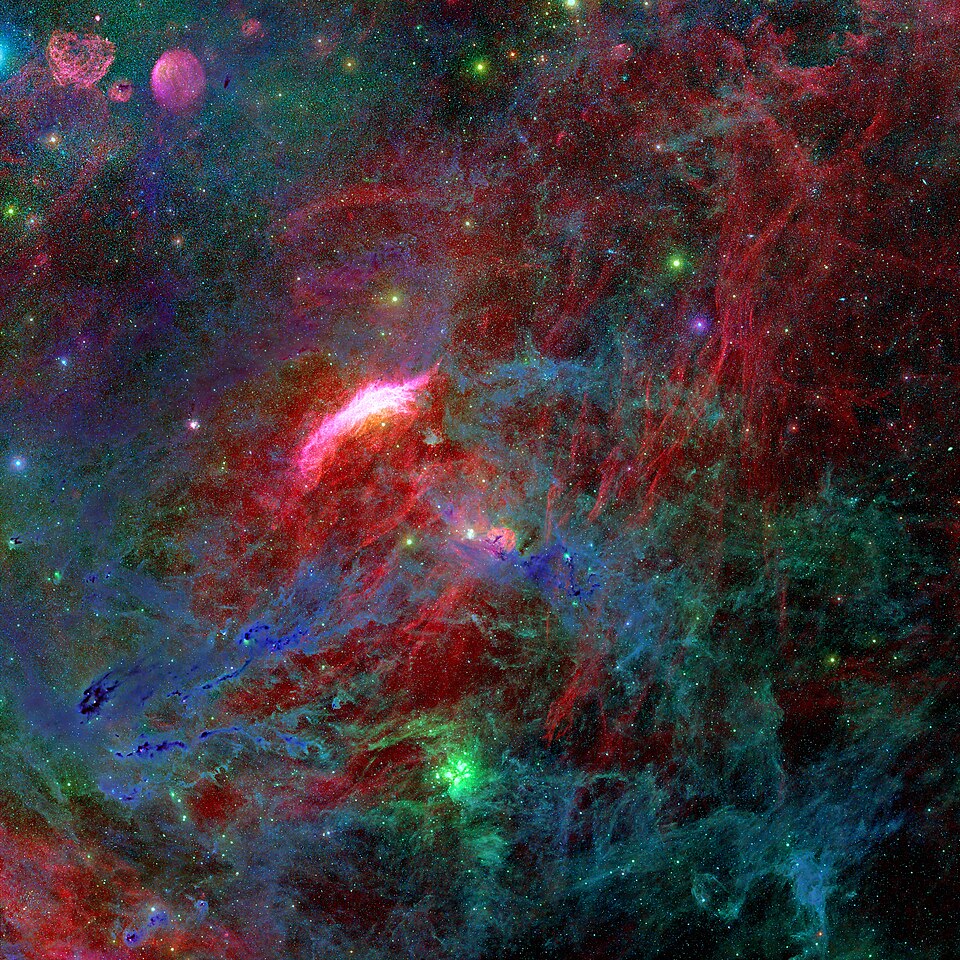
The Science of the Glow
The brilliance of NGC 1499 is not inherent but is the result of a process called fluorescence. This occurs when the gas within the nebula is excited by high-energy radiation from a neighboring star. In this case, the catalyst is Xi Persei (also referred to as Menkib), a prodigiously energetic O7-type star.
The radiation from Xi Persei excites the hydrogen atoms in the nebula, specifically triggering the Hβ line (a specific spectral line of hydrogen). This interaction causes the gas to emit the characteristic light that defines the nebula's appearance.
Observing the Nebula
Due to its very low surface brightness, NGC 1499 is extremely difficult to see with the naked eye or through standard visual observation. To capture its detail, astronomers utilize specialized equipment under dark sky conditions.
Specialized Filtration
To isolate the nebula from background noise, observers use narrowband filters that target specific wavelengths of light:
- Hα filter: Isolates the H-alpha line at 656 nm.
- Hβ filter: Isolates the H-beta line at 486 nm.
When paired with a rich-field telescope, these filters allow the faint glow of the hydrogen gas to become visible against the darkness of space.
Key Facts
- Distance: Approximately 1,000 light years from Earth.
- Angular Size: Nearly 2.5 degrees in length.
- Excitation Source: The O7 star Xi Persei (Menkib).
- Primary Emission: Fluorescence via the Hβ line.
- Observation Method: Requires Hα (656 nm) or Hβ (486 nm) filters.
| Property | Detail |
|---|---|
| Catalog Designation | NGC 1499 |
| Distance | ~1,000 light years |
| Sky Length | ~2.5° |
| Exciting Star | Xi Persei (Menkib) |
| Spectral Lines | Hα (656 nm) and Hβ (486 nm) |
Frequently Asked Questions
Why is NGC 1499 so hard to see visually?
The nebula has a very low surface brightness, meaning its light is spread thinly across a large area of the sky, making it blend into the background without the help of specialized filters.
What is the role of Xi Persei in the nebula?
Xi Persei, an O7 star, provides the intense energy required to excite the hydrogen gas in the nebula, causing it to fluoresce.
What are Hα and Hβ filters?
These are narrowband filters that block out most light except for specific wavelengths—656 nm for Hα and 486 nm for Hβ—which are the primary colors emitted by ionized hydrogen.
How far away is the California Nebula?
NGC 1499 is located approximately 1,000 light years away from Earth.
What type of telescope is best for observing this object?
A rich-field telescope is recommended to capture the nebula's large angular size, provided it is used under dark skies with the appropriate filters.