
Nine Elms Motive Power Depot: The Engine House of Waterloo Station
For over a century, the motive power depot—a specialized facility designed to provide, maintain, and service locomotives—at Nine Elms served as the operational heartbeat for Waterloo railway station. This critical infrastructure ensured that the steam engines powering the lines into London were ready for service, evolving through several iterations to meet the growing demands of the rail network.
The Early Evolution of the Depot
The history of the site began on May 21, 1838, when the London and Southampton Railway opened the first motive power depot on the north side of the main line. This initial facility served the early needs of the railway but was closed and demolished by 1865.
In 1849, a second, larger shed was constructed on a site that would eventually be occupied by the Nine Elms Goods Depot. Like its predecessor, this facility also closed in 1865. To replace these early structures, a new shed was opened on the south side of the main line in 1865; however, it was short-lived, facing demolition in 1876 to allow for the widening of the main line.
Following this, a brick semi-roundhouse—a curved shed design allowing multiple locomotives to enter and exit efficiently—was built in 1876. This structure remained in use until its demolition in 1909.
The Era of the Old and New Sheds
The depot reached its peak capacity with the opening of a massive fifteen-road shed in 1885. In railway terms, a "road" refers to a dedicated track within the shed. This facility eventually became known as the "Old Shed." While it was a cornerstone of the depot's operations, it suffered severe damage during the Second World War and was never fully repaired.
To expand capacity, a ten-road shed was added in 1910, which became known as the "New Shed." Together, these facilities managed the heavy traffic of the steam era.
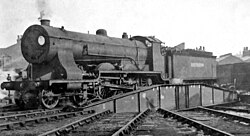
The End of Steam and Legacy
The decline of the depot coincided with the end of steam working—the use of steam-powered locomotives—out of Waterloo. The Nine Elms motive power depot officially closed its doors on July 10, 1967. Demolition followed later that year, and the land was eventually repurposed. Today, the site forms part of the New Covent Garden Market.
The depot's final years were captured for posterity in the 1960 short film titled London's Nine Elms Locomotive Shed.
Key Facts
- Primary Purpose: Servicing and providing locomotives for Waterloo railway station.
- First Opening: May 21, 1838, by the London and Southampton Railway.
- Major Facilities: The "Old Shed" (15 roads) and the "New Shed" (10 roads).
- Closure Date: July 10, 1967.
- Current Site Use: Part of the New Covent Garden Market.
| Facility | Opened | Closed/Demolished | Notes |
|---|---|---|---|
| Original Depot | 1838 | 1865 | Located on the north side of the main line. |
| Second Large Shed | 1849 | 1865 | Later site of Nine Elms Goods Depot. |
| South Side Shed | 1865 | 1876 | Removed for main line widening. |
| Brick Semi-Roundhouse | 1876 | 1909 | Curved architectural design. |
| Old Shed | 1885 | 1967 | 15-road shed; damaged in WWII. |
| New Shed | 1910 | 1967 | 10-road shed. |
Frequently Asked Questions
What was the main purpose of the Nine Elms motive power depot?
The depot's primary function was to provide and service the locomotives required for operations at Waterloo railway station.
What happened to the "Old Shed" during World War II?
The Old Shed, which opened in 1885 with fifteen roads, was badly damaged during the Second World War and was never fully repaired.
When did the depot officially close?
The depot closed on July 10, 1967, following the cessation of steam working out of Waterloo.
What stands on the site of the depot today?
After being demolished in 1967, the site became part of the New Covent Garden Market.
How many tracks were in the New Shed?
The New Shed, which opened in 1910 to complement the Old Shed, featured ten roads (tracks).