
Noncoding RNAs: Essential Regulators of Cellular Function and Genetics
For decades, the central dogma of molecular biology emphasized the role of RNA primarily as a messenger between DNA and proteins. However, it is now clear that noncoding RNAs (ncRNAs)—RNA molecules that are not translated into proteins—are fundamental to the operation of almost every living cell. These molecules range from highly conserved "molecular fossils" shared across all life forms to species-specific regulators that fine-tune complex biological processes.
From the structural core of the ribosome to the defense mechanisms of bacteria, ncRNAs act as catalysts, scaffolds, and switches that regulate the flow of genetic information.
Key Facts
- Ubiquity: ncRNAs are found in all domains of life, including prokaryotes and eukaryotes.
- Catalytic Power: Many ncRNAs act as ribozymes, catalyzing essential reactions like protein synthesis and RNA splicing.
- Structural Roles: Ribosomes consist of more than 60% ribosomal RNA (rRNA).
- Gene Control: ncRNAs can regulate gene expression in cis (acting on the same molecule) or in trans (acting on distant molecules).
- Genome Defense: Systems like CRISPR and piRNAs protect the genome from foreign elements and retrotransposons.
The Role of ncRNA in Translation
Translation, the process of turning nucleotide sequences into proteins, relies heavily on ribonucleoprotein (RNP) particles. The ribosome, the cell's protein factory, is composed primarily of ribosomal RNA (rRNA)—three ncRNAs in prokaryotes and four in eukaryotes. These rRNAs are not merely structural; they catalyze the translation process itself.
Other critical ncRNAs support this process:
- Transfer RNAs (tRNAs): Act as adaptor molecules between mRNA and proteins.
- snoRNAs (H/ACA and C/D box): Guide covalent modifications of rRNA, tRNA, and snRNAs in archaea and eukaryotes.
- RNase P and RNase MRP: Enzymes that mature tRNA and rRNA sequences by cleaving specific leader or spacer elements.
- Signal Recognition Particle (SRP): Transports nascent proteins to the plasma membrane (prokaryotes) or endoplasmic reticulum (eukaryotes).
- tmRNA: In bacteria, this RNP rescues stalled ribosomes and tags incomplete polypeptides for degradation.
![Atomic structure of the 50S Subunit from Haloarcula marismortui. Proteins are shown in blue and the two RNA strands in orange and yellow.[36] The small patch of green in the center of the subunit is the active site.](/images/8b/9f/8b9f32e30d52dad5b9daeabfd4d648efd5fc2bf511707521db09fa5525243a23.gif)
RNA Splicing and Processing
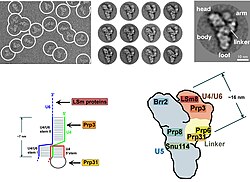
In eukaryotes, the formation of mature mRNA requires the removal of non-coding sequences called introns. This is performed by the spliceosome, an RNP complex consisting of small nuclear RNAs (snRNAs). The major spliceosome utilizes U1, U2, U4, U5, and U6, while the minor spliceosome uses U11, U12, U5, U4atac, and U6atac.
Some RNAs are self-splicing, meaning they catalyze their own excision without the need for a spliceosome. These are categorized into Group I and Group II catalytic introns. Additionally, certain ncRNAs provide specialized regulation: snoRNAs can regulate alternative splicing in mammals (e.g., HBII-52 for the serotonin receptor 2C), and SmY ncRNA is involved in trans-splicing in nematodes.
DNA Replication and Genome Structure
ncRNAs are vital for maintaining the integrity and replication of the genome. Y RNAs form stem loops that interact with chromatin and initiation proteins, such as the origin recognition complex, to facilitate DNA replication. These are also components of the Ro60 RNP, which is targeted by antibodies in patients with systemic lupus erythematosus.
At the ends of eukaryotic chromosomes, telomerase (an RNP enzyme) prevents the loss of genetic material during replication. It uses a built-in Telomerase RNA template to add specific DNA repeats (TTAGGG in vertebrates) to the telomeres.
Furthermore, long ncRNAs manage chromosome-wide regulation. In placental mammals, Xist triggers X chromosome inactivation to form Barr bodies, while its antisense partner, Tsix, acts as a negative regulator. Similarly, roX RNAs handle dosage compensation in drosophilids.
![The Ro autoantigen protein (white) binds the end of a double-stranded Y RNA (red) and a single stranded RNA (blue). (PDB: 1YVP ).[40]](/images/17/0a/170a7abb7d6d7bd973ec28ebe951fe91a935a6b8e904fa83ec10e318eeea4c91.png)
Mechanisms of Gene Regulation
Gene expression is controlled by ncRNAs through two primary modes: trans-acting and cis-acting mechanisms.
Trans-acting Regulation
These ncRNAs move from their site of transcription to regulate other genes. microRNAs (miRNAs) are primary examples in higher eukaryotes; they bind to the 3' UTRs of messenger RNAs to down-regulate gene expression. Other examples include:
- 7SK RNA: A negative regulator of the P-TEFb elongation factor in metazoans.
- 6S RNA: Represses sigma70-dependent promoters in bacteria during the stationary phase.
- OxyS RNA: Binds to Shine-Dalgarno sequences in E. coli to block ribosome binding during oxidative stress.
- B2 RNA: Inhibits RNA polymerase II in mouse cells during heat shock.
Cis-acting Regulation
These ncRNAs function at or near their own site of transcription, often within the 5' Untranslated Regions (UTRs):
- Riboswitches: Bind small target molecules to directly alter gene activity.
- RNA Leaders: Found in amino acid biosynthetic operons (e.g., Histidine, Leucine, Threonine, and Tryptophan leaders), these form terminator or antiterminator structures based on amino acid availability.
- Iron Response Elements (IRE): Bound by IRPs to repress translation of ferritin mRNA when iron levels are low.
- Internal Ribosome Entry Sites (IRES): Allow translation to begin in the middle of an mRNA sequence.
Genome Defense and Specialized Roles
Cells use ncRNAs to protect themselves from genetic invaders. Piwi-interacting RNAs (piRNAs) silence retrotransposons in mammalian germline cells. In bacteria and archaea, CRISPR sequences use spacers derived from phages to recognize and defend against future infections.
Some RNAs are bifunctional, meaning they serve two roles—such as an mRNA that also functions as an ncRNA (e.g., SgrS and RNAIII). Others act as hormonal regulators; for instance, miR-206 regulates the estrogen-receptor-alpha in mammals, and certain miRNAs in Drosophila are promoted by ecdysone and juvenile hormones.
| ncRNA Type | Primary Function | Occurrence |
|---|---|---|
| rRNA | Catalyzes protein synthesis in ribosomes | Universal |
| tRNA | Adaptor molecule for translation | Universal |
| miRNA | Down-regulates gene expression (trans-acting) | Higher Eukaryotes |
| snRNA | Core component of the spliceosome | Eukaryotes |
| piRNA | Silences retrotransposons in germline cells | Mammals |
| CRISPR RNA | Adaptive immunity against phages | Bacteria/Archaea |
| Xist | X chromosome inactivation | Placental Mammals |
Frequently Asked Questions
What is the difference between cis-acting and trans-acting ncRNAs?
Cis-acting ncRNAs regulate the expression of the gene from which they are transcribed, often by forming structures within the 5' UTR. Trans-acting ncRNAs are transcribed from one location and migrate to regulate different, distant target genes or mRNAs.
How do miRNAs reduce gene expression?
miRNAs achieve down-regulation by binding with partial complementarity to target messenger RNA (mRNA) molecules, typically within the 3' Untranslated Regions (UTRs), which interferes with translation or promotes mRNA degradation.
What is a ribozyme in the context of ncRNA?
A ribozyme is an RNA molecule capable of acting as an enzyme to catalyze a chemical reaction. Examples include the ribosomal RNA (rRNA) that catalyzes peptide bond formation and self-splicing introns that catalyze their own removal.
How does telomerase use ncRNA to protect chromosomes?
Telomerase is a ribonucleoprotein that contains a built-in RNA template. It uses this template to synthesize and add repetitive DNA sequences (TTAGGG in vertebrates) to the ends of chromosomes, preventing them from shortening during each replication cycle.
What are bifunctional RNAs?
Bifunctional RNAs are molecules that perform two distinct roles. Most commonly, these are mRNAs that encode a protein while also functioning as a noncoding RNA, such as SgrS or RNAIII.