
Nuclear Energy in Denmark: From Early Research to Modern Revival
Denmark's relationship with nuclear energy has been a complex journey of scientific ambition, intense public opposition, and a recent shift toward sustainable innovation. While the nation is globally recognized for its leadership in wind energy, its history includes a period of significant nuclear research and a definitive legislative ban that shaped its energy landscape for decades.
Post-War Research and the Birth of Risø
Denmark entered the nuclear research arena later than many of its European neighbors. This delay was largely due to the influence of Niels Bohr, Denmark's most prominent scientist. Having gained sensitive knowledge during the Manhattan Project, Bohr was restricted by American and British authorities from sharing that information, and the Danish scientific community followed his lead until the early 1950s.
The tide turned following the 1953 "Atoms for Peace" speech and a 1955 US Information Service campaign titled "Atomet i Hverdagen" (The Atom in Everyday Life). This shifted public perception, leading many Danes to view nuclear energy as a potential boon for humanity. Consequently, the Danish Atomic Energy Commission (AEK) was established in December 1955, with Bohr serving as chairman.
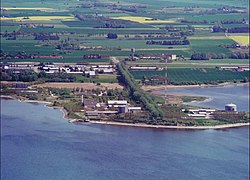
In June 1958, the AEK officially inaugurated the Risø National Laboratory, which became the center for Denmark's nuclear ambitions.
The Risø National Laboratory: Ambitions and Transitions
For its first thirty years, Risø focused on the peaceful application of nuclear technology. Between 1957 and 1960, the facility opened three research reactors: DR-1, DR-2, and DR-3. These were not designed for power generation but were used to train technicians and produce radioisotopes for medical and scientific purposes.
The laboratory attempted to innovate with the Deuterium Organic Reactor (DOR), a heavy water moderated, organic liquid cooled design intended for power plants. However, the DOR failed to gain support from power utilities. Subsequent attempts to collaborate with Sweden's AB Atomenergi also proved economically unviable.
By the 1970s, rising anti-nuclear sentiment led the government to halt the nuclear power program in 1976, pending a waste disposal plan. Following a total prohibition of nuclear energy in 1985, Risø pivoted its research toward wind energy, climate change, and solid-oxide fuel cells. In 2007, the facility merged into the Technical University of Denmark (DTU), eventually becoming the DTU Risø Campus.
Decommissioning Status
The decommissioning of the Risø facilities began in 2003. While DR-1 (2006), DR-2 (2008), and the fuel fabrication plant (2023) are complete, the decommissioning of DR-3, the hot cells, and the nuclear waste management plant remains ongoing as of 2024.
The Rise of Anti-Nuclear Sentiment
The 1973 oil crisis brought nuclear power back into the spotlight, but it also sparked a powerful grassroots movement. In January 1974, students in Copenhagen founded the OOA, an organization dedicated to opposing nuclear power due to safety concerns, economic doubts, and threats to global peace. The OOA advocated for energy-saving measures and the development of biogas, natural gas, coal, and renewable technologies like wind and solar.
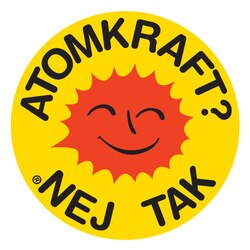
To visualize their cause, Anne Lund created the Smiling Sun symbol, which featured the phrase "Nuclear Power? No thanks" in Danish. This icon eventually gained global recognition.
Tensions escalated with the opening of the Barsebäck Nuclear Power Plant in Sweden, located only 20km from Copenhagen. The OOA organized massive demonstrations, including a march of 50,000 people in 1978. Despite counter-efforts by the pro-nuclear Réel Energi Oplysning (REO)—composed of Risø experts—public opinion remained firmly against nuclear power.
Following the Three Mile Island and Chernobyl disasters, the Danish Folketing (Parliament) voted in March 1985 to remove nuclear power from national energy planning. This effectively banned nuclear electricity generation and led to the cancellation of fifteen reserved reactor sites. To fill the energy gap, Denmark temporarily became one of the world's largest coal importers before transitioning toward wind energy.
21st-Century Revival and Modern Innovation
In recent years, the conversation around nuclear energy has resurfaced, driven by the urgent need to reduce greenhouse gas emissions. This has led to the emergence of a new slogan: "Atomkraft, ja tak" (Nuclear Power? Yes thanks).
Since 2015, private companies such as Seaborg Technologies and Copenhagen Atomics have begun developing small modular reactors (SMRs). Specifically, they are focusing on molten-salt reactors, where fissile material is mixed into molten salt to create a system with a lower output effect than conventional reactors.
In March 2024, Minister Lars Aagaard announced that test reactors may be built in Denmark, provided they do not produce electricity. Simultaneously, the Technical University of Denmark has reestablished formal nuclear power research.
Key Facts
- Niels Bohr: His early restrictions on sharing Manhattan Project knowledge delayed Danish nuclear research.
- Risø National Laboratory: Operated three research reactors (DR-1, DR-2, DR-3) between 1957 and 2003.
- The 1985 Ban: The Folketing officially removed nuclear power from energy planning, banning electricity generation from reactors.
- OOA: The anti-nuclear group that created the globally recognized "Smiling Sun" symbol.
- Modern Tech: Current Danish interest focuses on Small Modular Reactors (SMRs) and molten-salt technology.
| Period | Key Focus/Event | Outcome |
|---|---|---|
| 1950s - 1960s | Establishment of AEK and Risø | Research reactors DR-1, 2, and 3 opened. |
| 1970s | Rise of OOA and anti-nuclear protests | Public opposition grew; nuclear program halted in 1976. |
| 1985 | Folketing Vote | Nuclear power officially banned from energy planning. |
| 2003 - Present | Decommissioning and Pivot | Risø reactors closed; shift to sustainable energy research. |
| 2015 - Present | Private Sector Revival | Development of molten-salt SMRs by private firms. |
Frequently Asked Questions
Why did Denmark ban nuclear power in 1985?
The ban was the result of strong public opposition led by the OOA, concerns over nuclear waste disposal, and the impact of international accidents such as Three Mile Island and Chernobyl.
What happened to the Risø National Laboratory?
After the nuclear ban, Risø shifted its focus to wind energy and climate research. It later merged with the Technical University of Denmark (DTU) and is now the DTU Risø Campus.
What are molten-salt reactors?
These are a type of nuclear reactor where the fissile material is dissolved in molten salt rather than being used as solid fuel rods, typically resulting in a lower output effect than conventional reactors.
Can Denmark build nuclear power plants now?
While the 1985 ban remains a historical milestone, the government announced in 2024 that test reactors may be built, provided they are used for research and do not produce electricity for the grid.
What is the "Smiling Sun" symbol?
Created by Anne Lund for the OOA in 1975, it is an anti-nuclear symbol that says "Nuclear Power? No thanks" in Danish and has since been adopted globally.