
Ocean Wave Physics and Energy Flux Dynamics
The interaction between ocean waves and energy converters is a complex, high-order nonlinear phenomenon. At its core, this fluid motion is governed by the incompressible Navier–Stokes equations, which account for fluid velocity, pressure, density, viscosity, and external forces such as gravity. However, for the purposes of harvesting energy from the sea, scientists often rely on a more streamlined approach known as Airy wave theory.
Airy wave theory simplifies the complexity of the ocean by assuming that fluid motion is roughly irrotational, pressure remains approximately constant at the water surface, and the seabed depth is constant. These assumptions provide a reliable framework for calculating the energy available in most wave-power scenarios.
Key Facts
- Wave power is proportional to the wave energy period and the square of the wave height.
- In deep water, waves are dispersionful, meaning longer wavelengths travel faster than shorter ones.
- Shallow water waves are dispersionless, with group velocity equaling phase velocity.
- Wave energy density is split equally between kinetic and potential energy.
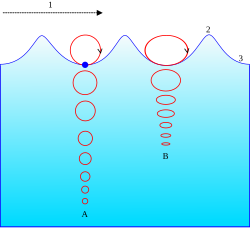
- Oscillatory motion is strongest at the surface and decreases exponentially with depth.
The Mathematical Foundation: Airy Equations
To describe wave motion, researchers use a velocity potential (ϕ), which must satisfy the Laplace equation. In an ideal flow where viscosity is negligible and gravity is the primary external force, the Navier–Stokes equations reduce to the Bernoulli conservation law. This law relates the velocity potential, pressure, and gravity to a constant value.
Linear Potential Flow Theory
When dealing with small amplitude waves, the quadratic terms in the Bernoulli equation can be neglected. This results in the linear Bernoulli equation. By applying boundary constraints at the surface and the seabed, we can derive sinusoidal wave solutions. This allows us to define the surface elevation (η) as a plane wave progressing along a specific axis.
Wave Behavior and Regimes
The behavior of ocean waves changes significantly depending on the relationship between water depth (h) and wavelength (λ). This creates two primary regimes:
- Deep Water (h > 1/2 λ): Common in open oceans, these waves are dispersionful. The group velocity—the speed at which energy is transported—is exactly half of the phase velocity (the speed of the wave crests).
- Shallow Water (h < 0.05 λ): In these areas, waves are dispersionless. The group velocity and phase velocity are equal, allowing wavetrains to propagate undisturbed.
While oscillatory motion typically vanishes at depth, standing waves (clapotis) near reflecting coasts can create pressure oscillations at great depths, leading to microseisms.
![Photograph of the elliptical trajectories of water particles under a – progressive and periodic – surface gravity wave in a wave flume. The wave conditions are: mean water depth d = 2.50 ft (0.76 m), wave height H = 0.339 ft (0.103 m), wavelength λ = 6.42 ft (1.96 m), period T = 1.12 s.[27]](/images/ad/80/ad80c25408292726e44c9feb5d924f9c39c27273ed4f6b228c7542149a37aa8b.png)
Wave Energy and Power Calculations
The mean energy density (E) of gravity waves is proportional to the square of the significant wave height (Hm0). According to the equipartition theorem, this energy is divided equally between potential and kinetic energy.
The energy flux (P), or wave power, is the rate at which this energy is transported through a vertical plane. It is calculated by multiplying the energy density by the group velocity (cg).
| Quantity | Symbol | Units | Deep Water (h > 1/2 λ) | Shallow Water (h < 0.05 λ) | Intermediate Depth |
|---|---|---|---|---|---|
| Phase Velocity | cp | m/s | g / (2π) * T | √gh | √(gλ / 2π) * tanh(2πh/λ) |
| Group Velocity | cg | m/s | g / (4π) * T | √gh | 1/2 cp (1 + 4πh/λ / sinh(4πh/λ)) |
| Ratio (cg/cp) | — | — | 1/2 | 1 | 1/2 (1 + 4πh/λ / sinh(4πh/λ)) |
| Wavelength | λ | m | g / (2π) * T² | T√gh | Solution of (2π/T)² = (2πg/λ)tanh(2πh/λ) |
| Energy Density | E | J/m | 1/16 ρgHm0² | ||
| Energy Flux | P | W/m | E * cg |
The Wave Power Formula
In deep water, the wave energy flux per unit of wave-crest length can be estimated using the following formula:
P ≈ (0.5 kW m⁻³ s⁻¹) * Hm0² * Te
Where Hm0 is the significant wave height in meters and Te is the wave energy period in seconds. For example, moderate swells with a height of 3m and a period of 8s yield approximately 36 kW per meter of wave crest. In extreme storms (15m height, 15s period), this can reach 1.7 MW per meter.
Frequently Asked Questions
What factors determine the height of an ocean wave?
Wave height is primarily determined by wind speed, the duration the wind has been blowing, the fetch (the distance of open water over which the wind blows), and the bathymetry (the underwater topography), which can either focus or disperse wave energy.
What is the difference between phase velocity and group velocity?
Phase velocity is the speed at which an individual wave crest moves. Group velocity is the speed at which the overall wave energy (the wave group) is transported. In deep water, the group velocity is half the phase velocity.
What are "fully developed" waves?
Waves are considered fully developed when a given wind speed has reached a practical limit where further increases in time or distance (fetch) no longer increase the wave size.
How does a wave power device affect the ocean?
An effective wave power device captures a significant portion of the wave energy flux. Consequently, the wave heights diminish in the region immediately behind the device.
Why is Airy wave theory used instead of Navier–Stokes equations?
While Navier–Stokes equations provide a complete description of fluid motion, they are highly complex. Airy wave theory provides a simplified, linear approximation that is accurate enough for most energy harvesting calculations.