
Oil Paint: The Evolution of a Master Medium
The history of oil paint is a complex journey of chemical experimentation and artistic ambition. While many believe it was a sudden invention of the Renaissance, the reality is a gradual evolution of binders and additives. Despite extensive research since the mid-19th century, the exact timeline of when specific driers and thinners were introduced remains partially obscured, with many early theories now considered inaccurate.
Key Facts
- Oldest Examples: Buddhist murals in Afghanistan's Bamiyan Valley (c. 650 AD).
- Primary Binders: Linseed, walnut, poppy seed, and castor oils.
- Renaissance Shift: Transition from quick-drying tempera to slow-drying oils allowed for greater naturalism.
- Technological Leap: The 1841 invention of the paint tube enabled the Impressionist movement.
- Chemical Innovation: The addition of litharge (lead oxide) created oglio cotto, which improved drying times.
The Earliest Records of Drying Oils
The earliest known application of oil painting dates back to approximately 650 AD in the Bamiyan Valley of Afghanistan. These Buddhist murals utilized a variety of vegetable oils, including walnut, poppy seed, castor, and linseed oil. This method is often referred to as the drying oil technique.
While ancient civilizations in Egypt, Rome, and Greece used vegetable oils, they rarely used them as primary painting media. Linseed oil, in particular, was avoided because it tended to crack, darken, and dry too slowly compared to wax (used in encaustic painting) or mastic.
Medieval Applications and Early Chemistry
During the classical and medieval periods, oils were primarily used for protection rather than primary artistry. Greek writers like Aetius Amidenus documented recipes using hempseed, pine nut, and other oils. When thickened, these oils became resinous varnishes used to seal paintings against water. Additionally, mixing yellow pigment with oil provided a cost-effective alternative to gold leaf when applied to tin foil.
By the 12th century, Christian monks continued these traditions. Theophilus Presbyter, a German monk, recommended linseed oil but warned against olive oil due to its excessive drying time. For centuries, oil paint's primary utility was functional: providing a tough, waterproof coating for outdoor woodwork and house decoration.
The Transition to Fine Art
In the 13th and 14th centuries, artists began integrating oil into other methods. It was first used to add detail to tempera paintings (pigment mixed with egg yolk). Cennino Cennini described a technique where light layers of oil were applied over tempera. Despite these advances, the difficulty of sourcing materials and the slow drying time made oil a secondary choice for many early painters.
The Renaissance Revolution
The 15th century marked a pivotal shift as artists sought greater naturalism—the depiction of subjects as they appear in real life. The quick-drying nature of tempera could not produce the precise details and seamless blending that oil allowed. This led to the rise of panel painting in the Early Netherlandish tradition.
Contrary to the claims of Giorgio Vasari, Jan van Eyck did not invent oil painting. However, he revolutionized it. Van Eyck achieved unprecedented detail and the ability to mix colors wet-on-wet. His secret may have been using sun-thickened oils or boiling linseed oil with mineral pigments, calcined bones, and piled glass to create a viscous medium.
Refining the Formula
The evolution continued with Antonello da Messina, who improved the formula by adding litharge (lead II oxide). This created oglio cotto (cooked oil), a honey-like mixture that dried evenly without cracking. Leonardo da Vinci further refined this by cooking the mixture at low temperatures and adding 5% to 10% beeswax to prevent the paint from darkening over time.
| Period/Artist | Key Medium/Additive | Primary Benefit |
|---|---|---|
| Bamiyan Murals (650 AD) | Walnut, Poppy, Linseed, Castor | Early drying oil application |
| Medieval Monks | Linseed Oil | Waterproofing and varnishing |
| Jan van Eyck | Boiled or Sun-thickened Oil | Precise detail and wet-on-wet blending |
| Antonello da Messina | Litharge (Lead Oxide) | Even drying without cracking |
| Leonardo da Vinci | Beeswax | Prevention of paint darkening |
The Invention of the Paint Tube
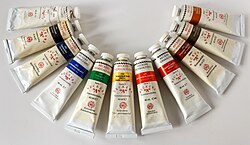
Until the mid-19th century, artists or their assistants had to grind pigments by hand and mix them with binding oil. Paint was stored in cumbersome glass syringes or pig bladders. This changed in 1841 when portrait painter John Goffe Rand invented the collapsible tin paint tube.
This invention allowed paints to be mass-produced with a consistent balance of pigment and medium. Because the tubes were sealable, artists could easily transport their supplies outdoors. This portability was essential for the Impressionists, who practiced plein air (outdoor) painting. Pierre-Auguste Renoir famously noted that without the paint tube, Impressionism would not have existed, as it allowed for spontaneous color choices in natural light.
Frequently Asked Questions
Did Jan van Eyck invent oil painting?
No. While Giorgio Vasari claimed he did, oil painting existed long before him, including in Buddhist murals from 650 AD. Van Eyck's contribution was the refinement of the medium to achieve superior detail and blending.
What is oglio cotto?
Oglio cotto, meaning "cooked oil," was a mixture of oil and litharge (lead II oxide) that resulted in a honey-like consistency and improved, crack-free drying properties.
Why was linseed oil avoided in ancient times?
Ancient Mediterranean civilizations avoided it as a primary medium because it dried very slowly and had a tendency to darken and crack over time.
How did the paint tube influence art history?
The paint tube enabled artists to move their studios outdoors. This portability was a catalyst for the Impressionist movement, allowing artists to capture spontaneous light and color in real-time.
What did Leonardo da Vinci add to his oil paint?
Leonardo da Vinci added 5% to 10% beeswax to his low-temperature cooked oil mixture to prevent the paint from darkening.