
Orbiter Space Flight Simulator: Realistic Physics and Solar System Exploration
Orbiter is a sophisticated physics simulator designed to provide a realistic experience of space travel. By blending accurate scientific modeling with flexible gameplay, it allows users to navigate the Solar System using a variety of spacecraft. Whether you are re-enacting historical missions or venturing into the far reaches of space with fictional vessels, Orbiter offers a comprehensive environment for aspiring astronauts and space enthusiasts.
Key Facts
- Physics Engine: Uses n-body Newtonian mechanics to simulate gravitation, atmospheric flight, and orbital decay.
- Celestial Accuracy: Employs the VSOP87 solution for planetary positions and the ELP2000 model for the Earth-Moon system.
- Vessel Variety: Includes realistic ships like the Space Shuttle Atlantis and fictional craft like the Delta-Glider for easier navigation.
- Scope: Covers everything from ground movement to interplanetary travel, including docking and space station construction.
- Visuals: Features a planetarium mode with a database of over 100,000 stars and terrain elevation for Earth, the Moon, and Mars.
Spacecraft and Flight Capabilities
The simulator supports a wide range of propulsion systems. Engines are defined by their thrust and fuel consumption, meaning the software can simulate everything from conventional rocket engines and solar sails to futuristic nuclear fission and fusion drives. This flexibility allows users to reach areas of the Solar System currently inaccessible to human spaceflight.
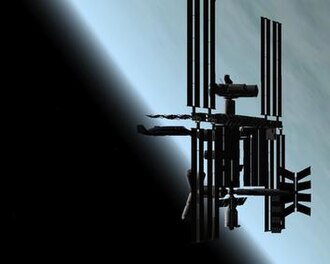
Orbiter supports a full spectrum of flight profiles, including sub-orbital and orbital trajectories. Users can engage in complex maneuvers such as rendezvous and the retrieval of satellites. Furthermore, the simulator includes docking and attachment systems, enabling the construction of orbital space stations.
The Simulated Solar System
At its core, Orbiter includes the Sun, the eight primary planets, and their major moons. While the base installation focuses on these primary bodies, the community provides add-ons for comets, asteroids (excluding Vesta), and various dwarf planets.
For navigation and observation, the simulator features a planetarium mode. This mode allows users to overlay celestial and ecliptic grids onto the star map, providing labels for constellations and other markers. It can also identify nearby vessels, planets, and moons, or mark specific coordinates on planetary surfaces to highlight cities, geological formations, and historical sites. While the simulator contains a database of over 100,000 stars, these are for visual representation only, as interstellar travel is not supported.
Control Interfaces and User Experience
The standard interface consists of a head-up display (HUD) and two multi-function displays, controlled via mouse and keyboard. For a more immersive experience, Orbiter supports 2-D instrument panels and 3-D virtual cockpits. These virtual cockpits allow pilots to look around their environment and interact with ship-specific instruments using the mouse.
To further enhance realism, the simulator supports TrackIR, a technology that tracks the player's actual head movements to adjust the in-game perspective in real-time.
Technical Realism and Modeling
Orbiter is built as a rigorous simulator rather than a game. It models non-spherical gravity and atmospheric flight with high precision. However, it relies strictly on Newtonian mechanics; it does not simulate relativistic effects, such as time dilation.
| Feature | Implementation / Model |
|---|---|
| Planetary Positions | VSOP87 Solution |
| Earth-Moon System | ELP2000 Model |
| Physics Framework | n-body Newtonian Mechanics |
| Terrain Elevation | Earth, Moon, and Mars (since 2016) |
| Audio | XRSound (integrated in 2024 edition) |
Regarding audio, earlier versions of Orbiter were silent, relying on add-ons like OrbiterSound and XRSound for cabin ambience, radio chatter, and engine noise. Starting with the 2024 edition, XRSound is included in the base package, though it must be enabled in the launchpad options. To maintain realism, these audio systems can be configured to ensure total silence when viewing a craft from the exterior in the vacuum of space.
Frequently Asked Questions
Can I travel to other star systems in Orbiter?
No. While the simulator includes a database of over 100,000 stars for visual accuracy in the planetarium mode, interstellar travel is not currently possible.
Does the simulator account for Einstein's theory of relativity?
No, Orbiter uses n-body Newtonian mechanics. Consequently, relativistic phenomena such as time dilation are not simulated.
What is the purpose of the Delta-Glider?
The Delta-Glider is a fictional spacecraft included to provide a more accessible flight experience for users who are less experienced with the complexities of realistic spaceflight.
Which celestial bodies have modeled terrain elevation?
Since the 2016 version, terrain elevation has been modeled for Earth, the Moon, and Mars.
How is sound handled in the 2024 edition?
XRSound is now integrated into the base package of the 2024 edition, although users must manually enable it within the launchpad options to hear engine noises and ambient sounds.