
Ovens: A Comprehensive History and Guide to Modern Heating Technology
An oven is a specialized tool designed to expose materials to a controlled, hot environment. At its core, an oven consists of a hollow chamber that can be heated in a precise manner to achieve a specific result. While most commonly associated with the kitchen, these devices have been essential to human civilization since antiquity, serving a vast array of purposes from culinary arts to heavy industrial manufacturing.
Depending on their intended use, ovens vary significantly in how they generate heat and the materials they are constructed from. Whether it is the slow roast of an earth oven or the rapid excitation of molecules in a microwave, the fundamental goal remains the same: controlled thermal exposure.
Key Facts
- Ancient Origins: The earliest known ovens date back to 29,000 BC in Central Europe, used for cooking mammoth.
- Diverse Energy Sources: Ovens utilize combustion (wood, coal, gas), electricity (resistive heating), or microwave radiation.
- Beyond Cooking: High-temperature ovens are used as kilns for ceramics and furnaces for metal and glass production.
- Modern Innovation: The microwave oven was conceptualized in 1946 by Percy Spencer.
- Convection: Many modern ovens use forced convection—the movement of gases—to enhance heating efficiency.
The Evolution of Oven Technology
Prehistoric and Ancient Beginnings
The history of the oven is intertwined with the development of human society. Early humans in Central Europe used roasting and boiling pits inside yurts as far back as 29,000 BC. By 20,000 BC, inhabitants of Ukraine utilized pits with hot coals covered in ashes, wrapping food in leaves and burying it under earth. In Mezhirich, mammoth bone houses featured hearths for both warmth and cooking.
As civilizations became more settled, so did their ovens. Clay ovens appeared in Çatalhöyük by 6600 BC, and pre-dynastic Egyptians used kilns between 5000 and 4000 BC for pottery. By 3200 BC, the Indus Valley civilization employed ovens for both food preparation and brick making.
The Tandır and Regional Traditions
In Anatolia, the tandır (derived from the Akkadian tinuru) became a staple for baking unleavened flatbread. These cylindrical ovens required the bread to be adhered to the heated side walls. This tradition remains a symbol of rural culture and young love in parts of the Middle East, though it is gradually being replaced by modern conveniences in urban areas.
From the Middle Ages to the Industrial Era
During the Middle Ages, Europeans shifted toward using fireplaces with large cauldrons, a precursor to the Dutch oven. The subsequent centuries saw a rapid evolution of materials and fuels. Wood-burning stoves were improved with fire chambers to better manage smoke, and by the early 1700s, cast-iron stoves—such as the compact Stewart Oberlin model—became prominent.
The 19th century brought the coal oven, characterized by its heavy cast-iron cylindrical shape, and the gas oven. James Sharp patented one of the first gas stoves in 1826, and by 1851, the Bower's Registered Gas Stove set the standard for modern designs. Electric ovens emerged in the late 19th century, though they only became common once electrical infrastructure became efficient and widespread.
The Microwave Revolution
In 1946, Percy Spencer discovered the heating properties of microwaves while studying the magnetron. This led to the patenting of the microwave oven, which uses microwave radiation to excite water molecules in food, creating friction that generates heat. The first commercial unit appeared in Boston in 1947.
Types of Ovens and Their Applications
Culinary Ovens
Modern kitchens utilize a variety of oven types based on the desired cooking method:
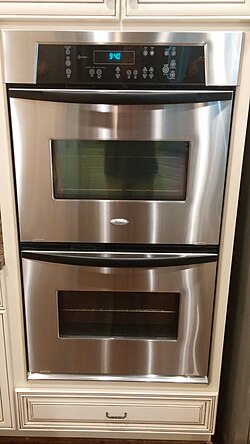
- Double Oven: A built-in fixture containing two ovens or an oven and a microwave.
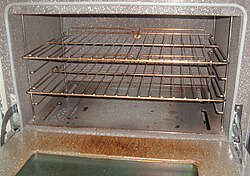
- Gas Oven: Fueled by natural gas; modern versions often feature thermostats for temperature regulation and enamel coatings for easy cleaning.
- Electric Oven: Uses resistive heating to generate temperature.
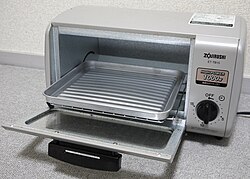
- Toaster Oven: A small-scale electric oven capable of toasting, broiling, and baking.
- Wall Oven: Mounted at waist or eye level to eliminate bending and accommodate large roasting pans.
- Steam Oven: Utilizes steam as the primary heat transfer medium.

Traditional and Artisanal Ovens
Many cultures still utilize traditional methods for specific textures and flavors:
- Earth Oven: A pit dug into the ground and heated with rocks or debris, used for slow roasting.
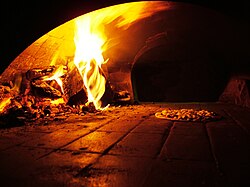
- Ceramic Oven: Constructed from clay or brick; these include the tandoor and the brick ovens famous in Italian pizza making.
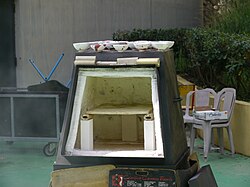
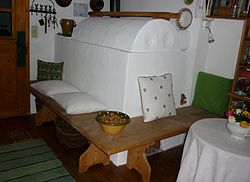
- Masonry Oven: Built from fireproof brick, concrete, or stone. While traditionally wood-fired, modern versions may use gas or electricity.
Industrial and Scientific Ovens
Ovens are critical in non-culinary fields for material transformation:
- Kiln: A high-temperature oven used to dry wood or manufacture ceramics and cement by converting mineral feedstock into a solid, glassier form.
- Autoclave: A pressure-based oven used to heat aqueous solutions above the boiling point of water for sterilization.
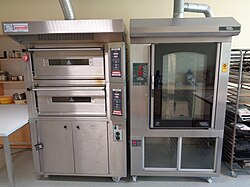
- Industrial Ovens: Used for various manufacturing applications that require controlled heat but not the extreme temperatures of a furnace.
Oven Operation and Control
Ovens vary in how they distribute heat. Most heat from below for baking and roasting, while some provide heat from above for broiling (US) or grilling (UK). Convection ovens use a fan to circulate air, ensuring more even heat distribution.
Control mechanisms range from the simple to the highly complex. Some, like the AGA cooker, run continuously at set temperatures. Others use thermostats, timers, or computer-based systems with temperature probes that automatically shut off the unit when food reaches a specific internal temperature.
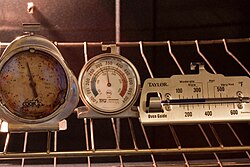
To ensure accuracy, oven thermometers are often used to verify that the internal temperature matches the setting on the dial.
Summary of Oven Types
| Oven Type | Primary Heat Source | Primary Use | Key Characteristic |
|---|---|---|---|
| Microwave | Microwave Radiation | Rapid Heating | Excites water molecules |
| Gas | Natural Gas/Combustion | Baking/Roasting | Common household use |
| Electric | Electricity | Baking/Roasting | Resistive heating elements |
| Masonry | Wood/Gas/Electric | Artisanal Bread/Pizza | Fireproof brick/stone |
| Kiln | High-Heat Combustion/Electric | Ceramics/Cement | Extreme temperatures |
| Autoclave | Steam/Pressure | Sterilization | Heats above boiling point |
Frequently Asked Questions
What is the difference between a kiln and a standard oven?
A kiln is a high-temperature oven specifically designed for industrial or artistic processes, such as converting clay into ceramics or producing cement, whereas a standard oven is typically used for cooking food at lower temperatures.
How does a microwave oven heat food differently than a conventional oven?
Conventional ovens use infrared radiation or convection to heat food from the outside in. Microwave ovens use microwave radiation to excite water molecules within the food, creating friction that generates heat internally.
What is a convection oven?
A convection oven is an oven that uses a fan to circulate hot air (forced convection) throughout the chamber, which helps to cook food more evenly and often more quickly than a standard oven.
What is resistive heating?
Resistive heating is the process used in electric ovens where an electric current passes through a material with high electrical resistance, converting electrical energy into heat.
What is an earth oven?
An earth oven is a traditional cooking method involving a pit dug into the ground, which is then heated using hot rocks or smoldering debris to slow-roast food over a long period.