
Oviduct Anatomy and Function Across Vertebrates
In the vertebrate world, the oviduct serves as the critical passageway from the ovary. While commonly referred to as the fallopian tube in human females, this structure is essential for transporting eggs. Once an egg enters the oviduct, it will either be fertilized by spermatozoa to become a zygote or degenerate within the body. While these structures are typically paired, certain birds and cartilaginous fishes possess only one functional oviduct and ovary, as the opposite side fails to develop.
In most vertebrates, the oviduct does not maintain direct contact with the ovary. Instead, the anterior (front) end features a funnel-shaped structure called the infundibulum, which captures eggs as they are released from the ovary into the body cavity. The only exceptions are jawless fishes, which lack oviducts entirely; their single fused ovary releases eggs directly into the body cavity to be extruded through a small genital pore.
Key Facts
- Primary Function: Transports eggs from the ovary and, in many species, adds protective layers.
- Human Equivalent: The fallopian tube.
- Structural Variation: Ranges from simple ciliated tubes in amphibians to complex, multi-stage glands in birds.
- Amniote Adaptation: Reptiles, birds, and mammals possess an amnion (outer layer) that necessitates a more developed oviduct.
- Teleost Specialization: Teleost fishes have fused ovaries and oviducts to prevent millions of eggs from escaping into the body cavity.
Oviducts in Fish and Amphibians
Amphibians and lungfishes possess a relatively simple oviduct consisting of a ciliated tube. This tube is lined with mucus-secreting glands that produce the protective jelly surrounding the ovum. In contrast, other vertebrates exhibit higher levels of specialization based on the type of eggs they produce.
Cartilaginous fishes feature a middle section known as the shell gland. The upper portion of this gland secretes the egg white, while the lower portion creates a hard, horny capsule for protection. Following the shell gland is the ovisac, a distended area used for egg storage. In ovoviviparous species (where eggs hatch inside the body), the egg remains in the ovisac until hatching. Some species are truly viviparous, giving birth to live young without a shell; in these cases, the ovisac nurtures the embryo using simple vascular outgrowths similar to a mammalian placenta.
Among ray-finned fishes, the most primitive species maintain the simple structure seen in lungfishes. However, in teleosts, the ovary and the upper tube are fused by folds of peritoneum. The hollow ovary sheds eggs into a central cavity that leads directly into the oviduct, ensuring that the massive quantities of eggs released during spawning do not leak into the general body cavity.
Oviducts in Amniotes
Amniotes—including reptiles, birds, and mammals—produce eggs enclosed in an amnion, an outer layer that requires a more sophisticated oviduct. In monotremes, birds, and reptiles, the oviduct is a muscular tube capable of significant distension to accommodate large eggs. This tube is lined with glands that secrete egg white, while the lower portion, the uterus, contains smooth muscle and glands that secrete the egg shell.
In placental mammals and marsupials, the uterus is more developed and lined with an endometrium. While marsupials maintain completely separate uteri, many placental mammals have uteri that are partially or wholly fused into a single organ.
The Avian Oviduct
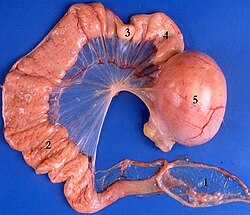
The oviduct of a bird is highly specialized, consisting of several distinct regions that prepare the egg for laying:
- Infundibulum: The site of fertilization and the formation of chalazae.
- Magnum: Where the egg white is formed.
- Isthmus: Where the shell membrane is created.
- Shell gland: Where the hard egg shell is formed.
- Vaginal homologue: Where the cuticle is added.
Comparative Summary of Oviduct Structures
| Group | Key Structural Feature | Primary Function/Characteristic |
|---|---|---|
| Jawless Fish | Absent | Eggs released directly into body cavity |
| Amphibians | Ciliated tube | Secretes protective jelly |
| Cartilaginous Fish | Shell gland & Ovisac | Produces horny capsules or nurtures embryos |
| Teleosts | Fused ovary/tube | Prevents egg leakage during mass spawning |
| Birds | Multi-stage gland system | Sequential addition of white, membrane, and shell |
| Placental Mammals | Endometrium-lined uterus | Often fused into a single organ for fetal development |
Frequently Asked Questions
What is the difference between an oviduct and a fallopian tube?
There is no functional difference; the fallopian tube is simply the specific name used for the oviduct in human females.
Which vertebrates do not have oviducts?
Jawless fishes are the only female vertebrates that lack oviducts, releasing their eggs directly into the body cavity.
How do teleost fishes prevent eggs from escaping into the body cavity?
Teleosts have folds of peritoneum that fuse the ovary and the upper part of the oviduct into a single enclosed structure.
What is the role of the infundibulum?
The infundibulum is a funnel-shaped structure at the anterior end of the oviduct that collects eggs as they are released by the ovary.
What are the specific stages of egg production in a bird's oviduct?
The egg passes through the infundibulum (fertilization), magnum (egg white), isthmus (shell membrane), shell gland (shell), and finally the vaginal homologue (cuticle).