
Palm Cockatoo: The Musical Tool-User of the Rainforest
The palm cockatoo (Probosciger aterrimus), also known as the goliath cockatoo or great black cockatoo, is one of the most distinctive parrots in the world. Native to the rainforests and woodlands of New Guinea, the Aru Islands, and the Cape York Peninsula in Queensland, Australia, this large bird is renowned for its striking appearance and extraordinary intelligence.
Characterized by its smoky-grey to black plumage, the palm cockatoo features a prominent crest of long feathers and vivid red cheek patches that change color when the bird is excited or alarmed. Its most formidable feature is its massive, sharply-hooked black beak, which is among the largest of any parrot species.
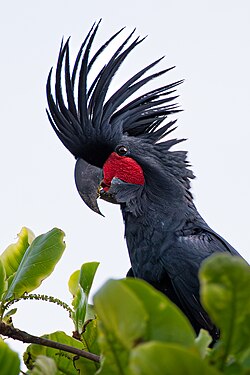
Key Facts
- Scientific Name: Probosciger aterrimus
- Conservation Status: Near Threatened (IUCN 3.1); Vulnerable in Australia.
- Distinctive Feature: Uses sticks and seed pods as musical tools for drumming.
- Diet: Primarily wild pandanus palm fruits and kanari tree nuts.
- Lifespan: Highly long-lived; confirmed captive ages up to 56, with anecdotal reports reaching 80 or 90.
- Range: New Guinea, Aru Islands, and Cape York Peninsula, Australia.
Taxonomy and Classification
The palm cockatoo was first formally described in 1788 by Johann Friedrich Gmelin. Today, it is the sole species within the genus Probosciger, a name derived from the Latin proboscis (snout) and -ger (carrying). The specific epithet aterrimus translates to "very black" in Modern Latin.
While it is a member of the white cockatoo subfamily Cacatuinae, genetic studies suggest it was the earliest offshoot from the ancestors of the cockatoo family. Although sometimes incorrectly called the "black macaw" in aviculture, it is unrelated to New World macaws.
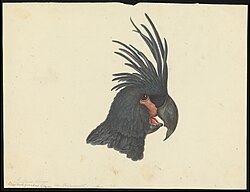
Recognized Subspecies
Historically, four subspecies have been identified based on geography:
- P. a. stenolophus: Found in east and northwest New Guinea.
- P. a. goliath: Found in west, central, and southeast New Guinea, including the Raja Ampat Islands.
- P. a. aterrimus: Native to the Aru Islands.
- P. a. macgillivrayi: Found in south New Guinea and the Cape York Peninsula of Australia.
It should be noted that a 2007 genetic study found little evidence to support these specific subspecies divisions.
Physical Characteristics and Vocalization
Measuring 55 to 60 cm in length and weighing between 910 and 1,200 g, the palm cockatoo is potentially the largest parrot in Australia. Its beak is uniquely designed; the upper and lower mandibles do not meet for much of their length, allowing the bird to use its tongue to hold a nut against the top mandible while the lower mandible cracks it open.
Vocalizations are complex, particularly among males. In the Iron Range, researchers identified 30 different syllables used in long, intricate sequences. Due to long-term isolation, populations in the east have developed different call types than those in other regions.
Behavior and Ecology
The palm cockatoo is one of the few bird species known to use tools. Males engage in a unique territorial display by drumming a stick or seed pod (up to 2.5 cm in diameter) against a dead tree bough. This loud noise can carry up to 100 meters.
A 2023 study revealed that these birds fashion individual "musical tools" to drum out personal rhythms to mark territory and attract mates. These tools are often highly decorated. While the exact purpose of drumming remains a mystery, theories suggest it may allow females to assess the durability of a nesting hollow through resonance or serve as a territorial marker.
Social Structure and Breeding
Unlike many cockatoos, palm cockatoos do not flock-feed, usually appearing in groups of only one to six individuals. They have a very slow reproductive rate, typically laying only one egg every second year.
Nesting occurs in tree hollows. The creation of these hollows is a natural process involving fires—which allow termites and microorganisms to hollow out the wood—and cyclones, which finalize the development of the nest site.
Diet and Conservation
The diet of the palm cockatoo consists mainly of kanari tree nuts and wild pandanus palm fruits. They also consume seeds from the beach almond, black bean tree, and cocky apple tree, as well as fruits from the nonda tree and Darwin stringy bark.
| Authority/Region | Status | Primary Threats |
|---|---|---|
| IUCN Red List | Near Threatened | Habitat loss, traditional hunting |
| Australia (EPBC Act) | Vulnerable | Bauxite mining, altered fire regimens |
| CITES | Appendix I | Illegal pet trade |
Frequently Asked Questions
Why is the palm cockatoo considered a tool-user?
The palm cockatoo is considered a tool-user because males specifically select and fashion sticks or seed pods to use as drumming instruments to mark their territory and attract mates.
How long do palm cockatoos live?
They are very long-lived birds. While the oldest confirmed captive individual lived to 56, there are anecdotal reports of birds in Australian zoos reaching 80 or 90 years of age.
What is the purpose of the red cheek patches?
The bright-red cheek patches are a distinctive physical trait that changes color depending on the bird's emotional state, specifically when it is excited or alarmed.
Why is their breeding success rate so low?
Palm cockatoos have a "slow life history," laying only one egg every two years. Their success is also heavily dependent on specific environmental conditions, such as fires and cyclones, to create suitable nesting hollows.
Is the palm cockatoo the same as a black macaw?
No. The term "black macaw" is a misnomer used in aviculture. Macaws are New World parrots and are not closely related to the palm cockatoo, which is a member of the cockatoo family (Cacatuidae).