
Palm Walk: The History and Evolution of ASU's Iconic Landmark
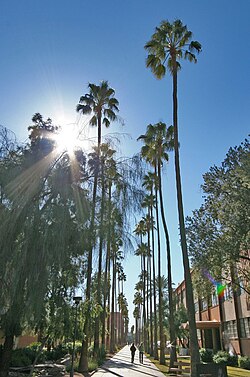
For generations of students and visitors, Palm Walk has served as a defining visual symbol of the Arizona State University Tempe campus. What began as a simple effort to beautify the grounds of a small teachers' college has evolved into a historic landmark that marks the growth and transformation of the university.
The Origins of the Walk
The creation of Palm Walk was driven by Arthur John Matthews, the president of Tempe Normal School, as part of an early campus beautification initiative. While popular tradition often cites 1916 as the planting date, historical records are less definitive. Estimates suggest the trees were planted between 1916 and 1919, with specific purchase orders for palms appearing in 1917 and 1918.
Initially, the trees were concentrated at the northern end of the walk near the original Normal School campus. As the college expanded, additional trees were planted further south. The final additions were made in 1930 or during the 1930s, resulting in smaller trees at the southern end of the route compared to the older, larger specimens in the north.
Historically, Palm Walk followed the former alignment of Normal Avenue and served as the eastern boundary of the main campus. Its significance extended beyond aesthetics; in earlier years, it was a ceremonial route where students paraded south toward Goodwin Stadium during commencement ceremonies.
The Evolution of a Name
The landmark was not always known by its current title. A 1926 school catalog referred to the area as "College Palms," and by 1932, the name was shortened to "The Palms." The first official university record using the term "palm walk" appeared in a pamphlet published in 1967.
The Transition to Date Palms
As the original Mexican fan palms approached a century of growth, they neared the end of their expected lifespan, despite scientific evidence suggesting such trees can live up to five hundred years. By 2013, ASU's grounds services department began planning a phased replacement of the aging palms.
The replacement process faced a significant engineering challenge: a utility tunnel running beneath the mall prevented the use of heavy cranes. This restriction meant that any new trees had to be small enough to be installed without heavy machinery.
By 2016, the university shifted its strategy from replacing the Mexican fan palms with more of the same species to installing date palms. This change was made to provide a larger shade canopy for students and to allow for the harvesting of fruit. ASU was already experienced with date palms, maintaining a germplasm and a grove of 138 trees at the Polytechnic campus.
In July 2016, the first 35 date palms—measuring approximately 18–20 feet (5.5–6.1 m)—were planted at the southern end of the mall. These trees, sourced from groves in California's Coachella Valley, produce Medjool dates. Although originally planned as a three-phase project extending into 2018, the installation was completed by late 2017.
Key Facts
- Original Species: Mexican fan palms.
- Current Species: Date palms (producing Medjool dates).
- Planting Window: Original trees planted between 1916 and the 1930s.
- Installation Constraint: A utility tunnel beneath the walk prohibited the use of cranes.
- Historical Use: Used for commencement parades leading to Goodwin Stadium.
- Naming History: Evolved from "College Palms" (1926) to "The Palms" (1932) to "Palm Walk" (1967).
| Feature | Original Palms | Replacement Palms |
|---|---|---|
| Species | Mexican fan palm | Date palm |
| Primary Benefit | Campus boundary/Aesthetics | Increased shade and fruit |
| Planting Era | 1916–1930s | 2016–2017 |
| Fruit Produced | None (commercial) | Medjool dates |
Frequently Asked Questions
When was Palm Walk first planted?
While often cited as 1916, the exact date is not definitive. Estimates range from 1916 to 1919, with records of palm tree purchases in 1917 and 1918.
Why were the original palms replaced?
The original Mexican fan palms were reaching the end of their expected lifespan as they approached 100 years of age.
Why did ASU switch to date palms instead of Mexican fan palms?
Date palms were chosen because they provide a larger shade canopy for students and produce harvestable Medjool dates.
What prevented the use of cranes during the replanting process?
A utility tunnel runs directly underneath the mall, making it impossible to use cranes for installing larger trees.
What was the original purpose of Palm Walk?
It began as a beautification project by President Arthur John Matthews and served as the eastern boundary of the campus, as well as a route for commencement parades.