
Pan Flute Acoustics and Construction
The pan flute is a captivating instrument that transforms a simple stream of air into a melodic experience. As an end-blown flute, it produces sound when a player blows across the open top of a resonating tube, creating a vibration that resonates through the pipe. Unlike many other wind instruments, the pan flute relies on a series of closed-end tubes of varying lengths to produce different pitches.
Key Facts
- The pan flute uses tubes stopped at one end, producing a note an octave lower than an open pipe of the same length.
- Frequency and tube length are inversely proportional.
- Tuning is achieved using materials like beeswax, cork, rubber stoppers, pebbles, or corn kernels.
- The ratio of the tube's diameter to its length significantly affects the instrument's timbre.
- The theoretical length of a pipe is calculated using the speed of sound (343 m/s).
The Physics of Sound Production
At its core, the pan flute operates on the principle of the fundamental frequency, which is the lowest frequency at which a tube vibrates. This frequency is determined primarily by the length of the tube. In cylindrical tubes, blowing harder can produce an overblown harmonic register approximately a 12th above the fundamental; however, if the tube has a decreasing taper, this jump can approach an octave (an 8th).
The relationship between pitch and length is mathematical. In a chromatic scale, which consists of 12 notes per octave, each half-step is calculated by multiplying the frequency by the 12th root of 2. This allows makers to determine the precise length of every pipe once the length of a single reference pipe is known.
Calculating Pipe Length
To determine the theoretical length (L) of a pipe, makers use the formula L = (c / f) / 4, where c represents the speed of sound (343 m/s) and f represents the desired frequency in hertz. This can be simplified to the equation: Length of pipe (cm) × Frequency (Hz) = 8575.
In practice, internal air compression can cause the pitch to sound flat. To compensate, makers often make the tube slightly shorter or use a more precise calculation: multiplying the bore diameter by 0.82 and subtracting that value from the total tube length. This adjustment accounts for internal compression and the fact that the player's lips partially cover the voicing hole.
Construction and Tuning Methods
The materials used for tuning often depend on the regional style of the instrument. In traditional South American styles, small pebbles or dry corn kernels are placed at the bottom of the pipes to fine-tune the pitch. In contrast, contemporary makers of curved Romanian-style panpipes typically use beeswax, applied with special tools, to adjust new instruments.
For those requiring quicker adjustments, corks and rubber stoppers are preferred as they can be moved more easily than wax or pellets.
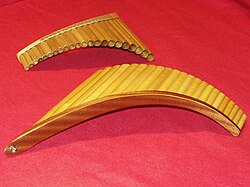
The Role of Bore Diameter
The timbre, or tone color, of the pan flute is heavily influenced by the ratio of the tube's inner diameter to its length. A typical tone is achieved when the diameter is 1/10 of the length. Generally, a range between 1/7 and 1/14 is acceptable. A narrower tube produces a "reedy" sound, while a wider tube results in a "flutey" tone.
| Feature | Detail/Formula | Effect on Sound |
|---|---|---|
| Tube End | Stopped (Closed) | Note is one octave lower than open pipe |
| Length Formula | L = (c / f) / 4 | Determines fundamental frequency |
| Bore Ratio (1/7) | Wide diameter | "Flutey" tone |
| Bore Ratio (1/14) | Narrow diameter | "Reedy" tone |
| Tuning Materials | Wax, cork, pebbles, corn | Corrects pitch and flat notes |
Frequently Asked Questions
Why are pan flute tubes closed at one end?
Closing one end of the tube reflects the standing wave, which allows the instrument to produce a note an octave lower than an open pipe of the same length.
How do makers adjust the pitch of a pipe?
Makers use various materials to change the effective length of the tube. This includes adding beeswax, corks, rubber stoppers, or even pebbles and corn kernels to the bottom of the pipe.
What happens to the sound if the tube is very narrow?
A tube with a narrow bore diameter (closer to 1/14 of its length) will produce a sound described as "reedy." Conversely, a wider tube produces a "flutey" sound.
How does temperature affect the pan flute?
Because air density and temperature influence the speed of sound, tiny adjustments to the fundamental pitch are often necessary to keep the instrument in tune.
What is the difference between cylindrical and tapered tubes?
In cylindrical tubes, the overblown harmonic register is near a 12th above the fundamental. In tubes with a decreasing taper, this jump can be reduced to an octave (an 8th).