
Parabolic Solar Reflectors: High-Efficiency Solar Cooking Technology
Solar cooking leverages the power of the sun to provide a sustainable alternative to traditional fuels. Among the various designs available, parabolic reflectors stand out for their ability to concentrate sunlight into a single, intense point of heat. This capability allows them to reach temperatures comparable to gas or charcoal grills, making them highly effective for rapid cooking and water heating.
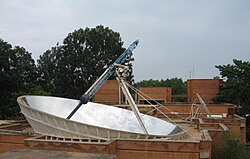
These systems are widely adopted globally, particularly in India and China, where hundreds of thousands of families utilize them. Beyond individual households, large-scale institutional projects demonstrate the scalability of this technology. For example, the Solar Bowl in Auroville, India, is capable of preparing two meals daily for 1,000 people.
Key Facts
- High Efficiency: Some advanced parabolic designs achieve solar energy efficiencies exceeding 90%.
- Environmental Impact: Certain projects in China abate between 1 to 4 tons of carbon dioxide annually, earning carbon credits via the Gold Standard and Clean Development Mechanism (CDM).
- Rapid Heating: Vacuum tube technology can reduce cooking times to as little as 20 minutes.
- Precision: Paraboloids focus parallel rays of light to a single point, provided the axis of symmetry is aimed at the sun.
Paraboloidal Reflectors
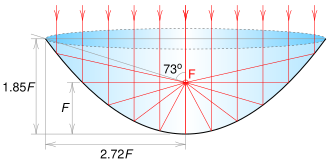
A paraboloid is a compound curve created by rotating a parabola. Because of its geometry, any object placed at the focal point receives highly concentrated sunlight. While these reflectors are superior in performance, they are more difficult to construct by hand than single-curve reflectors. To simplify production, many are built using small segments of single curves that together approximate a compound curve.
Manufacturing Techniques
Creating a perfect paraboloid from flat sheets is challenging. However, a technique involving rotating furnaces can be used. By rotating a liquid-filled container at a constant speed, centrifugal force creates a depression in the liquid that is an exact paraboloid. If the material solidifies during rotation, the resulting shape is a perfect reflector, a method also employed in the creation of astronomical telescope mirrors.
The Scheffler Cooker
Invented by Wolfgang Scheffler, the Scheffler cooker uses a large paraboloidal reflector that rotates at 15 degrees per hour to compensate for the Earth's rotation. The cooking vessel remains stationary at the focus on the axis of rotation.
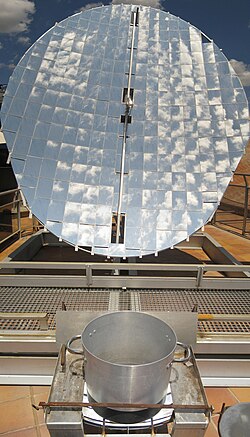
To account for seasonal changes in the sun's declination, the reflector must be tilted. Because tilting a rigid paraboloid would move the focus away from the pot, the Scheffler reflector is flexible. It is typically composed of small plane sections, such as glass mirrors joined by flexible plastic, allowing the shape to be adjusted to keep the focus stationary.
Optimizing the Center of Mass
For ease of movement, reflectors are often designed so their center of mass coincides with their focal point. For an axially symmetrical reflector of uniform thickness, this occurs when the depth (from vertex to rim) is 1.8478 times the focal length. In this configuration, the rim radius is 2.7187 times the focal length, and the angular radius from the focal point is 72.68 degrees.
Alternative Reflector Designs
Parabolic Troughs
Parabolic troughs use a single curve to concentrate sunlight along a focal line rather than a point. They are generally aligned east-west, with food arranged along the horizontal focal line. While simpler to build and requiring less frequent tracking (often only needing seasonal tilt adjustments), they are less efficient than paraboloids.
To achieve a point focus using troughs, two perpendicular parabolic troughs can be used. The first directs light to a line, and the second focuses that line into a point. This design is safer for the eyes as light is directed downward, though it requires more material and suffers from higher light loss due to double reflection.
Spherical Reflectors
Spherical reflectors are easier to manufacture but suffer from spherical aberration, meaning they cannot produce a perfect point focus. However, if the rim radius is small relative to the radius of curvature, the reflector closely approximates a paraboloid with a focal length equal to half the radius of curvature.
Vacuum Tube Technology
Evacuated tube cookers utilize a double-walled borosilicate glass tube with a vacuum seal. This vacuum serves as both a high-performance insulator and a "super" greenhouse, preventing heat loss. The interior is lined with materials like copper, stainless steel, or aluminum nitrile to maximize heat absorption.
These systems often include external reflectors to capture more energy. In some Indian models, energy storage devices are integrated at the bottom of the tube, allowing heat to be stored for cooking or warming food during the night.
Summary of Solar Reflector Types
| Reflector Type | Focus Type | Complexity | Key Advantage |
|---|---|---|---|
| Paraboloidal | Point | High | Maximum heat concentration |
| Parabolic Trough | Line | Low | Simple construction |
| Spherical | Approximate Point | Low | Easier to manufacture |
| Vacuum Tube | Internalized | Medium | Extreme insulation and speed |
Frequently Asked Questions
What is the main difference between a paraboloid and a parabolic trough?
A paraboloid concentrates sunlight to a single point, providing very high temperatures, whereas a parabolic trough concentrates sunlight along a line, which is simpler to build but generally less efficient.
How does a Scheffler cooker handle the Earth's rotation?
The Scheffler cooker uses a mechanical system to rotate the reflector at 15 degrees per hour, ensuring the sunlight remains focused on the cooking vessel throughout the day.
What is spherical aberration in solar reflectors?
Spherical aberration is the failure of a spherical mirror to focus all incoming parallel light rays to a single point, unlike a parabolic mirror which does so perfectly.
Why are vacuum tube cookers so fast?
They use a vacuum between two layers of borosilicate glass to eliminate heat loss through conduction and convection, acting as a powerful insulator that traps thermal energy efficiently.
Can solar cookers be used at night?
While they cannot collect energy at night, some vacuum tube systems in India feature energy storage devices at the base to store heat for nighttime use.