
Pencil Beams in Optics and Radiation Technology
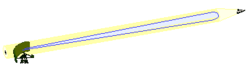
In the fields of optics and physics, a pencil beam (or a pencil of rays) is a geometric construct used to describe a highly concentrated stream of electromagnetic radiation or charged particles. Typically taking the form of a cone or a cylinder, these narrow beams allow scientists and engineers to direct energy with extreme precision across various technological applications.
Key Facts
- Pencil beams are geometric constructs consisting of a pencil of half-lines.
- They typically manifest as cylindrical or conical shapes.
- Phased array antennas use beamforming to create extremely thin pencil beams for tracking.
- In electron optics, these beams enable a deep depth of field in microscopy.
- Medical radiation therapy utilizes pencil beam scanning for targeted treatment.
Applications in Antenna Technology and Radar
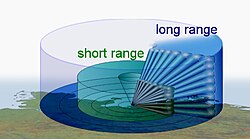
Antennas that can strongly bundle signals in both azimuth (horizontal angle) and elevation (vertical angle) are categorized as pencil-beam antennas. A primary example is the phased array antenna, which can generate an exceptionally thin beam. This capability is essential for tracking radar, utilizing a process called beamforming to steer and focus the signal.
When these beams are used to scan an area, they move in a sweeping motion to detect or track targets with high angular resolution.
Optical and Electron Beam Precision
In classical optics, the way a lens focuses light is often described through pencils of rays. While conical and cylindrical pencils are common, optics also accounts for astigmatic pencils, where the beam does not converge to a single point due to asymmetrical focusing.
This precision extends to electron optics. Scanning electron microscopes employ narrow pencil beams to achieve a deep depth of field, allowing for high-resolution imaging of specimen surfaces at various depths.
Medical and Imaging Radiation
Pencil beam technology is critical in the delivery of ionizing radiation for cancer treatment. Whether using photons or charged particles—such as in proton therapy and electron therapy machines—radiation is often delivered via pencil beam scanning to target tumors accurately.
Similarly, backscatter X-ray imaging utilizes a pencil beam of X-ray radiation. By scanning the beam over an object, the system creates an intensity image based on Compton-scattered radiation, which is the scattering of a photon by a charged particle, usually an electron.
Summary of Pencil Beam Applications
| Field | Technology/Tool | Primary Function |
|---|---|---|
| Radar/Telecom | Phased Array Antennas | Target tracking via beamforming |
| Optics | Lenses | Focusing light (conical, cylindrical, astigmatic) |
| Microscopy | Scanning Electron Microscope | Achieving deep depth of field |
| Medicine | Proton/Electron Therapy | Targeted ionizing radiation delivery |
| Imaging | Backscatter X-ray | Creating images via Compton-scattered radiation |
Frequently Asked Questions
What is a pencil beam in geometric terms?
In geometry, a pencil beam is a construct of half-lines used to describe a narrow portion of a beam of charged particles or electromagnetic radiation, usually shaped as a cylinder or a cone.
How does beamforming relate to pencil beams?
Beamforming is the process used by antennas, such as phased arrays, to strongly bundle signals in azimuth and elevation to create a thin, directed pencil beam for tracking purposes.
What are astigmatic pencils in optics?
Astigmatic pencils are a specific type of ray pencil in optics that differ from standard conical or cylindrical pencils, typically occurring when light does not focus to a single point.
How is pencil beam scanning used in medicine?
It is used in radiation therapy (including proton and electron therapy) to deliver ionizing radiation precisely to a targeted area within the body.
What role does a pencil beam play in X-ray imaging?
In backscatter X-ray imaging, a pencil beam scans an object to produce an intensity image based on the radiation that has been Compton-scattered.