
Personal Computer History: From Mainframes to the World Wide Web
In June 1949, a British newspaper called The Star speculated that computers—then massive machines like the EDSAC—might one day be accessible to common people to help with bookkeeping and income taxes. At the time, this was mere speculation. For decades, computing was the domain of massive mainframes and highly trained specialists. However, a series of breakthroughs in semiconductor technology eventually shrunk the "brain" of the computer, bringing it from the laboratory into the home.
The Foundations of Single-User Computing
Before the personal computer (PC) existed, early experimental machines like the ENIAC (1946) could be operated by a single trained attendant. This interactive mode predated batch programming and time-sharing systems. By the 1950s and 60s, computers designed for engineering and instrumentation, such as the Bendix G15, LGP-30, and the Soviet MIR series, allowed for single-person operation.
By the early 1970s, researchers in academic institutions could use systems interactively for long periods, though the cost remained far too high for individual ownership.
The Semiconductor Revolution of the 1960s
The birth of the PC was driven by advances in semiconductor technology—the use of conductive materials to create electronic components. Key milestones included:
- 1959: Robert Noyce developed the silicon integrated circuit (IC) chip.
- 1959: Mohamed Atalla and Dawon Kahng developed the metal–oxide–semiconductor (MOS) transistor.
- 1964: RCA commercialized the MOS integrated circuit.
- 1968: Federico Faggin developed the silicon-gate MOS integrated circuit.
These innovations culminated in 1971 with the Intel 4004, the first single-chip microprocessor (a central processing unit contained on a single integrated circuit). This made computers cheap enough for individuals and small businesses to own.
In 1968, Douglas Engelbart delivered the "Mother of All Demos," showcasing early versions of e-mail, hypertext, word processing, video conferencing, and the computer mouse. While these features became PC staples, they initially required expensive mainframe support.
The 1970s: The Rise of the Microcomputer
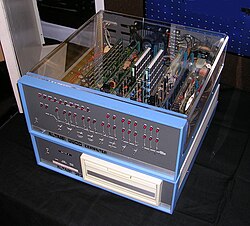
Early microcomputers were often sold as kits for hobbyists, requiring users to enter instructions via toggle switches and view output via lamps. To be practical, users had to add peripherals like keyboards and displays.
The Micral N (1972) was the first commercial non-kit microcomputer based on the Intel 8008. Around the same time, the Datapoint 2200 established a CPU design that would eventually form the basis of the x86 architecture used in the original IBM PC.
Pioneering Portables and GUIs
In 1973, IBM developed the SCAMP, a portable prototype that emulated the IBM 1130 minicomputer to run APL (A Programming Language). Because it brought APL performance to a single-user portable device, PC Magazine later called it the world's first personal computer. This led to the IBM 5100 in 1975.
Other significant 1973 developments included the MCM/70, the first personal desktop microcomputer, and the Xerox Alto. The Alto introduced the Graphical User Interface (GUI), which replaced text commands with visual elements, later inspiring the Macintosh and Windows.
The Microcomputer Revolution
The Altair 8800, released in 1974 by MITS, is widely credited with sparking the microcomputer revolution. It used the Intel 8080 processor and the S-100 bus, and it featured the first product from Microsoft: Altair BASIC.
In 1976, Steve Jobs and Steve Wozniak introduced the Apple I. Unlike other kits, it was sold as a pre-assembled circuit board to appeal to users beyond electronics hobbyists.
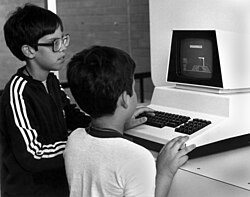
By 1977, the "1977 Trinity" arrived, bringing mass-market, ready-assembled computers to the public: the Commodore PET, the Apple II, and the TRS-80.
The 1980s: Home Computing and Standardization
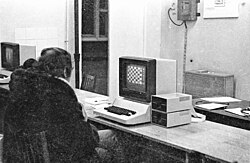
The early 1980s saw a surge in home computers used for gaming and productivity. These often connected to home televisions and featured limited color graphics. Popular models included the Sinclair ZX series (specifically the ZX Spectrum), the Commodore 64, and the NEC PC-98.
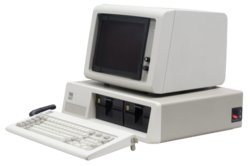
On August 12, 1981, IBM released the IBM 5150. It used the Intel 8088 chip and MS-DOS. Its open architecture encouraged third-party software and hardware, setting the global standard for PC design.
Workstations and the Macintosh
While home computers grew, high-performance workstations emerged for business, featuring multitasking operating systems and large disk storage. Eventually, the line between home and business computers blurred as both adopted similar processors and networking capabilities.
In 1984, Apple launched the Macintosh, the first successful mass-market mouse-driven computer using a "WIMP" (Windows, Icons, Menus, and Pointers) interface. Through a partnership with Adobe, the Macintosh also pioneered desktop publishing via the LaserWriter printer and Aldus PageMaker.
The 1990s and the Modern Era
The final piece of the puzzle arrived in 1991 with the public release of the World Wide Web. The combination of powerful PCs, high-resolution graphics, and Internet infrastructure transformed the computer from a productivity tool into a gateway for global information, from online encyclopedias to video distribution.
Key Facts
- First Microprocessor: The Intel 4004, released in 1971.
- The 1977 Trinity: Commodore PET, Apple II, and TRS-80.
- IBM PC: The IBM 5150 (1981) established the open architecture standard.
- GUI Pioneer: The Xerox Alto (1973) inspired modern visual interfaces.
- Mass Market Success: The Commodore 64 sold 17 million units; the NEC PC-98 sold over 18 million.
| Computer | Year | Key Feature/Contribution | Processor/Tech |
|---|---|---|---|
| Altair 8800 | 1974 | Sparked microcomputer revolution | Intel 8080 |
| Apple II | 1977 | Part of the "1977 Trinity" mass market | Pre-assembled |
| IBM 5150 | 1981 | Open architecture standard | Intel 8088 |
| Macintosh | 1984 | Successful mass-market GUI/Mouse | Motorola 68000 |
Frequently Asked Questions
What was the "1977 Trinity"?
The "1977 Trinity" refers to the Commodore PET, the Apple II, and the TRS-80. These three machines were the first successfully mass-marketed, ready-assembled personal computers, shifting the focus from hardware assembly to software applications.
Which computer is considered the first personal computer?
Opinions vary: the Altair 8800 is often cited as the first commercially successful PC, while PC Magazine designated the 1973 IBM SCAMP as the world's first personal computer due to its portable, single-user APL emulation.
How did the Xerox Alto influence modern computers?
The Xerox Alto developed a Graphical User Interface (GUI), which replaced text-based commands with visual elements. This design served as the primary inspiration for the Apple Macintosh and Microsoft Windows.
What is a microprocessor and why was it important?
A microprocessor is a central processing unit (CPU) contained on a single integrated circuit. Its development, starting with the Intel 4004 in 1971, made computers small and affordable enough for individuals and small businesses to own.
What was the significance of the IBM 5150's open architecture?
IBM encouraged the development of third-party software and peripherals for the 5150. This open approach created a mass-market standard for PC design that influenced the industry for decades.