
Phospholipids and the Architecture of Biological Membranes
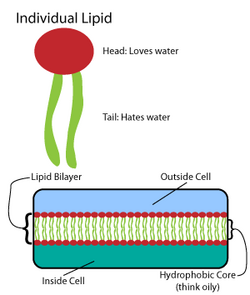
At the core of every living cell lies a sophisticated boundary that separates the internal machinery of life from the external environment. This boundary is primarily constructed from phospholipids, a specialized class of amphiphilic molecules. An amphiphilic molecule is one that possesses both a hydrophilic (water-attracting) polar head and a lyphophilic (water-repelling) non-polar tail. This dual nature is the fundamental driver behind the formation and function of biological membranes.
The Structure of the Lipid Bilayer
Because of their amphiphilic properties, phospholipids naturally organize themselves into a lipid bilayer. This structure consists of two parallel sheets of lipids. In each sheet, the lyphophilic chains are positioned on the same side. When these two sheets stack, the lyphophilic chains face inward, touching each other, while the polar groups face outward toward the surrounding aqueous media.
The result is a biological sandwich: a non-polar interior region shielded by two polar exterior surfaces. This arrangement is critical for maintaining the integrity of the cell and controlling what enters and exits.
Beyond Phospholipids: Membrane Composition
While phospholipids are the primary building blocks, biological membranes are complex mixtures. Other essential constituents include cholesterol and glycolipids. These additional molecules are integrated into the bilayer to modify its physical and biological properties, influencing factors such as fluidity and stability.
Interactions with Other Amphiphilic Compounds
The unique environment of the lipid bilayer makes it susceptible to interaction with other amphiphilic substances. These interactions can alter the membrane's physical behavior or, in some cases, disrupt it entirely.
Pepducins and Membrane Insertion
Pepducins are amphiphilic compounds that interact strongly with biological membranes. They function by inserting their hydrophobic (water-fearing) portion into the lipid membrane while keeping their hydrophilic portion exposed to the aqueous medium.
Aβ Proteins and Toxic Fibrils
Certain proteins, such as Aβ proteins, form antiparallel β sheets that are strongly amphiphilic. These proteins aggregate into toxic oxidative Aβ fibrils. These fibrils are composed of amphiphilic 13-mer modular β sandwiches separated by reverse turns. For the small plaque-forming Aβ fragments (consisting of 40 or 42 amino acids), hydropathic waves provide the most optimized description of their aggregative nature.
Antimicrobial Peptides (AMPs)
Antimicrobial peptides are another critical class of amphiphilic molecules. Big data analysis indicates that amphipathicity is the primary characteristic that distinguishes AMPs with anti-gram-negative bacteria activities from those without. Generally, higher amphipathicity increases the likelihood that an AMP will possess dual antibacterial and antifungal activities.
Key Facts
- Phospholipids are the main components of biological membranes due to their amphiphilic nature.
- The lipid bilayer consists of a non-polar interior sandwiched between two polar outer layers.
- Cholesterol and glycolipids are secondary constituents that alter membrane properties.
- Pepducins alter membrane behavior by inserting their hydrophobic parts into the bilayer.
- Aβ fibrils are formed by the aggregation of amphiphilic β sheets.
- AMPs with higher amphipathicity are more likely to exhibit both antibacterial and antifungal properties.
| Molecule/Compound | Primary Role or Effect | Key Characteristic |
|---|---|---|
| Phospholipids | Main membrane structural component | Forms lipid bilayers |
| Cholesterol/Glycolipids | Modifies physical/biological properties | Integrated membrane constituents |
| Pepducins | Alters or disrupts membrane behavior | Hydrophobic insertion |
| Aβ Proteins | Forms toxic oxidative fibrils | Antiparallel β sheets |
| Antimicrobial Peptides | Antibacterial/Antifungal activity | High amphipathicity |
Frequently Asked Questions
What makes a molecule amphiphilic?
A molecule is amphiphilic if it contains both a hydrophilic (polar) region that attracts water and a lyphophilic (non-polar) region that repels water.
How is a lipid bilayer formed?
It forms when two layers of phospholipids stack so that their lyphophilic chains face each other in the center, while their polar groups face the aqueous environment on the outside.
What is the role of cholesterol in biological membranes?
Cholesterol, along with glycolipids, acts as a constituent that provides biological membranes with specific physical and biological properties distinct from those provided by phospholipids alone.
How do antimicrobial peptides (AMPs) fight bacteria?
AMPs utilize their amphipathicity to interact with membranes; higher levels of amphipathicity are specifically linked to better antibacterial and antifungal dual activities, including activity against gram-negative bacteria.
What are Aβ fibrils?
Aβ fibrils are toxic oxidative aggregates formed by amphiphilic Aβ proteins that organize into antiparallel β sheets and 13-mer modular β sandwiches.