
Pineapple: History, Cultivation, and Global Impact of Ananas comosus
The pineapple, known scientifically as Ananas comosus, is more than just a tropical delicacy; it is a botanical marvel with a rich history of global trade and cultural significance. A member of the Bromeliaceae family, this fruit is a collective berry that has evolved from the river drainages of South America to become a staple of international commerce.
From its early domestication by ancient civilizations to the industrial innovations of the 20th century, the pineapple has transitioned from a rare luxury for European royalty to a widely available supermarket commodity.

Key Facts
- Scientific Name: Ananas comosus.
- Origin: The Paraná–Paraguay River drainages between southern Brazil and Paraguay.
- Primary Cultivar: "Smooth Cayenne" and its descendants (such as MD-2) dominate global production.
- Major Producers: Costa Rica, the Philippines, Indonesia, Brazil, and China.
- Unique Use: Beyond food, the leaves are used to produce piña textiles in the Philippines.
Botanical Classification and Taxonomy
The pineapple belongs to the order Poales and the family Bromeliaceae. It is a monocot, meaning it is a flowering plant with a single cotyledon. While the species A. comosus is the most prominent, it exists in several varieties distributed across the Americas:
- var. bracteatus: Found in Brazil, Bolivia, Argentina, Paraguay, and Ecuador.
- var. comosus: Distributed from Costa Rica to Paraguay.
- var. erectifolius: Found in Peru, Ecuador, Colombia, Venezuela, northern Brazil, and French Guiana.
- var. parguazensis: Found in Colombia, Venezuela, northern Brazil, Guyana, and French Guiana.
![1772 illustration of an Ananas comosus pineapple which was given the early scientific name of Cardus brasilianus folius aloes by Banhius in 1623[34]](/images/34/29/3429a5a3bd4afe806a3cb2f149ca05567e5d74cd0594b6cd8bd6b045ef7b5afa.jpg)
The History of the Pineapple
Precolonial Cultivation
Archaeological evidence suggests the pineapple was cultivated as early as 1200–800 BC in Peru and between 200 BC and 700 AD in Mexico by the Mayas and Aztecs. By the late 1400s, it was a staple food for Native Central and South Americans.
European Encounter and Introduction
Christopher Columbus first encountered the fruit in Guadeloupe on November 4, 1493, calling it piña de Indes ("pine of the Indians"). The Portuguese later introduced the fruit to India by 1550, while the Spanish brought the "Red Spanish" cultivar to the Philippines to produce textile fibers.
Cultivation in Europe was initially difficult until Pieter de la Court developed greenhouse horticulture near Leiden in the 17th century. This allowed the fruit to reach the gardens of the English and French elite, including King Louis XV at Versailles in 1733 and Peter the Great in St. Petersburg.
Mass Commercialization
The 19th century saw the rise of the "Smooth Cayenne" cultivar, which became the foundation for most modern production. In the 18th century, the Spanish introduced the fruit to Hawaii (where it is called hala kahiki), but commercial plantations didn't emerge until 1886.
James Drummond Dole, who arrived in Hawaii in 1899, founded a 24-hectare plantation in 1900, eventually creating the Dole Food Company. Innovation followed quickly, such as Henry Ginaca's 1911 invention of an automatic peeling and coring machine.

Modern Production and Varieties
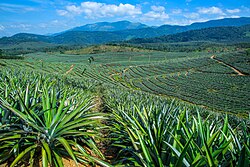
While Hawaii was once the center of the industry, production shifted in the late 20th century due to refrigerated sea transport and global competition. Today, the industry is dominated by a few key cultivars:
- Smooth Cayenne: A cylindrical, high-sugar fruit well-suited for canning.
- MD-2 (Gold Extra Sweet): A modern successor to Smooth Cayenne, widely marketed by Del Monte and Dole.
- Maui Gold: A variety grown on the slopes of Haleakala.
Nutritional Profile and Composition
Pineapples are highly valued for their vitamin content, particularly Vitamin C and Manganese. They are also a source of bromelain, an enzyme used in various industrial and medical processes.
| Nutrient | Amount | % Daily Value (%DV) |
|---|---|---|
| Energy | 50 kcal | - |
| Carbohydrates | 13.12 g | - |
| Sugars | 9.85 g | - |
| Vitamin C | - | 53% |
| Manganese | - | 40% |
| Vitamin B6 | - | 7% |
| Thiamine (B1) | - | 7% |
Culinary and Industrial Uses
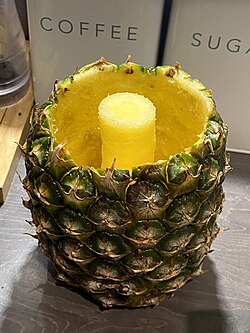
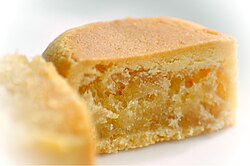
Beyond fresh consumption, pineapples are processed into juices, jams, and sweets. In Asia, they are used in traditional pastries, such as the Fenglisu from Taiwan.
In the Philippines, the plant serves a non-culinary purpose through the production of piña, a traditional textile made from the fibers of the pineapple leaves, used in garments like the barong tagalog.
Frequently Asked Questions
Where did the pineapple originally come from?
The wild pineapple originates from the Paraná–Paraguay River drainages, located between southern Brazil and Paraguay.
What is the most common variety of pineapple grown today?
The "Smooth Cayenne" cultivar and its descendants, such as the MD-2 (Gold Extra Sweet), make up the majority of global production.
Who was James Dole?
James Dole was a key promoter of the Hawaiian pineapple industry who founded the Dole Food Company in 1900.
Can pineapples be used for anything other than food?
Yes, in the Philippines, fibers from the leaves of certain pineapple cultivars are used to create a high-quality textile known as piña.
Which countries are the top producers of pineapples?
According to FAOSTAT, the leading producers include Costa Rica, the Philippines, Indonesia, Brazil, and China.