
Plant Photoperiodism and the Science of Flowering
For decades, botanists believed that the amount of daylight was the primary trigger for plants to bloom. In 1920, W. W. Garner and H. A. Allard published their findings on photoperiodism—the physiological reaction of organisms to the length of night or day. While they initially focused on daylight, later research revealed a surprising truth: the length of the night is actually the controlling factor in flowering.
This biological mechanism allows plants to sense seasonal changes, ensuring they flower at the optimal time of year for pollination and seed production. By utilizing internal clocks and specialized proteins, plants can distinguish between the subtle shifts in darkness that occur between spring, summer, and autumn.
Key Facts
- Night length, not day length, is the critical factor that triggers flowering in photoperiodic plants.
- Phytochromes and cryptochromes are the primary photoreceptor proteins used to sense light.
- Pfr is the active form of phytochrome that stimulates processes like germination and flowering.
- Obligate plants strictly require a specific night length to flower, while facultative plants are simply more likely to flower under certain conditions.
- Day-neutral plants flower based on age or other environmental cues rather than light cycles.
The Biological Machinery: Photoreceptors and Rhythms
Flowering angiosperms (flowering plants) rely on a circadian rhythm—an internal 24-hour biological clock—working in tandem with photoreceptor proteins to measure the photoperiod.
Phytochrome: The Red-Light Switch
Phytochrome exists in two interconvertible forms: Pr (inactive) and Pfr (active). During the day, red light converts Pr into Pfr, which stimulates branching, germination, and flowering. Conversely, far-red light (common in shaded areas) converts Pfr back to Pr, inhibiting these processes. At night, Pfr slowly reverts to Pr through a process called dark reversion.
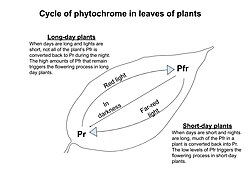
Research on Arabidopsis has shown that red light can actually inhibit flowering; plants exposed to more red light tend to flower later. This is evidenced by the fact that a short-day plant will fail to flower if its dark period is interrupted by a few minutes of artificial red light.
Cryptochromes: The Blue-Light Sensors
While phytochromes handle red light, cryptochromes absorb blue light and UV-A. These proteins help entrain the circadian clock to the external light environment. The abundance of both cryptochromes and phytochromes fluctuates based on day length, allowing the plant to accurately measure the passage of time.
Modern biology suggests that flowering occurs when the active forms of these photoreceptors coincide with specific phases of the plant's internal circadian rhythm.
Classifying Plants by Light Requirements
Plants are categorized based on how they respond to the critical night length required to induce the shoot to produce floral buds instead of leaves.
Long-Day Plants
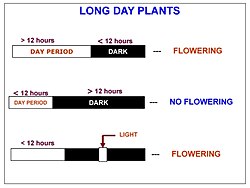
Long-day plants flower when the night length falls below a critical threshold. These typically bloom in late spring or early summer. In the Northern Hemisphere, this aligns with the period leading up to the summer solstice on June 21.
- Obligate: Carnation (Dianthus), Henbane (Hyoscyamus), Oat (Avena).
- Facultative: Pea (Pisum sativum), Barley (Hordeum vulgare), Lettuce (Lactuca sativa), Wheat (Triticum aestivum).
Short-Day Plants
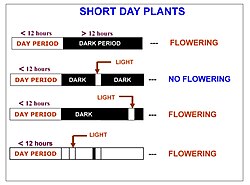
Short-day (or long-night) plants flower only when the night length exceeds a critical threshold. They require a continuous, uninterrupted period of darkness; even a brief pulse of artificial light can reset the clock and prevent flowering. Natural light from the moon or lightning is generally not bright enough to disrupt this process.
- Facultative: Kenaf (Hibiscus cannabinus), Marijuana (Cannabis), Cotton (Gossypium), Rice (Oryza), Sorghum (Sorghum bicolor), Green gram (Vigna radiata), Soybeans (Glycine max).
Dual-Day Length and Day-Neutral Plants
Some plants fall into a dual-day length category: Long-Short-Day Plants (LSDP) flower after long days followed by short days, while Short-Long-Day Plants (SLDP) require the opposite sequence.
Finally, day-neutral plants ignore the photoperiod entirely. They flower based on their developmental age or other stimuli, such as vernalisation (exposure to a period of low temperature). Examples include cucumbers, roses, tomatoes, and Ruderalis (autoflowering cannabis).
Summary of Plant Photoperiodism
| Category | Flowering Trigger | Typical Season | Examples |
|---|---|---|---|
| Long-Day Plants | Night length below critical threshold | Late Spring / Early Summer | Oats, Wheat, Lettuce |
| Short-Day Plants | Night length above critical threshold | Summer / Fall | Rice, Soybeans, Cotton |
| Day-Neutral Plants | Age or temperature (Vernalisation) | Independent of photoperiod | Tomatoes, Roses, Cucumbers |
Frequently Asked Questions
Why are they called "long-day" plants if the night length is what matters?
This terminology persists because early researchers, including Garner and Allard, mistakenly believed daylight was the controlling factor. The names were established before it was discovered that the length of the dark period is the actual trigger.
What happens if a short-day plant is exposed to light at night?
A short-day plant requires a continuous period of darkness to flower. If a pulse of artificial light is introduced in the middle of the night, it can interrupt the process and prevent the plant from flowering.
What is the difference between obligate and facultative photoperiodic plants?
Obligate plants have an absolute requirement for a specific night length to trigger flowering. Facultative plants are more flexible; while they are more likely to flower under certain light conditions, they can still flower under others.
How do plants "know" it is night?
Plants use the conversion of phytochrome from the active Pfr form back to the inactive Pr form through dark reversion. This chemical shift, combined with the plant's internal circadian rhythm, allows it to measure the duration of darkness.
Does photoperiodism affect anything other than flowering?
Yes. Photoperiodism also influences the loss of leaves (abscission) and the seasonal growth of stems and roots.