
Plutonium Sesquisulfide
Plutonium sesquisulfide (Pu2S3) is a complex inorganic compound formed from the interaction of plutonium and sulfur. This material is characterized by its ability to exist in several different structural forms, known as polymorphs, which change based on temperature and chemical composition.
The compound is typically synthesized through two primary chemical pathways. The first is the direct reaction between plutonium metal and sulfur gas: 2 Pu + 3 S → Pu2S3. Alternatively, it can be produced via the thermal decomposition of plutonium disulfide, expressed as: 2 PuS2 → Pu2S3 + S.
Key Facts
- Chemical Formula: Pu2S3.
- Polymorphs: Exists as α, β, and γ phases.
- Thermal Stability: α-Pu2S3 is stable up to 1100 °C.
- Structure: α-Pu2S3 is isostructural with La2S3.
- Composition: β-Pu2S3 is a ternary oxysulfide containing oxygen.
- Melting Point: Varies by stoichiometry, ranging from approximately 1725 °C to 1820 °C.
The Three Polymorphs of Pu2S3
Plutonium sesquisulfide manifests in three distinct phases: α, β, and γ. These phases are distinguished by their stoichiometry—the fixed ratio of atoms in a chemical compound—and their stability at different temperatures.
α-Pu2S3
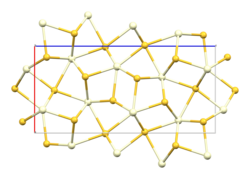
α-Pu2S3 is a stoichiometric compound, meaning it adheres strictly to the Pu2S3 ratio. It is the dominant form of the material at temperatures up to 1100 °C. Structurally, it mirrors rare earth compounds, specifically the La2S3-type structure, and is isostructural with α-Np2S3 and α-Ce2S3. It consists of a framework of PuS7 and PuS8 polyhedra.
The crystals of the α phase are orthorhombic, with a space group of Pnma and lattice parameters of a = 3.97, b = 7.37, and c = 15.45 ∠ (Angstroms). It possesses a density of 8.31 g/cm3.
β-Pu2S3
β-Pu2S3 forms when the α phase decomposes at 1100 °C. Unlike the α phase, β-Pu2S3 is a ternary oxysulfide, meaning it incorporates oxygen into its structure. It exists as a solid solution between Pu10S14O and Pu2S3, with the general formula Pu10S15-xOx.
This phase adopts a complex tetragonal structure (space group I41/acd) that features a Pu4O tetrahedron. In this structure, oxygen and sulfur substitute for one another at a single site. Recorded lattice parameters for one crystal are a = 14.90 and b = 19.78 ∠.
γ-Pu2S3
At 1550 °C, the β phase decomposes into γ-Pu2S3. This phase is substoichiometric, meaning it has a variable composition that typically ranges from Pu3S4 to Pu2S3, with an ideal composition of Pu3S4.
The γ phase adopts a Th3P4-type structure with bcc (body-centered cubic) symmetry and space group I43d. In this arrangement, each plutonium atom is coordinated to eight sulfur atoms. Its lattice parameter varies by stoichiometry: Pu3S4 is approximately a = 8.415 ∠, while Pu2S3 ranges from a = 8.453 to 8.459 ∠.
Thermal Properties and Phase Transitions
The transition between the polymorphs is driven by temperature. As the material is heated, it progresses from the α phase to the β phase, and finally to the γ phase. The melting point of the final phase is highly dependent on its specific stoichiometry.
| Phase | Stability/Transition Temp | Structure Type | Composition Type | Melting Point |
|---|---|---|---|---|
| α-Pu2S3 | Up to 1100 °C | La2S3-type | Stoichiometric | N/A |
| β-Pu2S3 | 1100 °C to 1550 °C | Tetragonal (I41/acd) | Ternary Oxysulfide | N/A |
| γ-Pu2S3 | Above 1550 °C | Th3P4-type | Substoichiometric | 1725 °C (Pu2S3) to 1820 °C (Pu3S4) |
Frequently Asked Questions
How is plutonium sesquisulfide produced?
It can be synthesized by reacting plutonium metal with sulfur gas or through the thermal decomposition of plutonium disulfide (PuS2).
What is the difference between the α and β phases?
The α phase is a stoichiometric binary sulfide stable up to 1100 °C, whereas the β phase is a ternary oxysulfide that incorporates oxygen and forms at higher temperatures.
What determines the melting point of γ-Pu2S3?
The melting point depends on the stoichiometry of the compound; for example, Pu2S3 melts at approximately 1725 °C, while Pu3S4 melts at approximately 1820 °C.
What is the crystal structure of α-Pu2S3?
α-Pu2S3 has an orthorhombic structure of the La2S3-type, characterized by a framework of PuS7 and PuS8 polyhedra.
Is β-Pu2S3 a pure binary sulfide?
No. While early reports suggested it was a binary substoichiometric sulfide, it is now known to be a ternary oxysulfide where oxygen and sulfur substitute for each other.