
Poll Tax Opposition and the Rise of Mass Non-Payment
The transition from a property-value-based payment system to a fixed-rate tax sparked one of the most significant periods of civil unrest in modern British history. Critics argued that the new system was fundamentally unfair, placing a disproportionate and burdensome financial strain on lower-income individuals who previously paid less based on the worth of their homes.
Key Facts
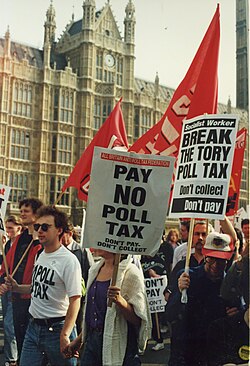
- Mass Mobilization: Protests were led by the All Britain Anti-Poll Tax Federation, the 3D network (Don't Register, Don't Pay, Don't Collect), and hundreds of local Anti-Poll Tax Unions (APTUs).
- The Trafalgar Square Riot: On March 31, 1990, between 70,000 and 200,000 people demonstrated, resulting in 113 injuries and 340 arrests.
- Widespread Defiance: In some regions, up to 30 per cent of former ratepayers refused to pay the tax.
- Police Limitations: South Yorkshire Police stated in November 1990 that arresting all defaulters would be "physically impossible."
The Architecture of Resistance
Opposition to the tax was highly organized. While some efforts were coordinated by national networks, much of the grassroots energy came from Anti-Poll Tax Unions (APTUs)—local groups that operated independently of any specific political party. In Scotland, where the tax was first implemented, these unions pioneered the call for mass non-payment.
As the tax was rolled out in England, the scale of protests grew, eventually escalating into riots. The most severe clash occurred on the eve of the tax's implementation on March 31, 1990. A massive demonstration in Trafalgar Square led to violent confrontations, leaving over 100 police officers requiring medical treatment.
Strategies of Non-Compliance
The resistance moved beyond street protests into a systemic campaign of non-compliance. Anti-poll-tax organizations encouraged citizens to adopt a three-pronged strategy: avoid registering for the tax, contest liability orders (court orders requiring payment) to clog the legal system, and simply refuse to attend court hearings.
This strategy proved effective due to the sheer volume of participants. Local councils found their enforcement measures largely useless against the tide of non-payers. The BBC reported that in certain areas, non-payment rates reached 30 per cent. The situation became so untenable that by November 1990, South Yorkshire Police announced they would refuse to arrest defaulters, even under court instruction, citing the impossibility of processing such a vast number of people.
Political and Legal Consequences
The political response was divided. The Labour Party officially decided against supporting a non-payment campaign during its 1988 annual conference. However, individual members took a different stance. Terry Fields, the Labour MP for Liverpool Broadgreen and a member of the Militant tendency, was imprisoned for sixty days for his refusal to pay. This prompted Labour leader Neil Kinnock to assert that "law makers must not be law breakers."
Cultural Impact and Artistic Protest
The poll tax controversy permeated popular culture, particularly within the punk and electronic music scenes. Various artists used their platforms to encourage defiance of the tax.
| Artist/Group | Work/Contribution | Year |
|---|---|---|
| The Exploited | "Don't Pay The Poll Tax" (The Massacre album) | 1990 |
| Punk Aide | Axe The Tax, Can't Pay Won't Pay, Fuck The Poll Tax | 1989 |
| Oi Polloi & Chumbawamba | Smash the Poll Tax (EP) | N/A |
| The Orchids | "Defy The Law" | N/A |
| Orbital | "Chime" (performed with "no poll tax" hoodies) | 1990 |
From compilation albums like A Pox Upon The Poll Tax to high-profile television appearances on Top Of The Pops, the movement found a loud voice in the arts, mirroring the unrest found in the streets.
Frequently Asked Questions
What were APTUs?
APTUs were Anti-Poll Tax Unions, local organizations that coordinated protests and non-payment campaigns. They were notable for not being aligned with any specific political grouping.
How many people protested at Trafalgar Square in 1990?
Estimates suggest that between 70,000 and 200,000 people participated in the demonstration on March 31, 1990.
Why did the police refuse to arrest poll tax defaulters?
South Yorkshire Police stated that the number of people refusing to pay was so large that it would be physically impossible to arrest all of them, even when ordered by the courts.
Did the Labour Party officially support the non-payment campaign?
No. At its 1988 annual conference, the Labour Party decided against supporting the non-payment campaign, although some individual members, such as Terry Fields, participated regardless.
What was the "3D" network?
3D was a national network that promoted the strategy: "Don't Register, Don't Pay, Don't Collect."