
Portland Protest History: A Legacy of Activism and Civil Unrest
Portland, Oregon, has a deep-rooted tradition of civic engagement and public demonstration. From the earliest organized protests in the mid-19th century to the complex social movements of the modern era, the city has served as a focal point for those seeking political change, social justice, and systemic reform. This history reflects a persistent drive to challenge authority and advocate for marginalized voices.
Key Facts
- First Organized Demonstration: Occurred in 1857.
- Suffrage Milestone: Women's suffrage was established in Oregon in 1912 after five ballot attempts.
- Civil Rights Victory: A 1915 protest against The Birth of a Nation led to a city ordinance banning films that incite racial hatred.
- Unique Event: Vortex I (1970) remains the only state-sponsored rock festival in U.S. history, created to distract from anti-war protests.
- Global Impact: The World Naked Bike Ride, started in 2004, grew to over 10,000 participants by 2019.
Early Activism and the Fight for Suffrage
The roots of Portland's activism stretch back to 1857. By the late 19th century, women began organizing around various social issues, with the temperance movement being particularly active. One of the most significant battles was for women's suffrage (the right to vote). In the early 1870s, Abigail Scott Duniway collaborated with Susan B. Anthony on an extensive speaking tour across the Pacific Northwest.
Duniway employed a non-confrontational strategy, believing that men—who held the voting power—needed to be coaxed rather than driven. Despite the challenges, suffrage was eventually established in 1912. During this same period, the Direct Legislation League worked to introduce direct democracy to the state of Oregon.
Civil Rights and Labor Struggles (1900–1970)
The early 20th century saw a rise in organized resistance against racial injustice. In 1915, Beatrice Morrow Cannady, a founder of the Portland NAACP chapter and staff member at The Advocate, organized protests against the racist film The Birth of a Nation. This effort successfully resulted in a city ordinance prohibiting films intended to incite racial hatred.
Labor disputes also shaped the city's landscape. In the early 1960s, journalists from the Oregonian and the Oregon Journal protested poor labor conditions. They launched an independent publication, The Portland Reporter, and encouraged readers to cancel subscriptions to competing papers. Although the strike involved marches and significant public support, the National Labor Relations Board eventually ruled the strike illegal.
By the 1970s, opposition to the Vietnam War reached a peak. This sentiment had been building since the 1950s, championed by U.S. Senator Wayne Morse, who was one of only two senators to oppose the Gulf of Tonkin Resolution. In 1970, to prevent violent anti-war protests during a planned visit by President Richard Nixon, Governor Tom McCall sponsored a rock festival called Vortex I in Milo McIver State Park.
Racial Justice and Environmentalism (1970s–1980s)
The 1970s and 80s were marked by intense struggles over education and police conduct. In 1970, Superintendent Robert Blanchard implemented a plan to bus Black students to white districts and close schools in Black neighborhoods. The National Black United Front emerged as the primary opposition to these policies.
On April 4, 1981, the Black United Front led a "March Against Racism," drawing approximately 1,500 people. This event followed an incident where police threw dead possums in front of a Black-owned restaurant. The resulting pressure led Oregon voters to approve Ballot Measure 51 in 1982, creating Portland's first public police review committee.
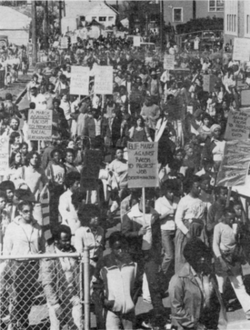
Violence further galvanized the community in 1988 following the murder of Mulugeta Seraw by the East Side White Pride gang. Simultaneously, environmental concerns rose regarding the Trojan Nuclear Power Plant, Oregon's only commercial nuclear facility, which faced protests from its installation in the 1970s until its decommissioning in 1992.
Globalization and Modern Movements (1990s–2010s)
The late 1990s saw Portland's activism intersect with global movements. The 1999 WTO protests in Seattle, which opposed globalization, drew heavily on the experience of "timber wars" veterans from the Pacific Northwest. In 2004, Portland hosted its first World Naked Bike Ride to protest oil dependency, which eventually became the largest of its kind globally.
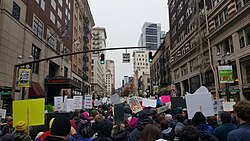
The 2010s brought a surge of diverse demonstrations, including Hands Across Hawthorne (2011) and Occupy Portland (2011). The 2016 election of Donald Trump sparked a series of riots and marches, including the Women's March, the March for Science, and the Trump Free Speech Rally in 2017. These events highlighted a broad spectrum of issues, from immigrant rights and homelessness to police accountability.
Recent Unrest and Contemporary Issues (2020–Present)
The year 2020 was defined by the George Floyd protests, the Indigenous Peoples Day of Rage, and the Red House eviction defense. In March 2021, tensions escalated at the Hatfield U.S. Courthouse, where federal officers used tear gas and impact munitions against protesters. Police also employed "kettling"—a tactic of surrounding and detaining a crowd—to manage the demonstrations.
Other notable recent events include:
- October 2021: Anarchist groups caused an estimated $500,000 in damage to downtown businesses and government buildings.
- November 2021: A riot was declared following the acquittal of Kyle Rittenhouse, resulting in street barricades and damage to the Justice Center.
- Iranian Solidarity: Protests in Pioneer Courthouse Square supporting Mahsa Amini and demanding a free Iran.
- 2024: Pro-Palestinian campus occupations at Portland State University.
- 2025: Continuous protests against ICE at their South Waterfront field office since June.
| Era | Primary Focus | Key Event/Movement |
|---|---|---|
| Late 19th Century | Women's Rights | Suffrage Movement (est. 1912) |
| 1915 - 1960s | Civil Rights & Labor | Anti-racist film protests; The Portland Reporter |
| 1970s - 1980s | Race & Environment | March Against Racism; Trojan Nuclear Plant protests |
| 1990s - 2010s | Globalization & Social Issues | WTO Protests; World Naked Bike Ride; Occupy Portland |
| 2020 - Present | Systemic Justice & Global Politics | George Floyd protests; PSU occupations; ICE protests |
Frequently Asked Questions
What was the first organized demonstration in Portland?
The first organized demonstration in Portland took place in 1857.
How did the 1915 protests against The Birth of a Nation affect city law?
The protests led to the creation of a city ordinance that banned films intended to incite racial hatred.
What was Vortex I and why was it created?
Vortex I was a state-sponsored rock festival held in 1970 at Milo McIver State Park. It was designed by Governor Tom McCall to distract the public from potential violent anti-war protests during President Richard Nixon's visit to the city.
What is "kettling" in the context of Portland protests?
Kettling is a police tactic used to surround a crowd of protesters, detaining them in a confined area to prevent them from blocking traffic or moving further into a city.
What led to the creation of Portland's first public police review committee?
The committee was created via Ballot Measure 51 in 1982, following large-scale demonstrations such as the 1981 "March Against Racism" and incidents of police misconduct.