
PubMed: The Essential Gateway to Biomedical Literature
In the world of medical research, access to peer-reviewed evidence is the cornerstone of clinical practice and scientific discovery. PubMed serves as the primary global portal for this information, providing a free, comprehensive search interface for millions of citations and abstracts. Managed by the United States National Library of Medicine (NLM), it has evolved from a restricted institutional tool into a ubiquitous resource for healthcare professionals, researchers, and students worldwide.
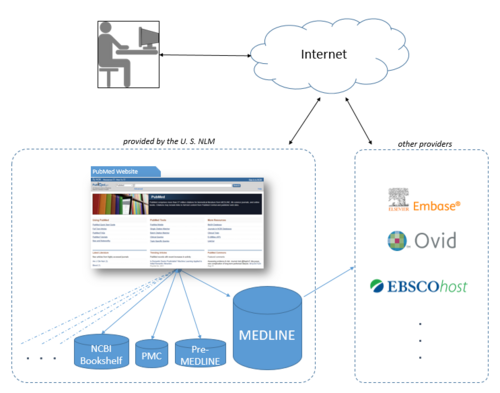
At its core, PubMed provides access to MEDLINE, the premier bibliographic database of life sciences and biomedical information. While MEDLINE is the primary engine, PubMed integrates several other critical resources to provide a holistic view of medical literature.
Key Facts
- Scale: Over 40 million citations and abstracts as of March 15, 2025.
- Historical Reach: Records date back to 1966, with selective entries reaching as far back as 1809.
- Accessibility: Free to the public since June 1997.
- Full-Text Access: Approximately 26.8 million records link to full-text versions, with 10.9 million available for free.
- Growth: An average of nearly one million new records were added annually between 2010 and 2019.
Evolution and History
Before the internet era, accessing MEDLINE (from 1971 to 1997) required specialized computer terminals and phone lines, typically found only in university libraries or institutional facilities. The launch of PubMed in January 1996 revolutionized this process, enabling private, home- and office-based searching.
PubMed was initially released alongside "Internet Grateful Med," a web-based version of the Grateful Med system. By 2001, Grateful Med was entirely replaced by PubMed, which had become the standard interface for the NLM's digital archives.
Content and Integration
While MEDLINE is the primary component, PubMed is an aggregator that includes several other vital data streams:
- Index Medicus: Older references from the print version, dating back to 1951 and earlier.
- PMC Citations: Links to PubMed Central, a free archive of biomedical and life sciences journal literature.
- NCBI Bookshelf: A collection of full-text books and other NLM records.
- NLM Catalog: Detailed information regarding the journals indexed within the system.
The Role of Identifiers: PMID vs. PMCID
Navigating PubMed requires understanding two distinct identification systems. A PMID (PubMed Identifier) is a unique integer assigned to every record in the PubMed database. In contrast, a PMCID (PubMed Central Identifier) is specifically used for works published in PubMed Central, the free-to-access full-text archive.
Advanced Search and User Tools
PubMed has evolved its interface to meet modern user expectations. In 2009, it introduced "telegram" searches—quick, Google-like formulations—and in 2020, it underwent a major domain and design update to enhance functionality.
Secondary Identifiers (SI)
Since July 2005, PubMed has utilized a Secondary Identifier field. This field extracts accession numbers from abstracts to link users to external databases, such as molecular sequence data, chemical compounds, or clinical trial registries like ClinicalTrials.gov (NCT identifiers) and the International Standard Randomized Controlled Trial Number Register (IRCTN identifiers).
Personalization with My NCBI
For frequent users, the My NCBI facility offers a suite of productivity tools, including:
- Saving complex search queries and sets of references.
- Filtering search results for higher precision.
- Configuring automatic email updates for new literature in specific fields.
- Customizing display formats and search term highlighting.
The Ecosystem: Derivatives and Alternatives
The NLM leases MEDLINE data to hundreds of private vendors, including Embase, Ovid, and EBSCO. This open licensing model has fostered a wide array of "PubMed derivatives"—third-party applications that use the eutils-application program interface (API) to provide specialized services.
These derivatives generally fall into categories such as ranking search results (e.g., MedlineRanker) or clustering results by topic and author (e.g., Anne O'Tate). Looking forward, the ZBMed (German National Library of Medicine) has announced plans to develop an internationally supported open-source version of PubMed to further diversify the research infrastructure.
Infrastructure and Reliability
Despite its robustness, the system is not immune to failure. On March 4, 2025, a temporary global outage lasted approximately one day. While services were quickly restored, the event sparked significant discussion among the global research community regarding the reliability and contingency planning for essential scientific infrastructure.
| Feature | Details |
|---|---|
| Primary Database | MEDLINE |
| Managing Body | United States National Library of Medicine (NLM) |
| Total Citations | 40+ Million (as of March 2025) |
| Free Full-Text Articles | 10.9 Million |
| Key Identifiers | PMID (Record) and PMCID (Full-text archive) |
Frequently Asked Questions
What is the difference between PubMed and MEDLINE?
MEDLINE is the actual database of citations and abstracts, while PubMed is the free search engine and interface used to access MEDLINE, along with other NLM records and PMC citations.
How do I find the full text of an article in PubMed?
PubMed provides links to full-text versions for millions of records. Many are available for free via PubMed Central (PMC), while others are accessed through the LinkOut facility, which connects users to their local institutional library holdings.
What is a PMID?
A PMID is a unique integer value assigned to every single record in the PubMed database, serving as a permanent identifier for that specific citation.
Can publishers correct errors in PubMed?
Yes. Since 2016, the NLM has utilized an indexing system that allows publishers to directly correct typos and errors within their indexed articles.
Is PubMed the only way to search MEDLINE?
No. While PubMed is the free public interface, the NLM leases MEDLINE data to various commercial and academic providers such as Ovid and EBSCO, who offer their own proprietary interfaces.