
Puerto Rico 2004 Election Results and Legal Controversies
The 2004 general elections in Puerto Rico were marked by razor-thin margins and a significant legal battle over the interpretation of voter intent. The results, announced by the State Commission of Elections (CEE-PUR) between November 2 and 3, 2004, revealed a deeply divided electorate and a complex struggle for executive and legislative control.
Key Facts
- Aníbal Acevedo Vilá (PPD) won the governorship by a narrow margin of 3,566 votes (0.2%).
- Luis Fortuño (PNP) was certified as the Resident Commissioner with a lead of 11,137 votes (0.49%).
- The New Progressive Party (PNP) secured dominance in both the Senate and the House of Representatives.
- A legal dispute over "mixed votes" reached the Supreme Court of Puerto Rico and the U.S. Court of Appeals.
- Voter turnout for the gubernatorial race was 81.57% of registered voters.
Preliminary Results and Certification
Following the closure of voting colleges on November 2, 2004, the CEE-PUR began computing the totals. By November 3, with 98.3% of the votes (1,970,759) counted, Aníbal Acevedo Vilá of the Popular Democratic Party (PPD) was preliminarily certified as the winner for Governor. Simultaneously, Luis Fortuño of the New Progressive Party (PNP) was certified as Resident Commissioner.
The preliminary certification was signed by electoral commissioners and alternates from the three major parties: Gerardo Cruz (PPD), Brunilda Ortiz (PNP), and Andrés Miranda Rosa (PIP). Because the margins of victory for both the Governor and Resident Commissioner were exceptionally small, Puerto Rican electoral law mandated a formal recount, which commenced on November 9 and concluded by December 28, 2004.
The "Mixed Vote" Controversy
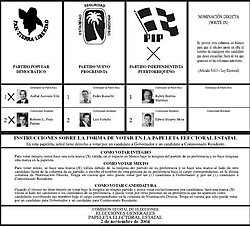
The election was overshadowed by a civil lawsuit filed by Pedro Rosselló against Acevedo Vilá. The dispute centered on ballots where voters had marked a political party emblem (either the PIP or PNP) but had also placed individual marks for candidates from a different party—specifically Acevedo Vilá for Governor and Roberto Prats for Resident Commissioner.
Under the Commonwealth's Electoral Law and CEE Rule 50, this is known as a mixed vote. In this system, marking a party selects that party's default slate of candidates, but voters are permitted to replace specific candidates on that slate with individuals from other parties. The vote for the individual candidate is then deducted from the default candidate of the voter's selected party, ensuring only one vote per office.
Judicial Rulings
The controversy moved through several judicial levels. The Supreme Court of Puerto Rico ruled 4–3 that these mixed votes were valid, noting that the practice had been used in the 1996 and 2000 elections without contest. Meanwhile, the case reached the United States District Court for the District of Puerto Rico, where Judge Daniel Domínguez initially ordered the CEE-PUR to count the votes without adjudicating them to any candidate.
Ultimately, the United States Court of Appeals for the First Circuit ruled in Rosselló-González v. Calderón-Serra that the validity of the ballots was not a federal constitutional issue and should be decided by the Puerto Rico Supreme Court. The Supreme Court affirmed its original decision, and Acevedo Vilá was officially certified as the winner on December 28, 2004.
Election Data Summary
| Office / Body | Winning Candidate/Party | Party Affiliation | Margin/Seats |
|---|---|---|---|
| Governor | Aníbal Acevedo Vilá | PPD | 3,566 votes |
| Resident Commissioner | Luis Fortuño | PNP | 11,137 votes |
| Senate | New Progressive Party | PNP | 17 seats |
| House of Representatives | New Progressive Party | PNP | 32 seats |
Detailed Vote Counts
The gubernatorial race saw Aníbal Acevedo Vilá receive 963,303 votes (48.62%), while Pedro Rosselló received 959,737 (48.44%). Rubén Berríos of the PIP received 54,551 votes (2.75%).
In the race for Resident Commissioner, Luis Fortuño secured 956,828 votes (48.83%) compared to Roberto Prats' 945,691 (48.26%). Edwin Irizarry Mora of the PIP received 56,589 votes (2.89%).
Frequently Asked Questions
What is a mixed vote in Puerto Rican elections?
A mixed vote occurs when a voter selects a political party's default slate by marking the party emblem but chooses to replace specific candidates on that slate by marking individual candidates from other parties.
Why was a recount necessary in the 2004 election?
A recount was required by Puerto Rican electoral law because the margins of victory for the Governor (0.2%) and the Resident Commissioner (0.49%) were extremely small.
Which party controlled the legislature after the 2004 election?
The New Progressive Party (PNP) dominated the legislature, winning 17 seats in the Senate and 32 seats in the House of Representatives.
How did the U.S. Court of Appeals rule on the ballot dispute?
The U.S. Court of Appeals for the First Circuit ruled that the validity of the disputed ballots was not a federal constitutional issue and therefore fell under the jurisdiction of the Supreme Court of Puerto Rico.
When were the winners of the 2004 election inaugurated?
The official winners were inaugurated to four-year terms on January 2, 2005.