
Qi Wireless Charging: The Evolution of Inductive Power Standards
In the modern era of mobile technology, the convenience of cable-free power has become a baseline expectation. At the heart of this shift is Qi (pronounced "chee"), an open standard for inductive charging developed by the Wireless Power Consortium (WPC). By utilizing electromagnetic fields, Qi allows compatible devices—most notably smartphones—to receive power simply by being placed on a charging pad, effective over distances of up to 4 cm (1.6 in).
The name "Qi" is derived from the Chinese word for "life force" or "vital energy," a fitting metaphor for a technology designed to breathe life back into depleted batteries without the need for physical connectors.
Key Facts
- Developer: Wireless Power Consortium (WPC).
- Core Technology: Inductive charging via planar coils.
- Current Version: 2.2.1 (released July 2025).
- Maximum Power: Up to 25W for Qi2; up to 2.2kW for the Ki standard.
- Qi2 Feature: Introduces the Magnetic Power Profile (MPP) for better alignment.
- Adoption: Used by major manufacturers including Apple, Samsung, Google, and Sony.
How Qi Charging Works
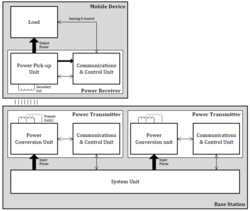
Qi charging relies on the principle of inductive coupling, where electricity is transferred between two coils through a magnetic field. The system is divided into two primary components: the transmitter and the receiver.
The Power Transmitter
The transmitter consists of a power conversion unit and a communications and control unit. The power conversion unit uses a transmitting coil (or array of coils) to generate a magnetic field. The control unit then regulates the power transfer based on the specific requests received from the device being charged.
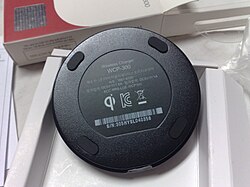
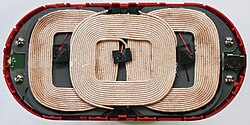
A standard low-power transmitter typically features a flat coil with 20 turns and a soft iron shield to focus the magnetic field. While many start at 140 kHz, transmitters can adjust their frequency (ranging from 105 to 205 kHz) to optimize the connection based on the distance between the coils.
The Power Receiver
The receiver, located inside the mobile device, uses a wire coil (often rectangular) and a magnetic shield. Once the magnetic field from the transmitter induces a current in the receiver coil, the power is passed through a full-wave bridge and filtered by a capacitor before reaching the device's charge controller.
The Evolution of Power Profiles
Since its debut in 2010, the Qi standard has expanded from basic low-power charging to high-capacity industrial applications.
- Baseline Power Profile: Originally the "low power" spec, delivering under 5W.
- Extended Power Profile: Introduced in 2015, supporting speeds up to 15W.
- Medium Power Standard: Currently delivering 30W to 65W, with a roadmap toward 200W for drones and e-bikes.
- Ki Standard: A high-power specification for kitchen appliances, evolving from 1kW in 2015 to 2.2kW in 2024.
The Arrival of Qi2 and Magnetic Alignment
One of the most significant updates is Qi2, which incorporates the Magnetic Power Profile (MPP). Based on Apple's MagSafe technology, MPP uses a ring of permanent magnets to ensure the receiver and transmitter coils are perfectly aligned, reducing energy loss and improving charging efficiency. Devices supporting this feature are identified by a specific "Qi2 in a circle" logo.
Industry Adoption and Market Impact
The journey to ubiquity began in 2012 with the Nokia Lumia 920 and the Samsung Galaxy S3. By 2017, the standard had displaced competitors like Rezence, and Apple integrated Qi into the iPhone 8 and subsequent models.
The ecosystem has expanded beyond phones into automotive integration (Toyota and Lexus) and home furniture (IKEA). Recent milestones include the HMD Skyline becoming the first Android device to support Qi2 MPP (2024), and the Google Pixel 10 Pro XL introducing support for the 25W Qi2 standard in 2025.
| Version | Released | Max Power | Key Improvements |
|---|---|---|---|
| 1.0 | July 2010 | 5 W | Initial standard launch. |
| 1.2 | Oct 2015 | 15 W | Extended Power Profile introduced. |
| 2.0 | April 2023 | 15 W | Introduction of Qi2 and Magnetic Power Profile. |
| 2.2 | April 2025 | 25 W | Support for 25W transfer and optimized power modes. |
| 2.2.1 | July 2025 | 25 W | Official Qi2 25W branding. |
Frequently Asked Questions
What is the difference between Qi and Qi2?
While both use inductive charging, Qi2 introduces the Magnetic Power Profile (MPP), which uses magnets to align the charging coils automatically, improving efficiency and stability compared to the traditional Qi standard.
Can any wireless charger work with any Qi device?
Generally, yes, but charging speeds vary. Some manufacturers use proprietary extensions for fast charging, and Qi2 devices offer the best experience when paired with Qi2-certified magnetic chargers.
What is the Ki standard?
Ki is a high-power wireless standard developed by the WPC for heavy-duty applications, such as kitchen appliances, capable of delivering up to 2.2kW of power.
How far apart can the coils be for Qi to work?
Qi charging is typically most effective when coils are 5 mm apart, but the standard can support distances up to 40 mm (4 cm) depending on the hardware.
Is Qi2 compatible with older MagSafe accessories?
Yes, the Magnetic Power Profile in Qi2 is based on MagSafe technology and is designed to be backwards compatible with MagSafe devices.