
Quedlinburg: The Cradle of the German Reich
Nestled in the heart of Saxony-Anhalt, the town of Quedlinburg stands as a living testament to over a millennium of European history. From its early beginnings as a settlement known as Gross Orden on the eastern bank of the River Bode in the 9th century, Quedlinburg evolved into a pivotal center of political and religious power. Often referred to as the "cradle of the German Reich," the town's legacy is inextricably linked to the rise of the Saxon emperors and the enduring influence of its historic abbey.
The Imperial Foundations
Quedlinburg first entered official records in 922 as part of a donation by King Henry the Fowler (Heinrich der Vogler), with records maintained by the abbey of Corvey. Local legend suggests that in 919, Franconian nobles offered Henry the German crown at Quedlinburg, cementing the town's status as a foundational site of the German state.
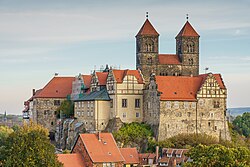
Following Henry's death in 936, his widow, Saint Matilda, established a Frauenstift (a religious community for women) on the castle hill. This collegiate foundation, known as Quedlinburg Abbey, served as an educational center for daughters of the high nobility and a spiritual hub dedicated to praying for the memory of King Henry and subsequent rulers. It was here that the Annals of Quedlinburg were compiled, with the first abbess being Matilda, the granddaughter of King Henry and St. Matilda.
The Imperial Pfalz
The castle complex, initiated by King Henry I and expanded by Emperor Otto I in 936, functioned as an imperial Pfalz (a palace used by the emperor for itinerant governance). The layout was divided by function: the male convent and the Pfalz were situated in the valley—where the Roman Catholic Church of St. Wiperti stands today—while the women's convent occupied the castle hill.
The town's international significance was highlighted in 973 during a Reichstag (Imperial Convention). Emperor Otto I hosted a gathering of nobles from as far as Bulgaria and Byzantium, including Mieszko, duke of Polans, and Boleslav, duke of Bohemia. During this event, Otto introduced his daughter-in-law, the Byzantine princess Theophanu, a marriage intended to foster peace and recognition between the Eastern and Western empires.
Economic Growth and Political Struggle
By 994, Otto III expanded the town's economic capabilities by granting the rights to hold a market, collect taxes, and coin money, establishing the first marketplace north of the castle hill.
In 1426, Quedlinburg joined the Hanseatic League, a powerful commercial and defensive confederation of merchant guilds and market towns. However, this era was marked by friction between the town's desire for independence and the authority of Quedlinburg Abbey. The town sought support from the Bishopric of Halberstadt, but in 1477, Abbess Hedwig and her brothers, Ernest and Albert, successfully suppressed the town's resistance and expelled the bishop's forces. Consequently, Quedlinburg was forced to leave the Hanseatic League and came under the protection of the Electorate of Saxony.
Reformation and Transition
The 16th century brought spiritual change as both the town and the abbey converted to Lutheranism in 1539 during the Protestant Reformation. Political ownership shifted in 1697 when Frederick Augustus I of Poland–Saxony sold his rights to Elector Frederick III of Brandenburg for 240,000 thalers. Despite this, the abbey continued to contest Brandenburg-Prussia's claims throughout the 1700s.
The abbey was eventually secularized in 1802 during the German Mediatisation, and the town became part of the Kingdom of Prussia. Between 1807 and 1813, it was part of the Napoleonic Kingdom of Westphalia, before being integrated into the Prussian Province of Saxony in 1815. Notably, the abbesses of Quedlinburg did not "take the veil" and remained free to marry; the final abbess was the Swedish princess Sofia Albertina, an early advocate for women's rights.
The Dark Era and Modern Recovery
During the Nazi regime, the memory of Henry I was co-opted as a cult of personality by Heinrich Himmler, who viewed himself as the reincarnation of the ruler. The castle and collegiate church were intended to become Nazi shrines, and the cathedral was closed in 1938. The town's dark history during this period includes the presence of subcamps from the Buchenwald and Mittelbau-Dora concentration camps. In a final act of brutality before the war's end, Nazi officials forced 22 inmates from the Langenstein-Zwieberge camp to burn Holocaust records in the local crematory before murdering them.
Following the American occupation, the Protestant bishop returned, church bells were restored, and Nazi symbols were removed. However, the 1980s revealed a separate tragedy: the theft of medieval art from Quedlinburg, which came to light after the death of a US military member.
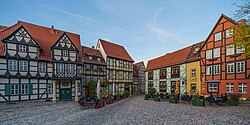
From 1949 to 1990, Quedlinburg was administered within Bezirk Halle in Communist East Germany. Following German reunification in 1990, it became part of the state of Saxony-Anhalt. During the 1980s, Polish restoration specialists helped preserve the town's historic architecture, and today, Quedlinburg is recognized as a center for the restoration of Fachwerk (half-timbered) houses.
Key Facts
- Founded: Existed since the early 9th century; first mentioned as a town in 922.
- Imperial Status: Known as the "cradle of the German Reich" due to King Henry I.
- Religious Hub: Home to Quedlinburg Abbey, a collegiate foundation for noblewomen.
- Economic History: Member of the Hanseatic League from 1426 until 1477.
- Architectural Legacy: A modern center for the restoration of half-timbered (Fachwerk) houses.
| Year/Period | Event | Significance |
|---|---|---|
| 919 | Offer of the German crown to Henry I | Established as "cradle of the German Reich" |
| 936 | Foundation of the Frauenstift | Established Quedlinburg Abbey for noblewomen |
| 973 | Imperial Reichstag | International diplomatic gathering under Otto I |
| 1426 | Joined Hanseatic League | Expanded commercial trade and influence |
| 1539 | Conversion to Lutheranism | Shift during the Protestant Reformation |
| 1802 | Secularization of the Abbey | Transition to the Kingdom of Prussia |
| 1990 | German Reunification | Became part of the state of Saxony-Anhalt |
Frequently Asked Questions
Why is Quedlinburg called the "cradle of the German Reich"?
This title stems from the legend that Franconian nobles offered the German crown to King Henry the Fowler in Quedlinburg in 919.
What was the purpose of Quedlinburg Abbey?
The abbey was a religious community (Frauenstift) founded by Saint Matilda to educate daughters of the higher nobility and to pray for the memory of King Henry and subsequent rulers.
What is a "Fachwerk" house?
Fachwerk refers to half-timbered architecture, a traditional building style where a wooden frame is filled with materials like brick or plaster. Quedlinburg is currently a center for the restoration of these houses.
How did the town's relationship with the Hanseatic League end?
Quedlinburg was forced to leave the Hanseatic League in 1477 after Abbess Hedwig broke the town's resistance and expelled the forces of the Bishopric of Halberstadt.
What happened to Quedlinburg during the Nazi era?
The town was used to create a cult around Henry I, the cathedral was closed in 1938, and it hosted subcamps of the Buchenwald and Mittelbau-Dora concentration camps.