
Rāhui: The Traditional Māori System of Resource Management
In Māori culture, the practice of rāhui serves as a powerful tool for environmental and social regulation. At its core, a rāhui is a form of tapu (sacred restriction) that limits access to or the use of a specific area or resource. This practice is carried out by the kaitiaki—the guardians of the land and sea—in the spirit of kaitiakitanga, the traditional Māori concept of guardianship and stewardship of the environment.
Key Facts
- Purpose: Used for conservation of food resources or as a mark of respect following a death.
- Scope: Can be applied to land, sea, rivers, forests, gardens, and fishing grounds.
- Authority: Derived from the mana (prestige or spiritual power) of the person or group imposing it.
- Geography: Practiced in New Zealand, the Cook Islands, and French Polynesia.
- Legal Status: While iwi-imposed rāhui lack official legal standing, they are deeply respected culturally.
The Purpose and Application of Rāhui
Rāhui are implemented for a variety of critical reasons. One primary driver is the conservation of food resources, allowing an area to lie fallow so that natural resources can regenerate. Beyond ecology, rāhui are often imposed for spiritual reasons. For instance, if a death occurs in a specific area, a rāhui may be placed to maintain the state of tapu, showing respect for the deceased and preventing the gathering of food in that location for a set period.
Furthermore, rāhui can be used to protect specific materials for high-status purposes. This might include setting aside particular trees for carving or protecting flax bushes intended for weaving a chief's special cloak.
Regional Practices and Legal Frameworks
While rooted in Māori tradition, similar practices exist across the Pacific. In the Cook Islands, raui (or rahui) are implemented by the National Environment Service. Similarly, in French Polynesia, many communities have collaborated with the territorial government over the last decade to establish rāhui marine management systems.
In New Zealand, the intersection of tradition and law is complex. Under the 1996 Fisheries Act, the New Zealand Ministry of Fisheries (now the Ministry for Primary Industries) gained the ability to impose rāhui. However, there is often a tension between government-mandated bans and traditional practices; Māori may view state-imposed restrictions on native birds or shellfish as a denial of their customary rights.
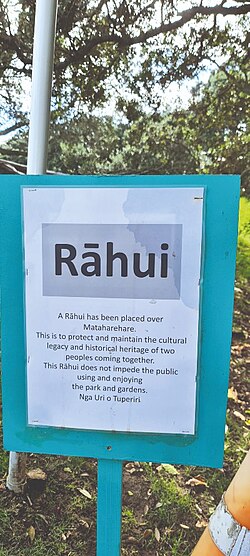
Identification and Enforcement
To notify the community that a restriction is in place, various physical markers may be used. These can include a carved or decorated wooden post placed in the ground, or the use of natural landscape features to define the boundaries. In addition to these visual cues, the community is formally informed of the rāhui's imposition.
It is important to note that when a rāhui is imposed by Māori iwi, it does not carry official legal weight, and there are no formal legal penalties for those who break it. Nevertheless, ignoring a rāhui is widely regarded as culturally insensitive.
| Category | Examples of Use | Primary Goal |
|---|---|---|
| Environmental | Fishing grounds, forests, gardens | Resource regeneration and conservation |
| Spiritual/Social | Areas where a death occurred | Respect for the dead and maintaining tapu |
| Specialized | Specific trees or flax bushes | Preservation for carving or weaving |
Frequently Asked Questions
What is the difference between a rāhui and a legal ban?
A rāhui is based on the mana of the kaitiaki and cultural concepts of tapu, whereas a legal ban is enforced by government legislation. While they may share the goal of conservation, Māori may view government bans as an infringement on customary rights.
Who has the authority to impose a rāhui?
Rāhui are imposed by the kaitiaki (guardians) of an area. Their authority is derived from their mana.
Where is the practice of rāhui found?
It is practiced in New Zealand (Māori culture), the Cook Islands, and French Polynesia.
What happens if someone breaks a rāhui imposed by an iwi?
Because iwi-imposed rāhui have no official legal standing, there are no formal legal penalties, but the act is considered culturally insensitive.
How can you tell if an area is under rāhui?
Signs, physical symbols like carved wooden posts, or natural landscape boundaries may be used, and the community is typically informed.