
Railways in Scotland: History, Infrastructure, and Modern Services
Scotland possesses an extensive railway network that serves as a vital artery for the country. From high-speed intercity links connecting to England to local commuter services and heavy freight transport, the rail system integrates the Scottish mainland and provides essential connectivity for millions of passengers and tonnes of cargo.
As of 2023, the network spans a total route length of 2,708 km (1,683 miles), featuring 362 stations. To improve efficiency and sustainability, 887 km (551 miles) of this network has been electrified.
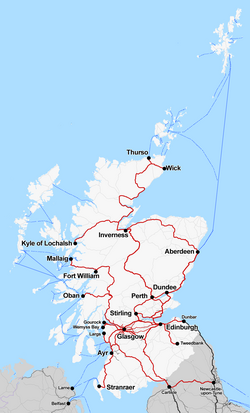
Key Facts
- Total Network Length: 2,708 km (1,683 miles).
- Electrified Routes: 887 km (551 miles).
- Total Stations: 362.
- First Railway: Monkland and Kirkintilloch Railway (1826).
- Freight Volume: 4 million tonnes transported by rail (as of December 2023).
- Unique Infrastructure: Home to the Glasgow Subway, one of the world's oldest underground systems.
The Evolution of Scottish Rail
The journey of Scottish rail began in 1826 with the opening of the Monkland and Kirkintilloch Railway. Shortly after, the Kilmarnock & Troon Railway became the first to carry passengers. In these early days, railways relied on horse traction rather than steam.
By 1850, the major cities of Scotland were linked to one another and integrated into the broader British railway network. The late 19th century marked a period of rapid expansion; by 1900, nearly every mainland town with a population exceeding 2,000 had its own station. During this era, travel became faster, more frequent, and more affordable relative to average wages.
Despite this growth, long-distance travel remained limited for the general public due to financial constraints, with annual journeys within Scotland peaking at around 100 million (roughly 20 per person). However, the railways were indispensable for moving heavy freight—specifically coal, iron, and steel—and played a critical role during the First World War.
Ownership and Governance
The management of the railways has shifted significantly over the last century. Following World War I, the Railways Act 1921 (the Grouping Act) merged the Caledonian Railway and the North British Railway into the London, Midland and Scottish Railway and the London and North Eastern Railway.
Post-World War II, the Transport Act 1947 nationalized the system into British Railways, with the Scottish network organized as the Scottish Region (ScR). In the 1980s, this region was rebranded as ScotRail. The system was privatized in March 1997, with the franchise passing through operators such as National Express, First ScotRail, and Abellio ScotRail.
Today, Network Rail owns the majority of the infrastructure. Regulation and major projects are overseen by Transport Scotland, established on January 1, 2006. In a move back toward public ownership, Transport Scotland took ScotRail over via its operator of last resort, Scottish Rail Holdings, in April 2022, followed by the Caledonian Sleeper in June 2023.
Cross-Border and Domestic Services
Scotland is connected to England via two primary arteries: the East Coast Main Line and the West Coast Main Line. These routes facilitate travel between major Scottish hubs and English cities like London, Birmingham, and Manchester.
| Route/Service | Primary Operator(s) | Key Destinations |
|---|---|---|
| West Coast Main Line | Avanti West Coast, TransPennine Express | London Euston, Birmingham New Street, Manchester Airport |
| East Coast Main Line | London North Eastern Railway (LNER) | London King's Cross, York |
| Cross Country Route | CrossCountry | Leeds, Sheffield, Bristol Temple Meads, Penzance |
| Caledonian Sleeper | Scottish Rail Holdings | Overnight service to London Euston |
| Glasgow South Western Line | ScotRail | Carlisle, Dumfries, Stranraer |
Domestically, ScotRail operates 94% of passenger services within Scotland. While the Strathclyde Partnership for Transport (SPT) was previously involved in regional services, the Transport (Scotland) Act 2005 removed SPT from the running of the rail network.
Urban Transit: Subways and Trams
Beyond the national rail network, Scotland has specialized urban transit. The Glasgow Subway, which opened on December 14, 1896, is the third-oldest underground network in the world, following London and Budapest. It is currently owned and operated by the Strathclyde Partnership for Transport.
In the capital, Edinburgh Trams began operations on May 31, 2014, providing a link to the airport. While cities like Aberdeen, Dundee, and Glasgow once had extensive tram networks, Edinburgh's is the only one currently in operation.
Frequently Asked Questions
Who currently operates the domestic rail services in Scotland?
The vast majority (94%) of domestic passenger services are operated by ScotRail, which is currently under public ownership via Scottish Rail Holdings.
What are the two main rail links between Scotland and England?
The two primary cross-border routes are the East Coast Main Line and the West Coast Main Line.
How old is the Glasgow Subway?
Opened on December 14, 1896, it is one of the oldest metro systems in the world, ranking third after the London Underground and the Budapest Metro.
What is the role of Transport Scotland?
Established in 2006, Transport Scotland oversees the regulation of the railways and administers major rail projects within the country.
How much freight is moved by rail in Scotland?
As of December 2023, approximately 4 million tonnes of freight were transported via the Scottish rail network.