
Reaper-Binders: The Evolution of Grain Harvesting Technology
Before the advent of modern machinery, harvesting small-grain crops was a labor-intensive process. The reaper-binder, commonly known as a binder, emerged as a critical innovation that streamlined this process by combining two essential tasks: cutting the crop and securing it into manageable bundles.
The Invention and Evolution of the Binder
The binder was invented in 1872 by Charles Baxter Withington, a jeweler from Janesville, Wisconsin. While the simple reaper could only cut the grain, Withington's machine added the ability to "bind" the stems into bundles, known as sheaves. These sheaves were then "shocked"—arranged into A-shaped conical stooks resembling small tipis—to allow the grain to dry for several days before the final threshing process.
Early iterations of the machine faced technical hurdles. Withington's original design utilized wire to tie the bundles, which proved problematic. This led to further innovation by William Deering, who developed a binder that successfully employed twine and a knotter, a mechanism originally invented by John Appleby in 1858.
How the Reaper-Binder Works
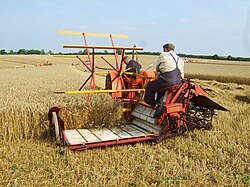
The mechanical operation of a binder is similar to the grain head of a modern combine harvester. It utilizes a reel and a sickle bar to cut the crop. Once cut, the stems fall onto a canvas bed that conveys them toward the binding mechanism. This system bundles the stems and ties them with string to create a sheaf, which is then discharged from the side of the machine for collection by "stookers."
Power Sources and Mechanics
The method of powering these machines evolved over time:
- Horse-drawn models: These early binders used a bull-wheel, which converted the forward traction of the horses into rotational force to power the cutting and tying mechanisms.
- Tractor-drawn models: Later versions were pulled by tractors, with some utilizing a power take-off (PTO) device to transfer mechanical power from the tractor to the implement.
The Transition to Modern Harvesting
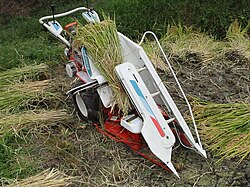
The rise of the combine harvester, which integrates cutting and threshing into a single operation, has rendered the binder largely obsolete. Today, some crops like oats are managed using a swather to form windrows. However, the binder remains useful in specific contexts, such as small fields or steep mountain terrain where heavy combine harvesters cannot operate.
Key Facts
- Inventor: Charles Baxter Withington (1872).
- Primary Function: Cuts small-grain crops and binds them into sheaves.
- Key Components: Reel, sickle bar, canvas bed, and knotter.
- Evolution: Transitioned from wire ties to twine and from horse-drawn bull-wheels to tractor-powered PTOs.
- Current Use: Limited to small or inaccessible areas too steep for combines.
| Machine | Primary Action | Output Form | Modern Status |
|---|---|---|---|
| Reaper | Cutting | Loose stems | Obsolete |
| Reaper-Binder | Cutting and Binding | Sheaves/Stooks | Rare/Niche |
| Swather | Cutting | Windrows | In Use (e.g., oats) |
| Combine Harvester | Cutting and Threshing | Processed Grain | Industry Standard |
Cultural Impact in Poland
In the People's Republic of Poland, reaper-binders were widely deployed. However, farmers frequently struggled to operate them due to chronic shortages of replacement parts and baling twine (sznurek do snopowiązałki). Because of these systemic failures, baling twine became a lasting cultural symbol of the dysfunction associated with the communist economy in Poland.
Frequently Asked Questions
What is the difference between a reaper and a binder?
A reaper only cuts the grain, whereas a binder both cuts the grain and ties the stems into bundles called sheaves.
What are stooks in grain harvesting?
Stooks are A-shaped conical piles of sheaves that allow the grain to dry in the field before it is picked up for threshing.
Who improved the binder to use twine instead of wire?
William Deering improved the binder by incorporating twine and a knotter mechanism, which had been invented by John Appleby in 1858.
Why are binders still used in some areas today?
Binders are much lighter than combine harvesters, making them suitable for small fields or mountainous regions that are too steep or inaccessible for heavy machinery.
What is a PTO in the context of farm machinery?
PTO stands for power take-off, a device that transfers mechanical power from a tractor to an attached implement to operate its components.