
Redmi History: The Evolution of Xiaomi's Budget and Flagship Powerhouse
From its humble beginnings as a value-driven line of devices to its current status as a global powerhouse, Redmi has redefined the budget smartphone market. Originally launched as a series under Xiaomi, Redmi eventually evolved into a distinct sub-brand, balancing high-performance specifications with accessible pricing.
Key Facts
- Launch: First released in China on July 12, 2013.
- Market Milestone: Overtook Samsung in China's smartphone shipment rankings in Q2 2014 with a 14% market share.
- Brand Evolution: Officially became a separate sub-brand from Xiaomi in January 2019.
- Global Reach: Became the second-largest smartphone brand globally in Q2 2021, surpassing Apple.
- Innovation: Introduced 48MP cameras (Note 7), 200MP cameras (Note 12 Pro+), and 5G connectivity (K30).
The Early Years: 2013–2015
The journey began in 2013 with the release of the first Redmi (known as Red Rice in Mandarin) in China. By early 2014, the brand expanded internationally. The demand was immediate; in Singapore, initial stocks sold out within eight minutes of becoming available on Xiaomi's website.
By the second quarter of 2014, Redmi's success propelled Xiaomi to a 14% market share in China, surpassing Samsung, Lenovo, and Yulong. In 2015, the brand introduced the Redmi Note 3, which marked a shift in design by removing the user-changeable battery and microSD slot in its initial MediaTek Helio X10 version, though microSD support returned in the later Snapdragon variant.
Scaling Up: 2016–2018
Between 2016 and 2018, Redmi focused on diversifying its lineup and enhancing hardware. In 2016, the brand appointed its first ambassadors in China—Liu Shishi, Wu Xiubo, and Liu Haoran—and introduced the Pro lineup. The Redmi Note 4 arrived in August 2016, featuring a 5.5-inch Full-HD display and a 4,100 mAh battery.
The following years saw rapid iterations in display and camera technology. The Redmi 5 and 5 Plus (2017) introduced the 18:9 screen aspect ratio. By 2018, the Redmi Note 5 and Note 5 Pro brought facial recognition to the series, while the Redmi 6 Pro adopted a 19:9 aspect ratio and a notch design. The year culminated in the Redmi Note 6 Pro, the first in the series to feature four cameras and a 6000 series aluminium build.
Independence and Diversification: 2019–2021
January 2019 marked a pivotal moment when Redmi was officially announced as a separate sub-brand from Xiaomi. This independence allowed Redmi to expand beyond phones into AIoT (Artificial Intelligence of Things), producing smart TVs, notebook PCs, and home appliances like washing machines.
The Redmi Note 7 and Note 7 Pro pushed photography boundaries with 48-megapixel rear cameras, selling over 20 million units within seven months. Simultaneously, the K20 and K20 Pro entered the flagship market, utilizing the high-end Snapdragon 855 processor.
In 2020, the Redmi K30 5G became the brand's first 5G handset, featuring a 120 Hz refresh rate. The brand also expanded its ecosystem with the massive 98-inch Redmi TV MAX. By the second quarter of 2021, Redmi's growth peaked as it became the second-largest smartphone brand globally and the largest manufacturer in Europe.
Modern Era: 2022–2024
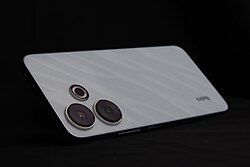
Recent years have seen Redmi push the limits of mobile imaging and charging speeds. The Redmi Note 12 series, launched in 2023, introduced a groundbreaking 200 MP camera and 120 W fast charging on the Pro+ model. In 2024, the Note 13 series launched globally with five variants, all transitioning to HyperOS, Xiaomi's revamped user interface.
The brand continues to break records, most recently with the K80 series in November 2024, which saw over 660,000 units sold on its first day, alongside the appointment of champion table tennis player Fan Zhendong as a brand ambassador.
Redmi Evolution Summary
| Year | Major Milestone / Device | Key Innovation/Achievement |
|---|---|---|
| 2013 | First Redmi (Red Rice) | Brand launch in China |
| 2014 | Market Shift | Overtook Samsung in China (14% share) |
| 2018 | Redmi Note 5 / 6 Pro | Facial recognition and quad-camera setup |
| 2019 | Sub-brand Status | Became a separate brand; launched K20 flagship |
| 2020 | Redmi K30 5G | First 5G handset and 120Hz display |
| 2021 | Global Ranking | 2nd largest smartphone brand globally |
| 2023 | Redmi Note 12 Pro+ | 200 MP camera and 120W charging |
| 2024 | Redmi K80 Series | Record-breaking first-day sales (660k+ units) |
Frequently Asked Questions
When did Redmi become a separate brand from Xiaomi?
Redmi was officially announced as a separate sub-brand, distinct from Xiaomi, in January 2019.
Which was the first Redmi phone to feature 5G?
The Redmi K30 5G, unveiled on January 7, 2020, was the first 5G handset available in the Redmi market.
What is the significance of the Redmi Note 7 series?
The Redmi Note 7 and Note 7 Pro were the first in the series to feature 48-megapixel rear cameras and were among the best-selling models, with over 20 million units sold in seven months.
What is HyperOS?
HyperOS is Xiaomi's revamped user interface (UI) that replaced previous versions of MIUI, as seen in the Redmi Note 13 series.
Did Redmi expand beyond smartphones?
Yes, after becoming a sub-brand, Redmi expanded into the AIoT sector, offering products such as smart TVs, notebook PCs, and home appliances like washing machines.