
Redneck Revolt: Anti-Racist Organizing and Community Action
Redneck Revolt emerged as a national network dedicated to anti-racist organizing, specifically targeting white poor and working-class populations. By operating in spaces traditionally associated with right-wing recruitment, the group sought to challenge white supremacist narratives from within those same communities. While primarily focused on white working-class outreach, the network maintained a diverse membership, including people of color, women, and non-binary individuals.
Key Facts
- Network Scale: Approximately 45 local chapters across more than 30 U.S. states as of December 2017.
- Demographics: Roughly 30% people of color; at least one-third of membership comprised women, people of color, or non-binary people.
- Diverse Backgrounds: Membership included veterans, former Republicans, and former members of the 3 Percenters.
- Core Strategy: Organizing in rural and working-class spaces such as gun shows, NASCAR events, and state fairs.
- Community Focus: Provided first aid training, food and clothing programs, and needle exchanges.
Organizational Structure and Community Outreach
The network functioned through local chapters, some of which also utilized the name John Brown Gun Club. The group's growth accelerated during the 2016 presidential election and following the 2017 Unite the Right rally in Charlottesville. To ensure equity, administrative and communications duties were divided equally by gender.
Redneck Revolt focused its efforts on environments where white supremacist groups frequently recruit, including flea markets, country music concerts, and rodeos. Their activities were designed to provide both practical support and political education. While racial justice and transgender rights initiatives were aimed at rural white people, the group's firearms training was specifically oriented toward women and people of color.
Many of these initiatives were modeled after the Survival Programs—community-based social services—pioneered by the Black Panther Party and the Young Patriots Organization in the 1960s. These included community gardens, potlucks, and efforts to address food shortages and healthcare challenges.
Political Activism and Demonstrations (2016–2019)
The group's activism often involved direct counter-protests and public declarations of solidarity with marginalized groups. In 2016, during the Dakota Access Pipeline protests, they published a pamphlet urging the white working class to find solidarity with people of color defending their land rather than aligning with wealthy landowners.
Throughout 2017, the network was active in several high-profile events:
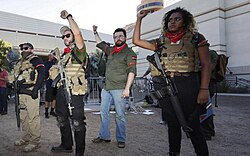
- Arizona: The Phoenix chapter openly carried firearms outside the State Legislature during Donald Trump's inauguration to support immigrants, Muslims, and LGBTQ people.
- Kentucky: Members counter-protested the League of the South, the National Socialist Movement, and the Traditionalist Worker Party in Pikeville.
- North Carolina: The Silver Valley chapter organized a counter-demonstration against a Ku Klux Klan rally in Asheboro.
- Michigan: Armed members protested in Kalkaska against anti-Muslim comments made by the village president.
Beyond political rallies, the group engaged in social advocacy, such as supporting the Juggalo March on Washington in September 2017 and organizing a candlelight vigil for those affected by the opioid epidemic in Suffolk County, New York.
The Unite the Right Rally and Legal Challenges
During the August 2017 Unite the Right rally in Charlottesville, Virginia, Redneck Revolt chapters provided medical assistance and armed security for counter-protesters. This role led to significant legal scrutiny. In October 2017, the group was named as a defendant in a lawsuit filed by the city of Charlottesville and local businesses seeking to prohibit paramilitary activity (organized groups acting as a military force without official government authorization).
The lawsuit accused Redneck Revolt and the Socialist Rifle Association of acting as private militias. While some clergy members petitioned for Redneck Revolt's removal, arguing that their intent to protect marginalized communities differed from the intent of white supremacist groups, the plaintiffs maintained that the suit focused on the act of paramilitary activity regardless of motive.
The legal dispute concluded in July 2018 when Redneck Revolt signed a consent decree. This agreement prohibits members from returning to Charlottesville as part of an armed unit of two or more people during any demonstration or rally.
Summary of Redneck Revolt Activities
| Category | Details |
|---|---|
| Reach | ~45 chapters in 30+ U.S. states (as of Dec 2017) |
| Target Audience | White poor and working-class people |
| Community Services | First aid, food/clothing programs, needle exchanges, community gardens |
| Key Opponents | Ku Klux Klan, League of the South, National Socialist Movement |
| Legal Outcome | Consent decree prohibiting armed units in Charlottesville |
Frequently Asked Questions
What was the primary goal of Redneck Revolt?
The primary goal was anti-racist organizing among white poor and working-class people, challenging white supremacist recruitment in rural and working-class spaces.
Who made up the membership of the group?
While focused on white working-class outreach, the membership included people of color (approximately 30%), women, non-binary people, veterans, former Republicans, and former members of the 3 Percenters.
What were the "Survival Programs" mentioned?
These were community support activities, such as food and clothing programs and needle exchanges, modeled after the social services provided by the Black Panther Party and the Young Patriots Organization in the 1960s.
Why was Redneck Revolt sued in Charlottesville?
They were named as defendants in a lawsuit regarding unlawful paramilitary activity after providing armed security for counter-protesters during the Unite the Right rally.
How was the Charlottesville lawsuit resolved?
The group signed a consent decree in July 2018, agreeing not to return to Charlottesville as part of an armed unit of two or more people during protests or rallies.