
RENAMO Conflict and Peace Process in Mozambique
The political landscape of Mozambique has been significantly shaped by the recurring tensions between the government and RENAMO (Resistência Nacional Moçambicana), a former rebel movement. Between 2013 and 2021, the country experienced a volatile cycle of armed resurgence, fragile ceasefires, and eventual disarmament, reflecting a deep-seated struggle for political representation and regional autonomy.
Key Facts
- Resurgence: Armed clashes reignited in April 2013, targeting police stations and military convoys.
- Leadership: The movement was long led by Afonso Dhlakama until his death in May 2018.
- Core Dispute: Tensions often centered on the creation of semi-autonomous provinces in northern and central Mozambique.
- Peace Agreements: Major deals were signed in September 2014 and August 2019.
- Splinter Groups: The RENAMO Military Junta (RMJ) emerged as a dissident faction before its final dissolution in 2021.
The Resurgence of Violence (2013–2014)
After a period of relative calm, RENAMO activity resurged in April 2013 with an attack on a police station in Muxungue. This sparked a series of violent encounters. In August 2013, clashes occurred where RENAMO claimed 36 government security forces were killed, though local media reported only two deaths.
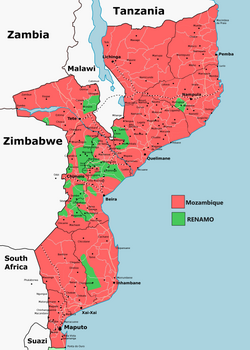
Throughout early 2014, the conflict intensified with ambushes in Muxungue and the Homoine district, as well as attacks in Gorongosa. Despite a "unilateral ceasefire" declared by leader Afonso Dhlakama on May 7, 2014, violence continued. By June 2014, RENAMO scrapped the truce, alleging that the government was massing forces in the Gorongosa mountain range to assassinate Dhlakama.
The 2014 Ceasefire and Political Crisis
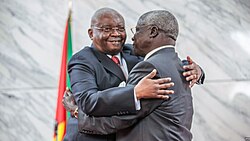
Following nearly a year of negotiations, the government and RENAMO signed a ceasefire on August 25, 2014. This agreement was intended to stabilize the nation ahead of the October 2014 elections. On September 5, President Armando Guebuza and Afonso Dhlakama formally signed a peace deal in Maputo.
However, the peace was short-lived. The provincial elections on October 15, 2014, triggered a political crisis. RENAMO rejected the official results, claiming they were "adulterated." While official counts favored the ruling FRELIMO (Frente de Libertação de Moçambique) party, RENAMO asserted it had won 139 seats across seven northern and central provinces.
Renewed Tensions and the Death of Dhlakama (2015–2018)
Tensions escalated again in March 2015 following the murder of Gilles Cistic, a legal expert who had supported RENAMO's proposal for semi-autonomous provinces. Dhlakama accused FRELIMO of the killing and threatened to rule autonomous provinces independently.
The ceasefire officially collapsed in June 2015 after a RENAMO ambush on government troops. Over the next few years, the conflict evolved into a guerrilla campaign targeting rail lines and police outposts, particularly in Sofala Province. Despite brief truces in 2017, the instability persisted until the death of Afonso Dhlakama from a heart attack on May 3, 2018.
Timeline of Key Events
| Period/Date | Event | Outcome |
|---|---|---|
| April 2013 | Attack on Muxungue police station | Resurgence of armed conflict |
| Sept 5, 2014 | Peace deal signed in Maputo | Temporary cessation of hostilities |
| June 2015 | Ambush on government troops | Collapse of the 2014 ceasefire |
| May 3, 2018 | Death of Afonso Dhlakama | Leadership transition to Ossufo Momade |
| Aug 1, 2019 | Peace agreement in Gorongosa | End of the six-year conflict |
| Oct 11, 2021 | Death of Mariano Nhongo | Effective end of the RMJ splinter group |
Final Peace Deal and the RMJ Splinter
On August 1, 2019, President Filipe Nyusi and RENAMO leader Ossufo Momade signed a definitive peace agreement at a military base in the Gorongosa mountains, followed by a second signing in Maputo on August 6. This led to the surrender of weapons by most fighters.
However, a dissident faction known as the RENAMO Military Junta (RMJ), led by General Mariano Nhongo, refused to disarm. The RMJ demanded direct negotiations with the government, bypassing Momade. This group continued sporadic attacks in Sofala and Manica provinces until its strength dwindled due to mass desertions.
The RMJ effectively ceased to exist after General Nhongo was killed in a firefight with security forces on October 11, 2021. By December 2021, the final 24 militants joined the Demobilization, Disarmament and Reintegration (DDR) program, marking the conclusion of the insurgency.
Frequently Asked Questions
Who led RENAMO during the 2013-2018 resurgence?
The movement was led by Afonso Dhlakama, who remained a central and influential figure until his death from a heart attack in May 2018.
What was the primary cause of the 2014 political crisis?
The crisis was sparked by RENAMO's rejection of the October 2014 provincial election results, which they claimed were adulterated and did not reflect the actual vote counts.
What was the RENAMO Military Junta (RMJ)?
The RMJ was a splinter faction led by General Mariano Nhongo that disagreed with the 2019 peace deal signed by Ossufo Momade and continued armed operations until 2021.
What is the DDR program mentioned in the text?
The DDR program stands for Demobilization, Disarmament and Reintegration, a process designed to transition former combatants back into civilian life.
Where did the final 2019 peace agreement take place?
The agreement was first signed at a remote RENAMO military base in the Gorongosa mountains and later ratified in Maputo's Peace Square.