
Republic of Chile: The Parliamentary Era (1891–1925)
The period between 1891 and 1925 in Chilean history is known as the Parliamentary Republic. Often described as a "pseudo-parliamentary" era, this epoch emerged from the ashes of the 1891 Civil War and fundamentally altered the balance of power between the executive and legislative branches of government.
Unlike a traditional parliamentary system, where the head of government is directly appointed by the parliamentary majority, Chile operated under a unique interpretation of the 1833 Constitution. While the President remained the formal head of state, their actual control over the government was significantly diminished, shifting the center of political gravity toward the National Congress.
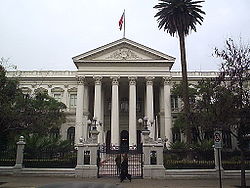
Key Facts
- Duration: 1891 to 1925.
- System: Unitary quasi-parliamentary republic.
- Economic Driver: Saltpeter (sodium nitrate) mining.
- Key Transition: Ended with the Constitution of 1925, which restored a presidential system.
- Official Religion: Roman Catholicism (until 1925).
- Currency: Chilean peso.
The Pseudo-Parliamentary System
The parliamentary system was established following the defeat of President José Manuel Balmaceda in the Civil War of 1891. In this arrangement, the Minister of Interior unofficially assumed the role of chief of government. The National Congress exerted indirect control over the cabinet through the approval of the budget, military credits, and periodical laws (leyes periódicas).
Checks, Balances, and Instability
The system lacked the stability of a true Westminster-style parliament. While the legislature could withdraw confidence from the government, the President lacked the power to dissolve parliament and call for new elections. This created a political environment where the executive was weakened but could not reset the legislative board.
Political parties were fluid and often centered around caudillos (strongman leaders) rather than strict ideologies. This led to the creation of "universal cabinets"—coalitions including ministers from all parties—which were frequently dissolved due to political intrigues, resulting in high cabinet turnover.
Political Structure and Social Classes
The political landscape was divided into several key parties and alliances. On the right sat the Conservative Party, closely tied to the Roman Catholic Church. The center was occupied by various liberal groups, including the National Party, the Liberal Party, and the Liberal Democratic Party. The left consisted of the Radical and Democrat parties, with the Socialist Workers Party gaining traction toward the end of the 1910s.
These groups typically formed two main blocs: the Coalition (Conservatives and liberals) and the Liberal Alliance (liberals and the Radical Party).
Social Stratification
Society was divided into three distinct tiers:
- The Oligarchy: Comprising landlords, bankers, intellectuals, and saltpeter entrepreneurs. This elite class lived in European-style mansions and dominated the political sphere.
- The Middle Class: A growing segment of society positioned between the elite and the laborers.
- The Working Class: Including industrial workers, landless peasants, and saltpeter miners. Many lived in extreme poverty in conventillos (crowded dormitories) or huts made of calamina (corrugated iron), working 12 to 16 hours a day without contracts or weekends.
The Saltpeter Economy
The Chilean economy during this era revolved almost entirely around saltpeter (sodium nitrate). This resource provided the primary source of national wealth. The distribution of profits was split into thirds: one third went to foreign investors, one third was reinvested into the mines, and one third was collected by the state through export taxes.
The state utilized these revenues to modernize the country, investing heavily in infrastructure such as ports, railroads, and roads.
Summary of the Parliamentary Republic
| Feature | Details |
|---|---|
| Government Type | Unitary quasi-parliamentary republic |
| Key Economic Resource | Saltpeter (Sodium Nitrate) |
| Primary Political Blocs | The Coalition and the Liberal Alliance |
| Ending Event | Constitution of 1925 |
| First President | Jorge Montt (1891–1896) |
| Last President | Arturo Alessandri Palma (1925) |
Frequently Asked Questions
Why was the system called "pseudo-parliamentary"?
It was called pseudo-parliamentary because while the legislature held significant power over the cabinet, the executive was not fully subject to the legislative power in the way a true parliamentary system is, and the President lacked the power to dissolve parliament.
What role did saltpeter play in the economy?
Saltpeter was the main resource of Chile. Export taxes on sodium nitrate funded the state's infrastructure projects, including the construction of roads and railroads.
How were elections conducted during this period?
Unlike previous eras, the executive power did not interfere directly in elections. Instead, they were organized by municipalities. However, this often led to frequent electoral fraud, bribes, and the stealing of ballot boxes in rural areas.
What changed with the Constitution of 1925?
The 1925 Constitution, drafted by President Arturo Alessandri and Minister José Maza, established a presidential system. It introduced the direct universal suffrage for electing the President and made the state budget approval automatic if Congress failed to act.
Who were the caudillos?
Caudillos were individual personalities or strongmen who held control over political parties and had the power to form or dissolve cabinets based on their influence.