
Respirators for Carbon Monoxide Protection in Mining
In the aftermath of a mining fire or explosion, the most immediate atmospheric threat to personnel is often carbon monoxide. To mitigate this risk, specialized self-rescue respirators are employed. Unlike standard masks that simply filter particles, these devices actively transform toxic gas into a safer form to allow miners to escape dangerous environments.
How Carbon Monoxide Respirators Work
The primary function of these respirators is to oxidize carbon monoxide, converting it into the less toxic gas carbon dioxide. This chemical transformation is made possible by a reactive catalyst bed. Most of these devices utilize Hopcalite, a specialized mixture of manganese and copper oxides that serves as an oxidizer.
To ensure the catalyst remains effective, the device incorporates pre-filters, including a moisture trap and a dust filter. These components prevent contaminants from reaching the catalyst bed, as moisture and dust can significantly reduce its efficiency. Because the catalyst is consumed during activation, the respirator must be stored in a sealed case until it is needed.
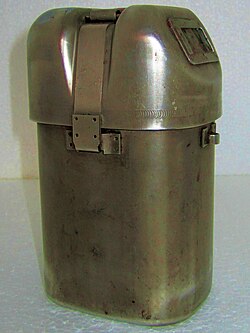
The Exothermic Reaction
The chemical process of oxidation is exothermic, meaning it releases heat. Consequently, the air passing through the respirator and the device itself become hot during use. To help manage this temperature, the respirator is housed in a metal case designed to conduct heat away from the user.
Operating the Device
Using a self-rescue respirator requires specific technique and training. The user secures the device via a headband to distribute the weight and holds a mouthpiece firmly in the mouth. A nose clip is used to seal the nostrils, ensuring that all inhalation and exhalation occurs exclusively through the respirator.
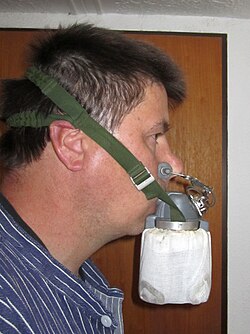
During operation, the inhaled air passes through the catalyst bed. However, exhaled air is routed through an exhaust valve, bypassing the catalyst. This design prevents damp exhaled breath from damaging the catalyst's efficiency. Some models include a heat exchanger to further reduce the temperature of the air using this exhaled flow.
Training is critical because the hot air produced by the device can be unpleasant. Users must be conditioned to continue breathing through the respirator despite the heat; a hotter exhaust typically indicates a higher concentration of carbon monoxide in the surrounding air, making the use of the device even more vital.
Capabilities and Limitations
It is important to note that these respirators are specifically engineered for carbon monoxide. While they may incidentally reduce other gases that can be safely oxidized (such as ozone), they are not designed for general toxic gas protection. Unlike many other respirators, they do not contain adsorbent materials like activated charcoal.
A critical limitation is the reliance on atmospheric oxygen. Because the catalyst requires oxygen to oxidize carbon monoxide, these devices are unusable in oxygen-deficient environments. In such scenarios, an oxygen-source rescuer must be used instead.
Key Facts
- Primary Purpose: Converts toxic carbon monoxide into carbon dioxide.
- Active Ingredient: Uses Hopcalite (copper and manganese oxides) as a catalyst.
- Operational Life: Approximately two hours once activated.
- Critical Requirement: Requires atmospheric oxygen to function.
- Maintenance: Must be stored in a sealed case to prevent premature catalyst consumption.
| Feature | Detail |
|---|---|
| Catalyst Material | Hopcalite (Copper and Manganese Oxides) |
| Working Duration | ~2 Hours |
| Protection Target | Carbon Monoxide (CO) |
| Pre-filtration | Dust filter and moisture trap |
| Thermal Property | Exothermic (generates heat) |
Frequently Asked Questions
Why does the air feel hot when breathing through the respirator?
The heat is a result of the exothermic chemical reaction where the Hopcalite catalyst oxidizes carbon monoxide into carbon dioxide.
Can this respirator be used for all toxic gases?
No. It is specifically designed for carbon monoxide. It does not contain activated charcoal and is not intended for general toxic gas protection.
What happens if the respirator is not stored in its sealed case?
If left unsealed, the catalyst may activate prematurely and become consumed, rendering the device ineffective during an actual emergency.
Why is a nose clip necessary?
The nose clip ensures that the user cannot breathe untreated ambient air through their nose, forcing all air to pass through the catalyst bed via the mouthpiece.
When is an oxygen-source rescuer required instead of this respirator?
An oxygen-source rescuer is necessary when there is insufficient atmospheric oxygen, as the catalyst bed requires oxygen to perform the oxidation of carbon monoxide.