
Revolving Door Effect in Political Imprisonment
The revolving door effect describes a systemic pattern of political repression where a government releases a group of political prisoners only to arrest new individuals shortly thereafter. This mechanism allows regimes to maintain a consistent number of detainees, potentially easing international diplomatic pressure while continuing to suppress dissent within the population.
Key Facts
- The revolving door effect involves the strategic cycle of releasing old political prisoners and detaining new ones.
- Venezuela has seen this pattern since at least 2014, with arrests often exceeding releases.
- Cuba utilized similar mechanisms following the 2003 "Black Spring" crackdown.
- The practice has been documented by NGOs and human rights organizations in Myanmar and Nicaragua.
Case Study: Venezuela
In Venezuela, the revolving door effect has been a recurring point of condemnation. Alfredo Romero has highlighted that during 2016, the volume of people imprisoned surpassed the number of those released. By 2017, a clear pattern emerged: individuals who had been held for one to three years were freed, only for new arrests to follow immediately.
A notable example of this trend was the detention of audiovisual producer Héctor Pedroza Carrizo, who was arrested at his home without a warrant by the Anti-Extortion and Kidnapping Command (CONAS), a specialized unit of the National Guard.
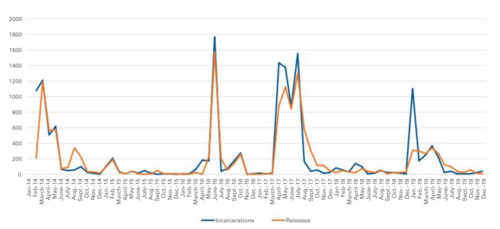
In 2018, the National Constituent Assembly announced the release of 79 individuals. However, only 40 of these were political prisoners from a larger list comprising 237 civilians and 79 military personnel. Furthermore, those released were subjected to an irregular requirement: they had to report periodically to the Constituent Assembly rather than to the judicial courts.
The correlation between these strategic releases and subsequent arrests was further detailed by Romero in the July 2020 Wilson Center publication, "The Clock of Repression."
Implementation in Cuba
Cuba adopted similar mechanisms starting in 2003 during the Black Spring, a period marked by the kidnapping, beating, and imprisonment of 75 dissidents. Following extensive international campaigning and negotiations, all 75 were eventually released.
The release process was fraught with conditions. Some dissidents chose to leave the island, while those who stayed faced continued harassment. This included forced disappearances for several hours or days, accusations of minor common crimes, and constant surveillance by security agents and supporters of the communist party.
Global Applications: Myanmar and Nicaragua
The revolving door phenomenon is not limited to the Americas. In 2016, the organization Burma Campaign UK applied the term to describe the treatment and cycling of political prisoners in Myanmar.
Similarly, non-governmental organizations (NGOs) in Nicaragua have denounced the regime of Daniel Ortega for implementing the revolving door mechanism to manage its political prisoners.
Summary of Regional Observations
| Country | Key Period/Event | Notable Characteristics |
|---|---|---|
| Venezuela | 2014–2020 | Arrests exceeding releases; irregular reporting to the Constituent Assembly. |
| Cuba | Post-2003 | Followed the "Black Spring"; releases tied to exile or continued harassment. |
| Myanmar | 2016 | Identified by Burma Campaign UK regarding political detainees. |
| Nicaragua | Ongoing | Denounced by NGOs under the Daniel Ortega administration. |
Frequently Asked Questions
What is the revolving door effect in a political context?
It is a practice where a government releases political prisoners to create an appearance of leniency or to satisfy international demands, while simultaneously arresting new dissidents to maintain a state of repression.
How did the revolving door effect manifest in Venezuela?
It manifested through cycles where long-term prisoners were released and new individuals, such as Héctor Pedroza Carrizo, were arrested, often without warrants, ensuring the prison population remained stable.
What was the "Black Spring" in Cuba?
The Black Spring occurred in 2003 and involved the kidnapping, beating, and imprisonment of 75 dissidents, who were later released after years of international pressure.
Which organizations have identified this pattern in Asia?
Burma Campaign UK used the term in 2016 to describe the situation of political prisoners in Myanmar.
Why is reporting to a Constituent Assembly instead of a court considered irregular?
In a standard legal system, prisoners or parolees report to judicial authorities (courts). Reporting to a political body like the Constituent Assembly bypasses judicial oversight and places the individual under political control.