
Robert A.M. Stern: A Legacy of Classical and Postmodern Architecture
Robert A.M. Stern has left an indelible mark on the skylines of the United States and beyond, blending historical reverence with contemporary functionality. From intimate private residences in the Hamptons to some of the most financially successful luxury towers in New York City, Stern's work reflects a deep engagement with the built environment and its history.
Architectural Style and Evolution
During the 1970s and early 1980s, Stern established himself as a postmodern architect—a style characterized by the integration of classical elements into contemporary building designs. This approach was highlighted in 1980 when he contributed a postmodern facade to the Strada Novissima in the "The Presence of the Past" exhibit at the Venice Architecture Biennale.
By the mid-1980s, his work shifted toward a more traditional aesthetic, aligning with the emerging New Classical architectural movement. While others categorized him this way, Stern rejected these labels, maintaining that his designs are instead rooted in vernacular context (the use of local materials and traditional building styles) and local traditions.
Major Works and Commercial Success
Residential and Urban Developments
Stern is widely recognized for his high-end residential projects in New York City. Among his most notable are The Chatham, The Brompton, and 20 East End Avenue. However, 15 Central Park West stands as a landmark of financial success; upon completion, it was one of the most profitable apartment buildings ever constructed, with sales reaching $2 billion. This success was later followed by the development of 220 Central Park South.
Skyscrapers and Civic Landmarks
Stern's portfolio includes some of the tallest structures in the U.S. In Philadelphia, he designed the glass-clad Comcast Center, which ranks as the second tallest building in both the city and the state of Pennsylvania. The Driehaus Prize committee noted that a preliminary stone-clad version of the building carried forward the proportions of a classical obelisk.
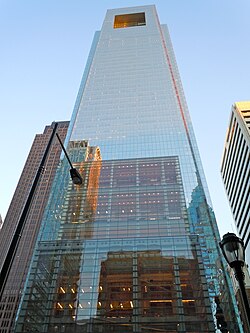
In New York City, he further expanded the skyline with 520 Park Avenue and 30 Park Place. Beyond commercial towers, Stern has designed significant institutional buildings, including the George W. Bush Presidential Center in Dallas and the Museum of the American Revolution in Philadelphia.
Academic and International Projects
Stern's influence extends to educational campuses. In 2017, his firm, RAMSA, completed a major addition to Yale University, creating Pauli Murray College and Benjamin Franklin College in the Collegiate Gothic style—an architectural style characterized by pointed arches and stone masonry typical of historic English universities.
Internationally, Stern designed the Schwarzman College in China. This 200,000-square-foot campus provides advanced higher-education facilities and achieved LEED Gold certification for its environmental sustainability.
Key Facts
- Financial Milestone: 15 Central Park West generated $2 billion in sales.
- Disney Connection: Stern served on the board of the Walt Disney Company from 1992 to 2003.
- Global Reach: Designed the LEED Gold-certified Schwarzman College in China.
- Academic Contribution: Added two residential colleges to Yale University in the Collegiate Gothic style.
- Urban Impact: Designed three major New York City skyscrapers: 220 Central Park South, 520 Park Avenue, and 30 Park Place.
Notable Project Summary
| Project Name | Location | Year |
|---|---|---|
| Disney's Beach Club Resort | Florida, US | 1990 |
| Norman Rockwell Museum | Massachusetts, US | 1993 |
| Darden School of Business | Virginia, US | 1996 |
| Federal Reserve Bank of Atlanta | Georgia, US | 2001 |
| Jacksonville Main Library | Florida, US | 2005 |
| Gerald R. Ford School of Public Policy | Michigan, US | 2006 |
| 15 Central Park West | New York, US | 2008 |
| George W. Bush Presidential Center | Texas, US | 2013 |
| Museum of the American Revolution | Pennsylvania, US | 2017 |
| 520 Park Avenue | New York, US | 2018 |
| 220 Central Park South | New York, US | 2019 |
Frequently Asked Questions
What is Robert A.M. Stern's architectural style?
Stern began as a postmodern architect, integrating classical elements into modern buildings. He later transitioned toward a more traditional approach, though he prefers to describe his work as being based on local traditions and vernacular context rather than a specific movement.
Which of Stern's projects was the most financially successful?
15 Central Park West in New York City was one of the most financially successful apartment buildings ever constructed, with total sales reaching $2 billion.
What was Stern's involvement with the Walt Disney Company?
Stern served on the board of the Walt Disney Company from 1992 to 2003. His architectural contributions to Disney include the master plan for Celebration, Florida, as well as Disney's Yacht Club Resort and Beach Club Resort.
What are some of Stern's tallest buildings?
His tallest works include the Comcast Center in Philadelphia, as well as 220 Central Park South, 520 Park Avenue, and 30 Park Place in New York City.
What is the significance of the Yale University addition?
In 2017, RAMSA completed Pauli Murray College and Benjamin Franklin College at Yale, both of which were designed in the Collegiate Gothic style to complement the university's campus.