
Rosakis Research: Advancing the Science of Dynamic Rupture and Hypervelocity Impact
The study of how materials fail under extreme conditions is critical for everything from predicting catastrophic earthquakes to protecting spacecraft in orbit. The extensive body of work by researcher Rosakis spans over 260 publications, focusing on the quasi-static and dynamic failure of metals, composites, interfaces, and micro-electronic structures. By leveraging high-speed diagnostics and advanced interferometry, this research provides a window into the physics of catastrophic failure and dynamic localization.
Key Facts
- Supershear Rupture: Credited with the experimental discovery of "intersonic" or supershear rupture, where rupture speeds exceed the shear wave speed of the solid.
- Laboratory Earthquakes: Developed controlled, repeatable surrogate scenarios to mimic natural earthquake processes.
- CGS Interferometry: Invented Coherent Gradient Sensing (CGS), a method sensitive to optical path gradients used in fracture mechanics and thin-film stress measurement.
- Hypervelocity Impact: Investigating debris and meteoroid threats to spacecraft using the SPHIR facility.
- Patents: Holds thirteen US patents covering high-speed infrared thermography and wafer-level metrology.
The Mechanics of Laboratory Earthquakes
Since the late 1980s, Rosakis has pioneered the concept of "laboratory earthquakes." The objective is to create highly instrumented environments that simulate the dynamic shear rupture and frictional sliding found in natural seismic events. These experiments allow researchers to observe new physical phenomena and establish benchmarks for field observations.
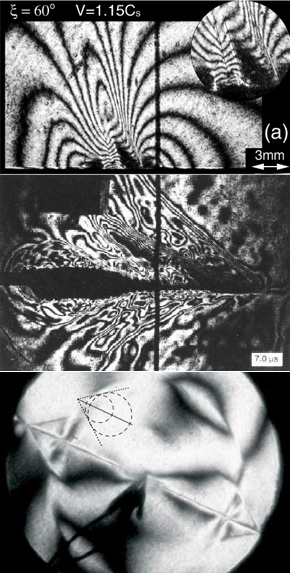
To simulate a fault system, two photoelastic plates are held in frictional contact. Tectonic loading is replicated via pre-compression, while the rupture is triggered by suddenly dropping the normal stress in a small region along the interface. By varying the angle of the frictional interface relative to the compression axis, researchers can provide the necessary shear driving force for continued rupturing.
Diagnostics used in these studies include laser velocimetry, full-field photoelasticity, high-speed photography, and Digital Image Correlation (DIC)—a technique that tracks motion by identifying gray-level patterns in small pixel subsets.
![A Dynamic shear rupture, is captured propagating (left to right) along a frictional interface between two elastic plates at supershear speeds (speeds exceeding the shear wave speed of the solid). The images are created by using high-speed, digital photography (106 frames/second) and Digital Image Correlation (DIC). DIC identifies gray level patterns in small pixel subsets and tracks their motion (From: Rosakis, Rubino and Lapusta, JAM, 2020, [DOI: 10.1115/1.4045715]).](/images/79/87/79878c8becb2d89eaae929b6070641267a6eca1ff4c14f78732a1921b2e6ab5a.gif)
Supershear and Intersonic Rupture
A major contribution of this research is the discovery of supershear rupture (also known as intersonic rupture). This occurs when a crack propagates faster than the shear wave speed of the material. This phenomenon has been investigated across various settings, including homogeneous and bimaterial interfaces, and has significantly refocused the geophysics community's attention toward the study of supershear earthquakes.
Hypervelocity Impact and Spacecraft Safety
Beyond seismology, recent research addresses the growing threat of man-made debris in Low Earth Orbit (LEO) and natural meteoroids. These objects travel at hypervelocity, capable of compromising the structural integrity of spacecraft.
Utilizing the Small Particle Hypervelocity Impact Range (SPHIR) facility at Caltech/JPL, researchers examine the mechanisms of deformation and damage evolution. By combining spectroscopic, infrared, and optical techniques—including CGS interferometry—the research analyzes dynamic perforation behavior, crater morphology, and the transitions between solid, fluid, and plasma states during impact.
Technical Summary of Research Areas
| Research Area | Key Focus | Primary Diagnostics/Tools |
|---|---|---|
| Seismology | Supershear rupture & frictional sliding | DIC, Photoelasticity, Laser Velocimetry |
| Materials Science | Dynamic failure of metals & composites | High-speed IR diagnostics, CGS |
| Aerospace | Hypervelocity impact & shielding | SPHIR facility, Spectroscopy |
| Microelectronics | Thin-film stress & wafer metrology | CGS Interferometry |
Frequently Asked Questions
What is supershear rupture?
Supershear rupture, or intersonic rupture, is a phenomenon where a crack or rupture propagates through a material at a speed that exceeds the shear wave speed of that solid.
How are laboratory earthquakes created?
They are created using two photoelastic plates in frictional contact. Pre-compression simulates tectonic loading, and a sudden drop in normal stress in a specific area triggers the spontaneous nucleation of the rupture.
What is Coherent Gradient Sensing (CGS)?
CGS is a type of interferometry invented by Rosakis and his coworkers. It is sensitive to gradients of optical path gradients and is used to measure thin-film stress and study fracture mechanics.
Why is hypervelocity impact research important for spacecraft?
Because man-made debris in low Earth orbit and meteoroids travel at extreme speeds, they can cause severe structural damage. Research into crater morphology and plasma transitions helps develop better shielding for spacecraft.
What is Digital Image Correlation (DIC)?
DIC is a high-speed digital photography technique that identifies gray-level patterns in small pixel subsets to track the motion and deformation of a material during a dynamic event.