
Russian Post Offices in Crete: A Brief Philatelic History
In 1898, Russia became part of a joint occupying force in Crete. As part of this military and administrative presence, Russia established its own post offices within the region it occupied, specifically focusing on the district of Rethymno. While the Russian postal presence was short-lived, it produced a fascinating array of stamps that are now highly sought after by philatelists.
The Brief Operation of the Rethymno Postal Service
The Russian postal service in the Rethymno district operated for a remarkably narrow window of time in 1899, functioning only from May to July. Despite this brief duration, the administration issued three distinct sets of postage stamps to facilitate mail.
Evolution of Stamp Designs
The First Issue: Handstamped Designs
The initial set consisted of four stamps created via handstamping. These were based on the imperial Russian double eagle emblem. The first design featured colorless Greek letters set within colored scrolls; the one metallik value was stamped in green, while the two metallik value was produced in both rose-red and black. A second design utilized colored Latin letters on a white background, issued exclusively as a one metallik value in blue.
The Second Issue: The Trident Series
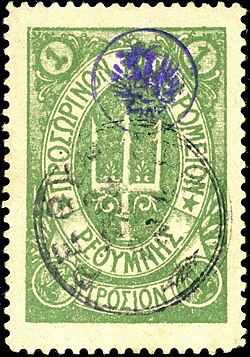
Later in 1899, the postal service transitioned to regularly printed stamps. These were produced by the firm Grundman & Stangel in Athens. Moving away from the imperial eagle, this series featured a design based on Poseidon's trident. These stamps were available in three denominations: one metallik, two metallik, and one grosion (a currency unit equivalent to four metallik or one piastre). This series was printed in seven different colors: orange, green, yellow, rose, lilac, blue, and black.
The Third Issue: The Star Variation
The final set issued by the Russian administration was a variation of the trident design. This version added five-pointed stars to the frame surrounding the trident and was printed in four colors: blue, rose, green, and lilac.
Authentication and Counterfeits
To ensure authenticity, stamps were typically given a control mark—a violet or blue stamp of a double eagle—before they were issued. However, some stamps exist without this mark. Because of their rarity and value, these stamps have been extensively counterfeited. Forgeries often include fake control marks and forged postmarks to deceive collectors.
Key Facts
- Location: District of Rethymno, Crete.
- Operational Period: May to July 1899.
- Printer: Grundman & Stangel of Athens (for regular issues).
- Currency: Metallik and Grosion (1 grosion = 4 metallik).
- Key Motifs: Imperial Russian double eagle and Poseidon's trident.
- End of Service: Replaced by Cretan government stamps on March 1, 1900.
| Issue Set | Primary Design | Printing Method | Key Values/Colors |
|---|---|---|---|
| First | Double Eagle | Handstamped | 1 & 2 metallik (Green, Rose-red, Black, Blue) |
| Second | Poseidon's Trident | Regular Print | 1, 2 metallik, 1 grosion (7 colors) |
| Third | Trident with Stars | Regular Print | Blue, Rose, Green, Lilac |
Frequently Asked Questions
When did the Russian postal service in Crete operate?
The service operated for a very short period from May to July 1899 in the district of Rethymno.
What was the relationship between the grosion and the metallik?
One grosion was equivalent in value to four metallik or one piastre.
How can one identify a genuine Russian Cretan stamp?
Genuine stamps often featured a violet or blue control mark in the shape of a double eagle, though some exist without it. Due to high rates of counterfeiting, expert verification of the control mark and postmark is recommended.
Who printed the regular issues of the stamps?
The regularly printed stamps were produced by Grundman & Stangel, a printing firm based in Athens.
What happened to the Russian post offices in 1900?
The Russian postal administration ended as the Cretan government began issuing its own postage stamps on March 1, 1900.