
S. I. Newhouse School of Public Communications: A Legacy of Journalism Excellence
The S. I. Newhouse School of Public Communications at Syracuse University stands as a cornerstone of media education in the United States. From its humble beginnings as a university department to its evolution into a world-class complex of innovation, the school has consistently pioneered new frontiers in broadcasting and journalism.
Key Facts
- Founded: Established as a department in 1919; became a separate school in 1934.
- Pioneering Milestones: First university in the U.S. to offer college credit for radio (1932) and the first to offer television instruction (1956).
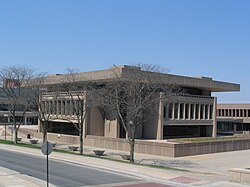
- Architectural Landmark: Newhouse 1 was designed by the renowned architect I. M. Pei.
- Major Benefactor: Significant funding provided by Samuel Irving Newhouse Sr. and the Newhouse family.
- Modern Facilities: Includes the Newhouse Studio and Innovation Center and the Dick Clark Studios.
Early Years and Academic Foundations
The journey began in 1919 when the Department of Journalism was created within the College of Business Administration at Syracuse University. The early 20th century saw a rapid expansion of student involvement, including the 1920 establishment of the Theta Sigma Phi (ΘΣΦ) journalism sorority. By 1932, the university was producing a radio show over WSYR-FM, with production studios located in Crouse College.
Syracuse University quickly established itself as a leader in media education. In 1932, it became the first university in the nation to provide college credit for a radio course. This momentum continued in 1947 with the launch of WAER, one of the first college radio stations in the country. As the media landscape shifted toward visual storytelling, the university again led the way in 1956 by becoming the first to offer instruction in television.
The Evolution of the School of Journalism
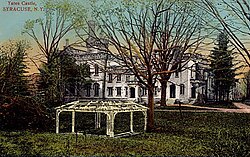
In 1934, the department transitioned into a separate School of Journalism under the leadership of founding dean Matthew Lyle Spencer. For two decades, the school was housed in the Yates Castle (also known as Renwick Castle) until the building's demolition in 1954. Between 1953 and 1965, the school operated out of the Old Gym before that facility was also razed.
The Newhouse Communications Complex
The modern era of the school began in 1964 with a transformative $15 million gift from Samuel Irving Newhouse Sr. This funding enabled the inauguration of the Newhouse Communications Complex, starting with Newhouse 1. Designed by the award-winning architect I. M. Pei, the building was dedicated by President Lyndon B. Johnson, who delivered his historic "Gulf of Tonkin Speech" on the Newhouse Plaza.
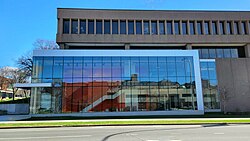
Growth continued in 1971 when the School of Journalism merged with the Department of Television-Radio, officially becoming the S. I. Newhouse School of Public Communications. In 1974, Newhouse 2 was dedicated at a cost of $7.2 million, featuring a keynote address by CBS chairman William S. Paley.
Expanding the Modern Campus
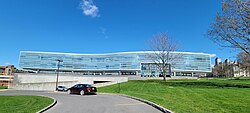
The complex expanded further in 2007 with the completion of Newhouse 3. Funded by a $15 million gift from the S. I. Newhouse Foundation and the Newhouse family, this $31.6 million, 74,000-square-foot structure was designed by the former Polshek Partnership. A striking feature of the building is the First Amendment, etched in six-foot-high letters across its curving glass windows. The building was dedicated on September 19, 2007, with a keynote address by Chief Justice John Roberts.
Innovation and Recent Developments
In September 2014, the school completed an $18 million renovation of Newhouse 2 to create the Newhouse Studio and Innovation Center. This state-of-the-art hub includes the Dick Clark Studios, the Alan Gerry Center for Media Innovation, and the Diane and Bob Miron Digital News Center. The dedication ceremony was attended by Oprah Winfrey. Most recently, in January 2020, Donald E. Newhouse donated $75 million to the school through the Newhouse Foundation to ensure its continued growth.
Facility Summary
| Building | Year Dedicated | Key Feature/Architect | Notable Event/Detail |
|---|---|---|---|
| Newhouse 1 | 1964 | I. M. Pei | President LBJ's Gulf of Tonkin Speech |
| Newhouse 2 | 1974 | Innovation Center | Renovated in 2014; Dick Clark Studios |
| Newhouse 3 | 2007 | Polshek Partnership | First Amendment etched in glass |
Frequently Asked Questions
When was the Department of Journalism first established?
The Department of Journalism was established at Syracuse University in 1919 as part of the College of Business Administration.
What architectural significance does Newhouse 1 hold?
Newhouse 1 is an award-winning building designed by the world-renowned architect I. M. Pei.
Which media milestones was Syracuse University the first to achieve?
Syracuse University was the first in the nation to offer a college credit radio course (1932) and the first to offer instruction in television (1956).
What is unique about the design of Newhouse 3?
Newhouse 3 features the First Amendment etched in six-foot-high letters on its curving glass windows.
What facilities are included in the Newhouse Studio and Innovation Center?
The center includes the Dick Clark Studios, the Alan Gerry Center for Media Innovation, and the Diane and Bob Miron Digital News Center.