
Saint Finbarr: The Legacy of the Patron Saint of Cork
The history of Cork is inextricably linked to the life and teachings of Saint Finbarr, a pivotal figure in early Irish Christianity. From his early education in the east of Ireland to the establishment of a renowned center of learning in the south, Finbarr's journey reflects the spiritual and academic growth of the region during the early medieval period.
Early Life and Education
Born as Lóchán (modern form, Loan) in Templemartin near Bandon, he was the son of Amergin of Maigh Seóla, a skilled craftsman from Galway. To pursue his spiritual calling, Lóchán traveled to Ossory, an area corresponding to present-day County Kilkenny, for his studies.
It was during his tonsure—the practice of shaving the top of the head to symbolize religious devotion—that he received his lasting name. The presiding cleric remarked, "Is fionn barr Lócháin," meaning "Fair is the crest of Loan." Consequently, he became known as Findbarr (modern Irish: Fionnbharra), which translates to "Fairhead." His spiritual journey later took him on a pilgrimage to Rome, and on his return journey, he visited Saint David in Wales.
The Hermitage at Gougane Barra
Upon completing his education, Finbarr returned to his home region. He spent a period of solitude and prayer on an island within a small lake then known as Loch Irce. Today, this site is famously known as Gougane Barra, meaning "the little rock-fissure of Finnbarr."
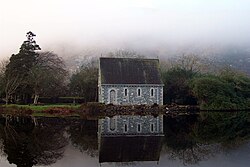
Beyond his retreat, Finbarr is credited with building several small churches. One such site was Cell na Cluaine in Ballineadig, County Cork. This location, anglicized as Cellnaclona, is sometimes referred to as Cloyne, which often leads to historical confusion with Cloyne (Cluain Uamha) located in east Cork.
The Foundation of Cork's Learning Center
For the final seventeen years of his life, Finbarr settled in Corcach Mór na Mumhan, the "Great Marsh of Munster," which evolved into the modern city of Cork. Here, he established a monastery and a school that attracted numerous monks and students, transforming the area into a premier center of learning.
This academic legacy is preserved today by University College Cork. The university's Irish motto, "Ionad Bairre Sgoil na Mumhan," translates to "Finbarr's foundation, the School of Munster." The English version of the motto, "Where Finbar taught let Munster learn," captures the spirit of this historical intellectual hub.
The Cathedral and Spiritual Landmarks
In 606, Finbarr founded a church and monastery on a limestone cliff overlooking the River Lee. This site later became known as Gill Abbey, named after Giolla Aedha Ó Muidhin, a 12th-century Bishop of Cork. The site remained the cathedral of the diocese for centuries.
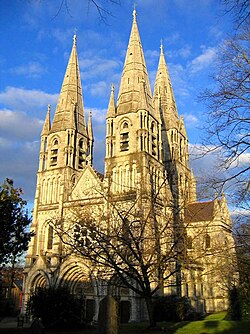
The current building on this historic site is Saint Fin Barre's Cathedral, which is owned by the Church of Ireland. In the South Parish, the Catholic community maintains a church dedicated to St Finbar on Dunbar Street, commonly called "the South Chapel." This distinguishes it from the Catholic Cathedral of Saint Mary and Saint Anne, often referred to as "the North Chapel."
Saint Finbarr passed away at Cell na Cluaine while returning from a visit to Gougane Barra. He was laid to rest in the cemetery attached to his church in Cork.
Key Facts
- Original Name: Lóchán (later renamed Findbarr/Fionnbharra).
- Education: Studied in Ossory (modern County Kilkenny).
- Key Sites: Founded a monastery in 606 on the River Lee and established a retreat at Gougane Barra.
- Academic Influence: His foundation served as the "School of Munster," inspiring the motto of University College Cork.
- Death: Died at Cell na Cluaine and was buried in Cork.
| Location | Historical Significance | Modern Name/Association |
|---|---|---|
| Loch Irce | Early island retreat | Gougane Barra |
| Corcach Mór na Mumhan | Center of learning and monastery | City of Cork / UCC |
| Limestone cliff, River Lee | Original 606 foundation | Saint Fin Barre's Cathedral |
| Ballineadig | Site of Cell na Cluaine | Cellnaclona / Cloyne |
Frequently Asked Questions
How did Saint Finbarr get his name?
Originally named Lóchán, he was renamed "Fionnbharra" (Fairhead) after a cleric remarked on the fairness of his crest during his tonsure.
What is the significance of Gougane Barra?
Gougane Barra is the modern name for the island in Loch Irce where Saint Finbarr lived as a hermit after completing his education.
What is the connection between Saint Finbarr and University College Cork?
The university's motto, "Ionad Bairre Sgoil na Mumhan" (Finbarr's foundation, the School of Munster), honors the center of learning Finbarr established in Cork.
Where was Saint Finbarr's original monastery located?
He founded his monastery in 606 on a limestone cliff above the River Lee, a site now occupied by Saint Fin Barre's Cathedral.
Where did Saint Finbarr die?
He died at Cell na Cluaine while returning from a visit to Gougane Barra and was buried in his church cemetery in Cork.