
Saint Lucia National Flag: Symbolism and Design
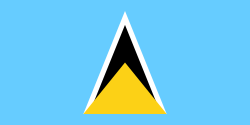
The national flag of Saint Lucia is a vibrant emblem of the island's natural beauty and the aspirations of its people. Adopted on March 1, 1967, the flag was introduced as the nation achieved self-government, marking a significant milestone in its political history. Designed by the artist Dunstan St. Omer, the flag combines geometric precision with deep symbolic meaning to represent the identity of the Caribbean nation.
Key Facts
- Adoption Date: March 1, 1967.
- Designer: Dunstan St. Omer.
- Primary Colors: Cerulean blue, gold, white, and black.
- Central Motif: Superimposed isosceles triangles.
- Key Symbolism: The Pitons, fidelity, and prosperity.
The Visual Composition
The flag features a plain blue field that serves as the backdrop for a unique central device. This device consists of three superimposed triangles—white, black, and gold—that share a common base. The base of these triangles measures exactly one-third of the flag's total length.
Geometric Specifications
The design follows strict proportions to maintain consistency. The black triangle is superimposed on the white, and the gold triangle is superimposed on the black. The black section terminates as a three-pointed star in the center of the flag. To ensure the distinct layering, the white part of the triangle maintains a width of one-and-a-half inches on both sides of the black, with a four-inch distance between the peaks of the black and white triangles.
Symbolism and Meaning
Every color and shape on the Saint Lucian flag is chosen to reflect the physical and spiritual essence of the island.
Colors of the Caribbean
The blue field represents fidelity. Visually, it mirrors the tropical sky and the emerald waters of the surrounding Caribbean Sea and Atlantic Ocean. The gold element symbolizes the prosperity of the nation and the prevailing sunshine characteristic of the Caribbean region.
The Significance of the Triangles
The central figures are partition isosceles triangles (triangles with two equal sides). These shapes are a direct reference to the Pitons in Soufriere—the famous twin volcanic spires that rise sheer from the sea toward the sky. Beyond their geological representation, these peaks serve as a symbol of the hope and aspirations of the Saint Lucian people.
| Element | Representation |
|---|---|
| Blue Field | Fidelity, tropical sky, and surrounding oceans |
| Gold Triangle | Prosperity and Caribbean sunshine |
| Triangles (Shape) | The Pitons of Soufriere; hope and aspirations |
| Black/White Layers | Geometric contrast and structural design |
Frequently Asked Questions
When was the flag of Saint Lucia adopted?
The flag was officially adopted on March 1, 1967, coinciding with the island achieving self-government.
Who designed the national flag?
The flag was designed by Dunstan St. Omer.
What do the triangles on the flag represent?
The triangles represent the Pitons, the famous twin mountains in Soufriere, and symbolize the hope and aspirations of the people.
What is the meaning of the blue color in the flag?
The blue represents fidelity and reflects the tropical sky as well as the waters of the Atlantic Ocean and the Caribbean Sea.
What does the gold color symbolize?
Gold represents prosperity and the prevailing sunshine found in the Caribbean.