
Salva Kiir and the Presidency of South Sudan
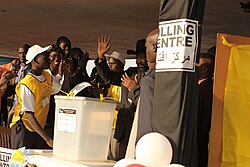
On July 9, 2011, South Sudan officially became an independent state following a January referendum where 98.83% of voters chose to split from Sudan. Salva Kiir assumed office as the nation's first president, initially positioning himself as a reformer. In his inaugural address, he called for forgiveness regarding past injustices imposed by northern Sudanese and announced a general amnesty for groups that had previously fought against the Sudan People's Liberation Movement (SPLM).
Early in his term, Kiir warned military and police personnel that human rights violations, including rape and torture, would be prosecuted as criminal acts. However, his presidency became a complex era of reconstruction marked by severe internal political strife and foreign disputes.
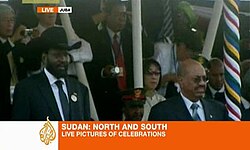
Key Facts
- Independence: South Sudan gained independence on July 9, 2011.
- First President: Salva Kiir served as the inaugural president of the new nation.
- Civil War: A major conflict began in December 2013 following a political rift between Kiir and Riek Machar.
- Border Conflict: The Heglig Crisis in 2012 led to a brief border war with Sudan.
- Humanitarian Crisis: A man-made famine occurred in 2017, exacerbated by civil war and drought.
Domestic Policy and Governance
Kiir's domestic administration was characterized by frequent shifts in leadership and crackdowns on dissent. In June 2013, he lifted the immunity of two ministers to investigate corruption, and by July 2013, he dismissed his entire cabinet, including Vice President Riek Machar. While Kiir stated this was to reduce the size of government, Machar viewed the move as a step toward dictatorship.
Kiir also took strong public stances on social issues, describing homosexuality as a "mental disease" and a "bastion of Western immorality," stating it was not part of the Southern Sudanese character.
Ethnic Violence and Human Rights
The presidency faced significant challenges regarding ethnic conflict. Between December 2011 and February 2012, attacks by Lou Nuer armed child soldiers on Murle communities resulted in approximately 800 deaths and numerous abductions. Despite UN investigations, critics argue that a lack of accountability contributed to continued violence. Furthermore, during "Operation Restore Peace" in Jonglei in 2012, soldiers were reported to have engaged in extrajudicial killings and torture to locate weapons.
Consolidation of Power and Press Freedom
Following coup rumors in late 2012, Kiir reorganized the government and military on a massive scale. In early 2013, he replaced the police inspector general and retired over 100 army generals. By December 2013, Kiir accused Riek Machar and other party members of plotting a coup, leading to their arrest.
The environment for the press became increasingly dangerous. In August 2015, political reporter Moi Peter Julius was murdered shortly after Kiir warned that freedom of the press did not mean working against the country. Other journalists were also killed in 2015, with the Committee to Protect Journalists describing these events as a devastating attack on the press corps.
Foreign Policy and International Relations
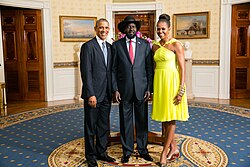
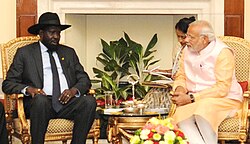
Kiir sought to integrate South Sudan into the regional economy by applying for accession to the East African Community in 2011. He also visited Israel in December 2011 to thank the nation for its support during the First Sudanese Civil War and discussed the possibility of establishing an embassy in Jerusalem.
However, relations with the international community soured during the civil war. In 2014, Kiir accused the United Nations and humanitarian organizations of supporting Riek Machar. By 2015, he revealed that some international partners had threatened his government with sanctions and referrals to the International Criminal Court.
The Heglig Crisis
In March 2012, the South Sudanese army attacked the Heglig oilfield, sparking a border war with Sudan. The crisis was partially resolved in September 2012 when Kiir and Sudanese President Omar al-Bashir signed agreements in Addis Ababa to resume oil exports and create a 10-kilometer demilitarized zone.
Political Crisis and Civil War
Tensions between Kiir and Riek Machar culminated in December 2013. Following meetings of the National Liberation Council, shooting broke out within the Presidential Guards. Kiir denounced Machar for a failed coup, an event that triggered the South Sudanese Civil War. By April 2018, an estimated 400,000 people had died in the conflict, including victims of the 2014 Bentiu massacre.
Economic Interests and Famine
Reports have linked Kiir to the ABMC Thai-South Sudan Construction Company Limited, which received $161 million in government contracts, though his spokesperson denied these ties. Additionally, his wife previously held shares in the Yanyyom Mineral Water and Beverage Factory.
In 2017, South Sudan suffered a famine. International advocates labeled it "man-made," citing the civil war and drought. While millions were displaced and food supplies failed, the government increased business visa prices from $100 to $10,000, and UN officials accused Kiir of blocking food deliveries to certain areas.
| Event/Topic | Details | Outcome/Impact |
|---|---|---|
| Independence Referendum | January 2011 (98.83% in favor) | Creation of South Sudan on July 9, 2011 |
| Heglig Crisis | March 2012 oilfield attack | Border war; later resolved via Addis Ababa agreements |
| Cabinet Dismissal | July 2013 | Sacking of Riek Machar and entire cabinet |
| Civil War | Started December 2013 | Approx. 400,000 deaths by April 2018 |
| 2017 Famine | Man-made crisis due to war/drought | Over 3 million people displaced |
Frequently Asked Questions
How did South Sudan become independent?
South Sudan became independent on July 9, 2011, after a referendum in January 2011 where 98.83% of voters chose to separate from Sudan.
What caused the South Sudanese Civil War?
The war began in December 2013 following a political crisis and power struggle between President Salva Kiir and his then-Vice President, Riek Machar, after Kiir accused Machar of attempting a coup.
What was the Heglig Crisis?
The Heglig Crisis was a border conflict triggered in March 2012 when the South Sudanese army attacked an oilfield in Heglig, located between Sudan and South Sudan.
Why was the 2017 famine described as "man-made"?
Humanitarian advocates called the famine man-made because the ongoing civil war and government offensives forced millions of people to abandon their agricultural lands and livestock, destroying food security.
How did Salva Kiir handle the press?
Kiir's relationship with the press was hostile; he publicly threatened journalists who worked against the country, and several reporters were murdered during his presidency without the perpetrators being brought to justice.