
San Andrés Archaeological Site: A Legacy of Volcanic Resilience
Located in the heart of the Zapotitán Valley, the San Andrés Archaeological Site stands as a testament to human adaptability in the face of geological upheaval. Rather than succumbing to the volatile nature of its environment, the ancient occupants of San Andrés integrated volcanic events into their social fabric and architecture, transforming natural disasters into catalysts for growth and spiritual expression.
The Architecture of Memory and Power
Following the Tierra Blanca Joven eruption, the inhabitants of San Andrés began a period of large-scale monumental construction between 30 and 80 years after the event. In a striking choice of engineering, they utilized tephra—the fragmented material produced by a volcanic eruption—as a primary building material. This is most evident in the platform of the Campana structure.
Researchers believe the use of tephra was not merely practical but symbolic, serving to memorialize the eruption within the site's physical layout and emphasizing a deep religious and spiritual connection to the surrounding volcanoes.
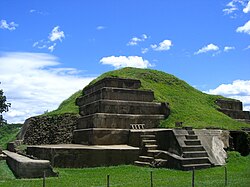
The Magnitude of La Campana
During the Late Classic period, La Campana emerged as the largest structure in the Zapotitán Valley. The pyramid itself measured 35 by 40 meters wide and reached a height of 13 meters. However, it sat upon an even more massive platform measuring 85 by 65 meters wide and 7 meters tall. Together, the platform and the pyramid rose to a total height of 20 meters.
The construction timeline reveals a shift in materials. While the majority of the platform was built before the Loma Caldera Eruption, the pyramid and the platform's extensions were completed afterward. During this later phase, builders transitioned away from tephra, opting instead for adobe (sun-dried mud brick) and mud plaster.
A Regional Epicenter of Trade and Culture
Between AD 600 and 900, San Andrés served as the epicenter of the Zapotitán Valley. Its influence extended far beyond its immediate borders, with archaeological evidence pointing to strong contacts with Copán and the Guatemalan Highlands. The site acted as a commercial hub, receiving luxury goods from as far away as Belize and the Petén region.
Local interaction was also vibrant; residents of nearby Joya de Cerén likely traveled to San Andrés to participate in trade and religious ceremonies. The ability to organize massive labor projects following both the Tierra Blanca Joven and Loma Caldera eruptions suggests that volcanic activity may have actually spurred social change and organizational growth rather than causing societal collapse.
Decline, Reoccupation, and the Guazapa Phase
The site began to decline toward the end of the Late Classic period. While the El Boquerón eruption occurred between AD 964 and 1040, evidence suggests the site had already been abandoned. Significant erosion found in the rubble beneath the El Boquerón tephra indicates that the eruption was not the primary cause of the abandonment.
San Andrés saw a resurgence during the Early Postclassic period. New occupants returned to the site, treating the existing ruins as sacred monuments and repairing them. The final era of pre-Hispanic activity occurred between AD 900 and 1200. This period, known as the Guazapa phase, is associated with the city of Cihuatán and is characterized by residential layers containing ceramics and censers painted with sacrifice scenes in the Mixteca-Puebla style.
Colonial Era and Modern Preservation
Following the Spanish Conquest, the area became part of a colonial estate focused on cattle ranching and the production of indigo. In 1658 AD, the eruption of the Playón volcano buried the site, which inadvertently preserved the colonial indigo production facilities almost perfectly.
Today, the site is preserved as the Archaeological Park of San Andrés, inaugurated by the Government of El Salvador in 1996. Visitors can now explore the site museum, view the indigo production areas, and climb the ancient pyramids.
Key Facts
- Peak Influence: San Andrés was the Zapotitán Valley's epicenter between AD 600 and 900.
- Architectural Giant: La Campana reached a total height of 20 meters (including its platform).
- Volcanic Integration: Tephra from the Tierra Blanca Joven eruption was used as a symbolic construction material.
- Trade Network: The site maintained trade links with Belize, Petén, Copán, and the Guatemalan Highlands.
- Preservation: The 1658 Playón volcano eruption preserved colonial-era indigo production.
| Period/Event | Key Characteristics | Materials/Influence |
|---|---|---|
| Post-Tierra Blanca Joven | Initial monumental construction | Volcanic tephra |
| Late Classic (AD 600-900) | Regional epicenter and trade hub | Adobe and mud plaster |
| Post-Classic (AD 900-1200) | Guazapa phase residential use | Mixteca-Puebla style ceramics |
| Colonial Era (Pre-1658) | Cattle and indigo production | Colonial estate |
| Modern Era (1996-Present) | Archaeological Park | Tourism and Museum |
Frequently Asked Questions
Did the El Boquerón eruption cause the abandonment of San Andrés?
No. Evidence of significant erosion in the rubble beneath the El Boquerón tephra suggests that the site had already been abandoned before the eruption occurred between AD 964 and 1040.
What is the Guazapa phase?
The Guazapa phase is a cultural period between AD 900 and 1200, related to the city of Cihuatán. It is identified by residential activity and ceramics featuring Mixteca-Puebla style scenes of sacrifice.
Why was volcanic tephra used in the construction of La Campana?
Beyond its availability, researchers theorize that using tephra served to memorialize the Tierra Blanca Joven eruption and highlight the spiritual and religious connection the occupants felt toward volcanoes.
What was the significance of the 1658 Playón eruption?
While destructive, the eruption of the Playón volcano buried the colonial estate, which served to preserve the indigo production area almost intact for future archaeological study.
How large was the La Campana structure?
The pyramid itself was 35 by 40 meters wide and 13 meters high, sitting on a platform 85 by 65 meters wide and 7 meters tall, for a combined height of 20 meters.