
Santa Barbara News-Press: A History of Journalism, Conflict, and Relaunch
The story of the Santa Barbara News-Press is a dramatic chronicle of American local journalism, spanning over 150 years of political turmoil, prestigious accolades, and a controversial decline that ended in bankruptcy. From its humble beginnings in the 19th century to its recent transition into a nonprofit digital entity, the publication has mirrored the evolving landscape of the media industry.
Early Foundations and Turbulent Beginnings
The publication's roots date back to May 30, 1868, when E. B. Boust first published the Santa Barbara Post. Within a year, Reverend James Ashbury Johnson took sole ownership and renamed the paper the Santa Barbara Press. The early years were marked by volatility; Johnson himself was once severely beaten by Mayor Jarrett T. Richards on Election Day.
The paper passed through several hands, including Harrison Gray Otis and J. P. Stearns. During this era, the role of the editor was often perilous. In 1880, editor Theodore Glancey was fatally shot by Clarance Gray, a Republican candidate for district attorney who was incensed by Glancey's descriptions of him as a "hoodlum and a lawbreaker."
Throughout the late 19th century, the paper saw a succession of owners, including Charles Fayette McGlashan, W. G. Kinsell, and Walter H. Nixon. By 1896, the Santa Barbara Morning Press was sold for $50,000 to the Press Publishing and Printing Company, led by S. Howard Martin.
The Storke Era and Pulitzer Recognition
A pivotal shift occurred in 1932 when Thomas M. Storke, a prominent local rancher and descendant of Santa Barbara's Spanish founders, acquired the Morning Press. He merged it with his own publication, the Santa Barbara Daily News (which may have dated back to 1855), to create the Santa Barbara News-Press.
Under the Storke family—including Charles A. Storke on the editorial page and Charles A. Storke II in operations—the paper rose to national prominence. This era peaked in 1962 when T. M. Storke won the Pulitzer Prize for Editorial Writing for his courageous reporting on the John Birch Society, a semi-secret organization.
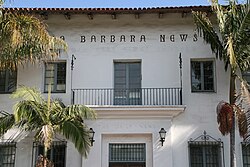
Ownership Transitions and the McCaw Era
In 1964, Storke sold the paper to Robert McLean of the Philadelphia Bulletin, who appointed his nephew, Stuart S. Taylor, as publisher. This period was a golden age for news writing, fostering talents like environmentalist Dick Smith (for whom the Dick Smith Wilderness Area is named) and editorial writer Larry Pidgeon. The paper was later sold to The New York Times in 1985, and eventually to Wendy P. McCaw in 2000.
The transition to McCaw's ownership led to severe internal strife. In early summer 2006, six editors and a long-time columnist resigned, alleging that McCaw and her managers were imposing personal opinions on news reporting. McCaw countered that the staff had become biased and sloppy.
The Newsroom Dispute and Legal Battles
Between July 2006 and February 2007, the newsroom was decimated, with 60 of 200 employees—including nearly all news reporters—either resigning or being fired. This led to a labor struggle as employees voted to unionize with the Teamsters, resulting in multiple appeals to the National Labor Relations Board.
The conflict extended into the courtroom. McCaw's attorneys filed lawsuits against former employees and competing newspapers. Notably, the parent company, Ampersand Publishing, sued the Santa Barbara Independent for copyright infringement over a website link, though the case was settled and dismissed in 2008.
Decline, Bankruptcy, and Closure
The paper's operational capacity dwindled over the next decade, with the newsroom shrinking from 65 employees to just 20 by 2016. During this time, the publication shifted toward a right-wing editorial stance, becoming one of the first newspapers to endorse Donald Trump for president and criticizing COVID-19 social distancing rules.
The decline culminated on July 21, 2023, when Ampersand Publishing LLC filed for Chapter 7 bankruptcy liquidation. The final print edition was published that same day, with Wendy McCaw announcing that all jobs were eliminated. The filing revealed a dire financial state: approximately $50,000 in assets against liabilities ranging from $1 million to $10 million.
The Final Auction and Digital Relaunch
In March and April 2024, the remnants of the business were auctioned. A group managed by Ben Romo won the bid for the domain names, website contents, and social media accounts for $285,000. Separately, the Santa Barbara Historical Museum purchased the paper's historical archives, dating back to 1870, for $70,000.
The legacy of the paper took a new turn when Romo donated the intellectual property to NEWSWELL, a nonprofit affiliated with the Walter Cronkite School of Journalism and Mass Communication. In January 2025, NEWSWELL announced the relaunch of the News-Press as a digital newspaper.
Key Facts
- Founded: May 30, 1868, as the Santa Barbara Post.
- Pulitzer Prize: Won by T. M. Storke in 1962 for editorials on the John Birch Society.
- Bankruptcy: Filed for Chapter 7 liquidation on July 21, 2023.
- Financials at Closure: Assets of $50,000 vs. liabilities of $1M–$10M.
- Current Status: Relaunched as a digital nonprofit by NEWSWELL in January 2025.
| Era/Year | Owner/Key Figure | Significant Event |
|---|---|---|
| 1868 | E. B. Boust | Founded as the Santa Barbara Post |
| 1932 | Thomas M. Storke | Merged to create the Santa Barbara News-Press |
| 1964 | Robert McLean | Transition to Stuart S. Taylor's leadership |
| 1985 | The New York Times | Corporate acquisition |
| 2000 | Wendy P. McCaw | Period of newsroom disputes and decline |
| 2024 | Ben Romo / NEWSWELL | Bankruptcy sale and nonprofit relaunch |
Frequently Asked Questions
Why did the Santa Barbara News-Press close in 2023?
The paper's parent company, Ampersand Publishing LLC, filed for Chapter 7 bankruptcy liquidation due to severe financial instability, reporting liabilities up to $10 million against only $50,000 in assets.
Who won the Pulitzer Prize associated with the paper?
Thomas M. Storke won the Pulitzer Prize for Editorial Writing in 1962 for his work exposing the activities of the John Birch Society.
What caused the mass resignations in 2006?
Six editors and a columnist resigned due to the imposition of owner Wendy McCaw's personal opinions on the reporting process, leading to a wider conflict where 60 staff members eventually left or were fired.
What happened to the paper's historical archives?
The archives, which included bound newspapers dating back to 1870, were sold for $70,000 to the Santa Barbara Historical Museum during the bankruptcy proceedings.
How is the News-Press operating now?
Following a donation of intellectual property by Ben Romo, the nonprofit NEWSWELL (affiliated with the Walter Cronkite School of Journalism and Mass Communication) relaunched the publication as a digital newspaper in January 2025.