
Scythe Mowing: Techniques, Tool Maintenance, and Traditional Use
Historically, the act of using a scythe was simply called mowing. Today, the term scything is often used to distinguish this manual skill from modern machine mowing. Scything is a rhythmic, skilled task that requires a combination of proper tool setup, physical coordination, and diligent blade maintenance to achieve a clean, uniform cut.
Key Facts
- Blade Lengths: Beginners typically start with blades 70 cm or shorter, while professionals use long blades (90–100 cm) for grass and wheat.
- The Motion: The blade is swung in a long arc from right to left, depositing cut grass into a windrow (a row of cut grass).
- Maintenance: Blades are maintained through occasional peening (hammering the edge) and frequent honing (sharpening with a stone).
- Timing: Mowing is most effective when grass is damp, which is why traditional hay-making often began at dawn.
- Steel Types: European blades are typically malleable steel (peened), while American blades are often harder, more brittle steel (ground).
The Art and Technique of Scything
To operate a scythe, the mower holds the top handle in the left hand and the central handle in the right. With arms kept straight and the blade held parallel and close to the ground, the mower cuts along the edge of the meadow. The process involves hooking the grass on the right and swinging the blade in a wide arc to the left.
This slicing action leaves a swathe of uniformly cut stubble and forms a regular windrow on the left. The mower takes a small step forward and repeats the motion in a steady rhythm, stopping frequently to hone the blade.
Team Mowing and Learning Curve
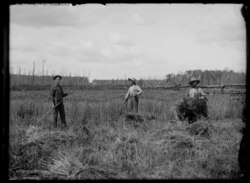
Scything is a skilled craft that takes time to master. When working in teams, mowers typically start at the edge of the meadow in a staggered line, proceeding clockwise until they reach the center. Beginners often struggle with several common errors, including:
- Incorrect handle placement on the snaith (the scythe's shaft) relative to their body.
- Wrong turn-in and turn-up angles of the blade.
- Using a blade that is too long for their current skill level.
- Chopping or hacking at the grass rather than using a slicing motion.
- Striking the ground with the blade or attempting to cut too wide a strip.
Scythe Types and Specialized Uses
Different tasks require different blade specifications. A long, thin blade (90 to 100 cm) is the most efficient choice for wheat or grass. In contrast, a shorter, more robust blade (60 to 70 cm) is better suited for clearing reeds, sedge, or weeds, and can even be used underwater to clear ditches.
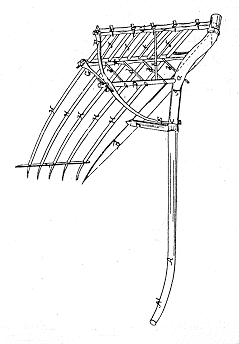
Before the invention of the lawnmower, skilled mowers used highly honed long blades to maintain short lawn grass. Additionally, some cultures utilize cradles—attachments that catch grain stems to keep seed heads aligned, making winnowing and sheafing easier.
Scythe Specifications Summary
| Blade Length | Primary Use | Characteristics |
|---|---|---|
| 60–70 cm | Weeds, reeds, sedge, ditches | Short, robust, suitable for underwater use |
| 70 cm or less | Beginner practice | Easier to control for novices |
| 90–100 cm | Grass, wheat, lawns | Long, thin, requires high skill |
Blade Maintenance: Peening and Honing
Maintaining a scythe's edge involves two distinct processes: peening and honing.
Peening
Peening is the process of reforming the malleable steel edge by hammering it. This creates the desired edge profile, removes nicks, and locally work-hardens the metal. The bevel angle is adjusted based on the task: a very fine angle for fine grass and a larger, more robust angle for coarser vegetation.
Peening is done occasionally using a peening hammer and an anvil or a peening jig. For example, a blade used for tough brambles might be peened every thirty hours of work.
Honing
While peening happens occasionally, honing occurs frequently—sometimes every half hour. This is done in the field using an ovoid whetstone (or rubber) kept in a water-filled holster. The mower strokes the inside of the blade to create a burr (a small ridge of metal), then gently removes that burr by stroking the outside of the blade.
Regional Differences in Steel
The method of maintenance depends heavily on the steel used:
- European Blades: Made from malleable steel; they are peened to reshape the edge.
- American Blades: Made from harder, more brittle steel. These cannot be peened as they risk cracking; instead, they are reshaped by grinding. Because the steel is harder, they hold an edge longer and may only need grinding 1–3 times per season.
- Laminated Blades: Some designs feature a hard, wear-resistant core for the edge with softer iron sides or a top layer for strength.
Frequently Asked Questions
Why is it better to mow grass at dawn?
Mowing is easier when the grass is damp, which typically occurs in the early morning. This allows the mower to work before the heat of the day, which is then used for raking, carting hay, or peening blades.
What is the difference between peening and honing?
Peening is a structural process using a hammer to reform the metal's edge profile and work-harden the steel. Honing is a finishing process using a whetstone to sharpen the existing edge during use.
Can all scythe blades be peened?
No. European blades made of malleable steel are designed for peening. American blades are typically made of harder, more brittle steel that can crack if hammered, meaning they must be ground to reshape the edge.
What is a windrow?
A windrow is the regular row of cut grass deposited to the left of the mower as they proceed across the field.
How should a beginner choose their first scythe blade?
Beginners should generally start with a shorter blade, typically 70 centimeters or less, as long-bladed scythes (90 cm+) are significantly harder to use until the proper technique is mastered.