
Sejm History: The Evolution of Poland's Parliamentary System
The Sejm—a term derived from an ancient Proto-Lechitic word meaning "gathering" or "meeting"—stands as one of the oldest parliamentary traditions in Europe. From its origins as royal councils to its current role in the Third Polish Republic, the Sejm has mirrored the turbulent political shifts of the Polish state, evolving through periods of noble dominance, foreign partition, and communist rule.
Key Facts
- Origins: Traces back to the wiece (King's Councils) during Poland's fragmentation (1146–1295).
- First Parliament: The 1180 Sejm in Łęczyca established laws to limit the ruler's power.
- The Liberum Veto: A controversial unanimity principle that allowed a single deputy to void all legislation of a session.
- Constitutional Milestone: The May 3rd Constitution of 1791 abolished the liberum veto.
- Modern Structure: A bicameral system consisting of the Sejm (lower house) and the Senate (upper house).
The Kingdom of Poland and Early Governance
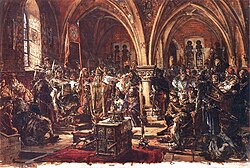
The early foundations of the Sejm were laid during the period of fragmentation. The most significant early milestone was the 1180 Sejm in Łęczyca, which acted as the first Polish parliament by constraining the monarch's power, specifically forbidding the arbitrary seizure of countryside supplies and bishopric lands.
By 1493, following the Sejm in Piotrków, the body began convening regularly with indirect elections every two years. This era saw the birth of a bicameral system: the Senate (comprising 81 bishops and dignitaries) and the Chamber of Deputies (54 envoys elected by local sejmik, or assemblies of landed nobility). During this time, the nobility—making up roughly 10% of the population—gained immense influence through the development of "Golden Liberty."
The Polish–Lithuanian Commonwealth
The Union of Lublin in 1569 merged the Kingdom of Poland and the Grand Duchy of Lithuania into a single state, expanding the Sejm to include Lithuanian nobility. The Sejm became the supreme deliberating body, managing taxation, the budget, foreign policy, and the confirmation of nobility.
A landmark achievement of this era was the 1573 Warsaw Confederation, where the Sejm guaranteed religious tolerance, providing a sanctuary for those fleeing the Reformation and Counter-Reformation wars across Europe.
The Rise and Fall of the Liberum Veto
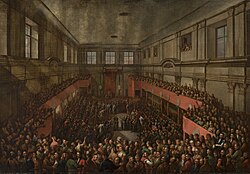
While early voting relied on majority rule, the rise of powerful magnates led to the introduction of the liberum veto (Latin for "free veto"). This principle required total unanimity; a single objection could not only reject a specific resolution but annul every act passed during that entire session. By the mid-17th century, this mechanism was frequently used to paralyze the government, pushing the Commonwealth toward collapse.
Efforts to reform the system culminated in the Constitution of 3 May 1791. This "Government Act" abolished the liberum veto and sought to modernize the state. However, this move toward stability alarmed neighboring powers, contributing to the partitions of Poland by Russia, Prussia, and Habsburg Austria.
The Era of Partitions and Limited Sovereignty
Between 1795 and 1918, Poland's legislative power was severely curtailed by occupying forces. In Congress Poland (under the Russian Empire), a Sejm existed but held limited authority. Its Chamber of Deputies included both hereditary nobility and elected non-nobles, though sessions were often secret or infrequent due to clashes with the conservative government.
In other partitioned areas, such as the Free City of Cracow and the Grand Duchy of Poznań, legislative bodies remained largely powerless. A notable exception was the National Sejm in autonomous Galicia (1861–1914), which played a vital role in maintaining Polish national institutions.
The Second Polish Republic (1918–1939)
With the restoration of independence after World War I, the Sejm became a symbol of national continuity. The Small Constitution of 1919 and the March Constitution of 1921 established a parliamentary republic based on the separation of powers. This era also saw the first woman, Roza Pomerantz-Meltzer, elected to the Sejm in 1919.
However, legislative gridlock led to a shift in power. Following Józef Piłsudski's May Coup, the April Constitution of 1935 strengthened the presidency and the Senate at the expense of the Sejm. The parliament's pre-war activity ended on September 2, 1939, just before the German invasion.
The Polish People's Republic (1945–1989)
Under communist rule, the Senate was abolished in 1946, leaving the Sejm as the sole legislative body. While the 1952 Constitution described the Sejm as the "highest organ of State authority," it functioned primarily as a rubber stamp for the Polish United Workers' Party due to the principle of democratic centralism (a system where party decisions are binding on all members).
The Third Polish Republic (1989–Present)
Following the fall of communism, Poland reinstated its bicameral system. The modern Sejm consists of 460 deputies elected every four years via proportional representation. To enter parliament, political parties must generally meet a 5% nationwide vote threshold, though ethnic-minority parties are exempt.
| Period | Structure | Key Characteristic | Primary Power Source |
|---|---|---|---|
| Kingdom of Poland | Bicameral (after 1493) | Rise of the Nobility | King's Councils / Sejmiks |
| Commonwealth | Bicameral | Liberum Veto / Religious Tolerance | Szlachta (Middle Nobility) |
| Partitions | Variable / Limited | Foreign Control | Occupying Empires |
| Second Republic | Bicameral | Parliamentary Sovereignty | Democratic Elections |
| People's Republic | Unicameral | Rubber-stamping / Communist rule | United Workers' Party |
| Third Republic | Bicameral | Proportional Representation | Universal Suffrage |
Frequently Asked Questions
What was the liberum veto?
The liberum veto was a parliamentary mechanism in the Polish-Lithuanian Commonwealth that required unanimous agreement for any legislation to pass. A single deputy could object to a resolution, which would not only void that specific act but annul all other legislation passed during that session.
When was the first Polish parliament established?
The 1180 Sejm in Łęczyca is recognized as the first Polish parliament, as it established laws that constrained the arbitrary power of the ruler.
What is the difference between the Sejm and the Senate today?
The Sejm is the lower house, consisting of 460 deputies elected through proportional representation. The Senate is the upper house, and together they form the bicameral national assembly of the Third Polish Republic.
How did the May 3rd Constitution change the Sejm?
The Constitution of 3 May 1791 abolished the destructive liberum veto and introduced a more functional government structure, though its adoption contributed to the subsequent partitions of Poland by neighboring empires.
Who was the first woman elected to the Sejm?
Roza Pomerantz-Meltzer, a member of the Zionist party, became the first woman elected to the Sejm in 1919.